
Excessive power, lack of civility and the economy drove young KU voters in midterm elections
Some also criticized U.S. involvement in Iran. "I hate it," one student said.
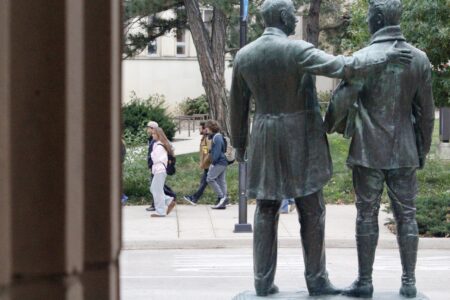
photo by: Dmitry Martirosov/Journal-World
Students walk past Lippincott Hall at the University of Kansas on Friday, Nov. 6, 2026.
Fed-up young voters were a vital demographic in sweeping Democrats into power on Tuesday. Some University of Kansas students joined the revolt. But what propelled them?
Among the responses provided by a handful of KU students who spoke to the Journal-World on Friday were intolerance, incivility and the high cost of living. The country’s direction under the current administration and a general sense of uncertainty about the job market were also mentioned.
“I think people are trying to minimize Trump’s power — or at least regulate him a little more so he doesn’t have so much free will,” said Jordan Coughlin, a sophomore. “It felt like he had unlimited power, even though he didn’t. Like, more than I feel most presidents should be able to have.”
Coughlin, 19, said Tuesday’s results were a rebuke directed at President Donald Trump, who he said was acting like a “dictator.” That was what propelled him to vote for Adam Hamilton, the pastor who triumphed over Sen. Roger Marshall, the Republican incumbent, by running on a message of civility.
Politically, Coughlin doesn’t lean either way, he said. What matters most to him is how decisions made politicians impact his life.
“Which party is in my best interest to help me in my future,” he said.
Tuesday’s midterm elections ushered in waves of young voters who swung wildly to the left, especially those aged 18-29, according to a New York Times analysis of voter turnout data. Hispanic men aged 18-29 shifted left by nearly 50 percentage points since 2024. White men of the same age group swung left by 36 points, while those without college degrees — a group that shifted right by nearly 20 points in 2024 — veered left by 38 points on Tuesday. All three cohorts were in deep red territory just two years ago.
Dakari Wake, a 19-year-old sophomore, wasn’t surprised by the results. Social media algorithms were flooding his feeds with predictions of Democrats sweeping the elections, he said — predictions that matched many of the polls that were touted for weeks ahead of Tuesday, which amounted to one of the most historic midterm elections in decades.
Young voters were also irked by incivility inside the White House, which only appeared to exacerbate with time.
Allison Price, an 18-year-old freshman from Texas, said she was fed up with Republicans’ attacks on minorities. Price, who has transgender members in her family, said that played a big role for her this election cycle.
“I feel that people don’t have to understand what’s always happening,” she said. “But as long as no one is being harmed, then people should be accepting of others. That’s a big influence in the way I vote.”
Texas was one of several states on Tuesday that flipped from Republican to Democrat in the U.S. Senate. Voters there also revolted against the incumbent governor, Greg Abbott, voting him out of office after more than a decade in the governor’s mansion.
It’s these types of victories that make students like Mia Neville hopeful about the future. Before Tuesday’s elections, Neville, 20, said it felt like the country was slowly deteriorating and not serving young people like her.
But Neville said she believes there is even more room for improvement, especially among Democrats.
“To me, (Democrats) aren’t left enough,” Neville said. “I feel like they are pretty center-right. And so while it is exciting, I think it’s just a good start. But a lot of it is, like, holding our Democratic lawmakers accountable so we can see the changes that we want.”
Neville said affordability has been a concern for both her and her peers. The turbulent job market, she said, is creating uncertainty among college students, many of which are unsure about their chances of securing a job when they graduate.
And she also had some words on the U.S. war with Iran.
“I hate it,” she said. “I think it’s so unnecessary.” Instead of spending money on foreign wars, Neville said, it should be invested domestically.
“It just feels incredibility selfish,” she said.
KU
New post-tenure review data for KU shows no dismissals, few denials
Excessive power, lack of civility and the economy drove young KU voters in midterm elections

Military helicopters to fly over Lawrence before KU vs. UCF game
Lawrence City Commission OKs up to $100M in bonds for second phase of KU’s Gateway project
KU to raise employee pay by 3% across all campuses