Local historians celebrate 170th anniversary for Lecompton’s Constitution Hall, a hotbed during ‘Bleeding Kansas’ era that changed the country
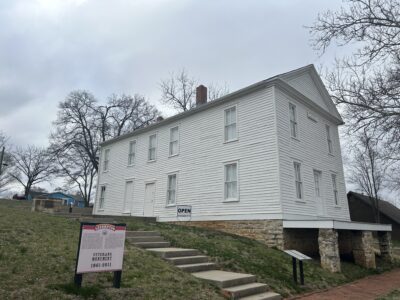
photo by: Bremen Keasey/Journal-World
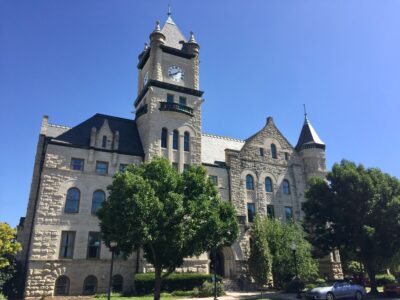
Lecompton's Constituion Hall, 319 Elmore St., as seen on March 5, 2026. The Lecompton Historical Society is hosting a special event celebrating the 170th anniversary of the building — which played a key factor during the "Bleeding Kansas" era in the build up to the Civil war — on Sunday March 8, 2026.
As Lecompton’s Constitution Hall celebrates its 170th anniversary this year, Eric Smallwood said it’s a miracle this historic site reached the milestone.
While the two-story building, which is now a National Historic Landmark, is a calm museum, it was the center of national attention for at least four years and a key marker of the Bleeding Kansas period. With fighting and tension over the question of slavery in Kansas — and the wider country — bubbling over to the point that there were brawls on the floor of the U.S. Congress, Smallwood, a site administrator with the Kansas Historical Society, said it’s remarkable this key slice of history is still around.
“To put it bluntly, the fact this building survived is insanely lucky,” Smallwood said.
The Lecompton Historical Society will wrap up its annual “Bleeding Kansas program” at Constitution Hall, 319 Elmore St., with a special program Sunday commemorating the 170th year of the building. The event, originally scheduled for Jan. 25 but moved due to weather, will feature a presentation from Dan Rockhill, a distinguished professor of architecture with the University of Kansas whose company Rockhill and Associates helped restore the building in the 1990s. The program also underscores the importance of the landmark — and Lecompton itself — in the history of the U.S.
At the time, who had governmental authority in Kansas was a touchy subject, according to Smallwood. The initial territorial legislature who wrote the Lecompton Constitution in 1857 was pro-slavery, and anti-slavery settlers to Kansas pretty much ignored the government, boycotting elections and not taking part. That was until the legislators in Lecompton began writing the proposed state constitution which would have been explicitly pro-slavery, Smallwood said. Those legislators sent the constitution to Washington D.C., and they supported the views of the president, James Buchanan.

Paul Bahnmaier of Lecompton received the 2019 Governor’s Award for tourism. Mr. Bahnmaier is the President of the Lecompton Historical Society and has been an avid educator of the importance of Kansas Territorial history.
Paul Bahnmaier, the president of the Lecompton Historical Society, said debate over the Lecompton Constitution was heated in Congress during 1858. It was passed by the Senate that year, but the vote failed in the House of Representatives by a vote of 120-112. During the debate, Bahnmaier said, a brawl took place between 50 different legislators, and a representative from Wisconsin ripped the wig off the head of a legislator from Mississippi.
Smallwood said that after the Lecompton Constitution was written, anti-slavery Kansans got involved with the government, pulling their side together to vote out “nearly every person” who was a part of the legislature in 1857 and replaced them with abolitionists in 1859. That eventually led to Kansas entering the union as a free state.
But the aftermath of the Lecompton Constitution rippled across the country. Bahnmaier said that the vote over the constitution in the House eventually split the Democrat Party, which led to a four-way race for president in 1860. That led to the election of Abraham Lincoln, and the eventual secession of what became the Confederacy.
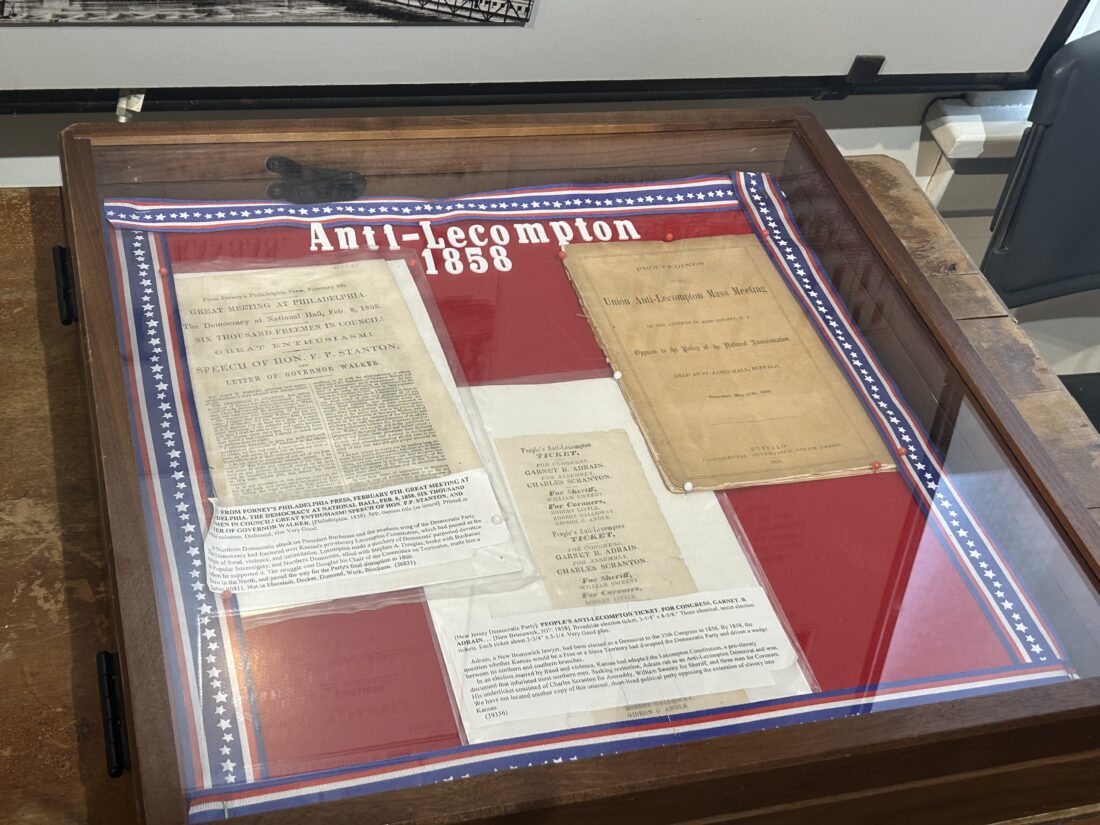
photo by: Bremen Keasey/Journal-World
Pamphlets on display at Constitution Hall, 319 Elmore St. in Lecompton, that report on “Anti-Lecompton” meetings that took place in Philadelphia and Buffalo, N.Y. in 1858. Those demonstrations stood against the Lecompton Constitution, which would have let Kansas into the United States as a slave-state.
“It can very easily be said without the writing of the constitution in this room,” Bahnmaier said. “Lincoln wouldn’t have been elected president.”
The issue in Lecompton was a national obsession, according to Bahnmaier. For four years after the constitution was first written, Lecompton “was the word in Washington,” Bahnmaier said. Two political parties carried the name “Lecompton” on their ticket, with eight “Lecompton Democrats” winning election to Congress in 1859 and the governor of California.
After plans for the state capitol shifted away from Lecompton, Constitution Hall was used as a meeting place by various social groups before it became a state historic site in 1986, according to Bahnmaier. That’s when Rockhill got involved in a project to help restore the two-story building. The restoration was done in two phases in 1991 and in 1995, and his team lifted the building up and dug under it to replace its foundation, Rockhill said.
Today, Constitution Hall has exhibits that detail the history of the Lecompton Constitution and the corresponding “Bleeding Kansas” period that helped lead to the Civil war. In fact, the term Bleeding Kansas was coined after a clash outside of Constitution Hall that required the militia to be called in from Fort Leavenworth, according to Rockhill. The blowback from the Lecompton Constitution was felt across the country, and if not for those meetings in 1857, Small wood said “The Civil War probably wouldn’t have happened how and when it did.”
That’s why the fact that Constitution Hall still exists is so important for history buffs, Smallwood said. Some people think about the Civil War as far in the past, but he noted the impact it had on the country lingers to this day.
That’s why the celebration of the building’s 170th year is so important. The celebration will be held on Sunday, March 8, at Constitution Hall at 2 p.m. More information can be found on the historic site’s website, https://lecomptonkansas.com/2026-bleeding-kansas-program-series/.
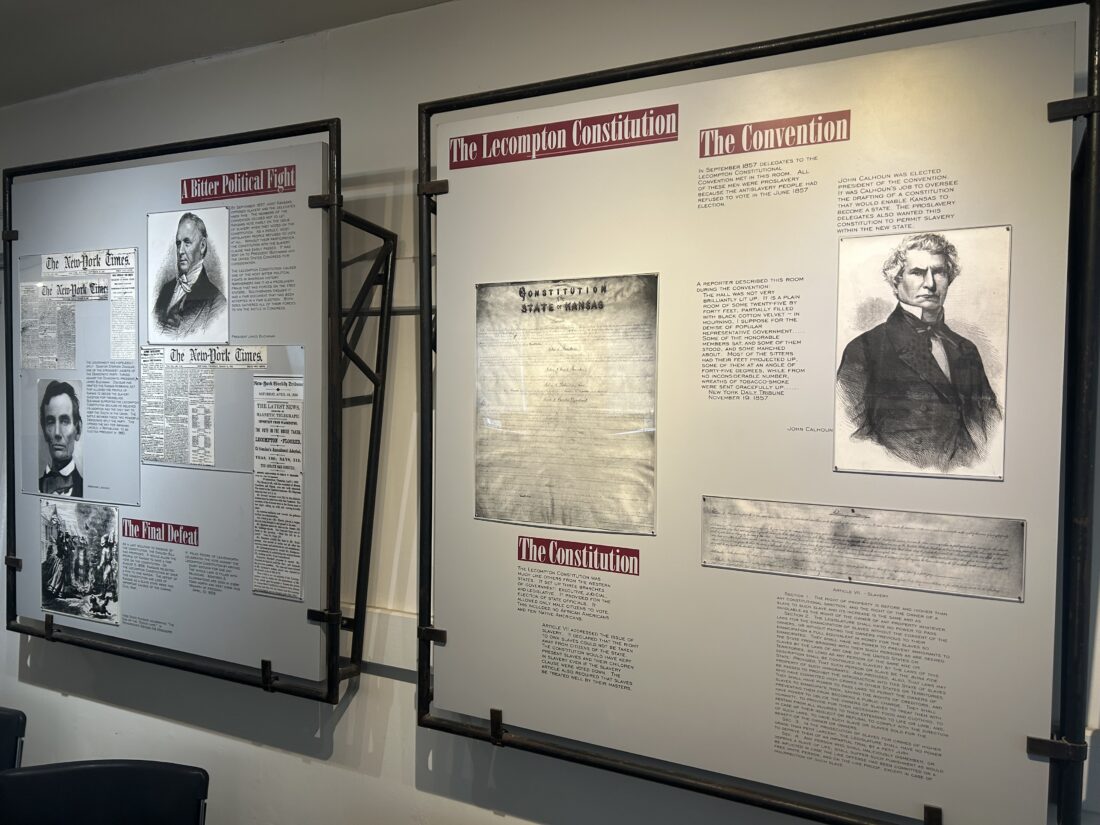
photo by: Bremen Keasey/Journal-World
Panels at Constitution Hall in Lecompton detailing the history of the Lecompton Constitution. The document, written in 1857 by the territorial legislature, would have made Kansas a slave state, and led to political backlash across the country and the state.
Other News
Housing Stabilization Collaborative’s new system directs rental and utility aid to more vulnerable households, review finds

Go, See, Do: Maple Leaf Festival, concerts and a haunting tour
Douglas County commissioners discuss tracking results of awarded funding to community partners

Baldwin High already has won $25K and is competing for $1M through national sports program

On sister city visit, delegates from Hiratsuka, Japan, see Lawrence’s friendship firsthand