Douglas County judge temporarily blocks enforcement of Kansas law banning gender-affirming care for minors; Kobach says he’ll appeal
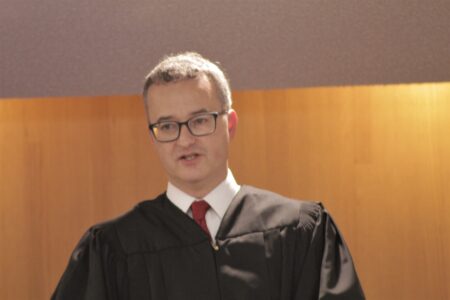
photo by: Chris Conde/Journal-World
Carl Folsom III addresses the crowd at his swearing in ceremony on Dec. 2, 2022, at the Judicial and Law Enforcement Center.
Updated at 12:09 p.m. Saturday, May 16
A Douglas County judge on Friday issued a temporary order blocking the State of Kansas from enforcing parts of a law that would prevent minors from receiving gender-affirming care, saying that the plaintiffs had shown a reasonable probability that they would suffer irreparable harm if the law stood during the pendency of the lawsuit.
Attorney General Kris Kobach on Saturday said he would appeal the ruling, calling Judge Carl Folsom’s 116-page decision “a stark example of judicial activism.”
The law, Senate Bill 63, was passed by the Kansas Legislature last year over Gov. Laura Kelly’s veto; it bans gender-affirming care such as puberty blockers and hormone therapies for minors.
The American Civil Liberties Union quickly sued on behalf of two transgender teenagers, known as Lily Loe and Ryan Roe, one of whom is from Douglas County. The ACLU sought the injunction to block the law from being enforced, saying that the plaintiffs and their families were immediately harmed by enforcement of the law and would be irreparably harmed if it were allowed to remain in effect pending a final determination of the lawsuit.
In closing arguments in November, Harper Seldin for the ACLU told Folsom that SB 63 is against the Kansas Constitution, which he said explicitly protects “natural rights,” such as parental rights to make medical decisions. He argued that SB 63 was impermissibly aimed at transgender people solely for a discriminatory purpose and that its enforcement by the state would irreparably harm the plaintiffs.
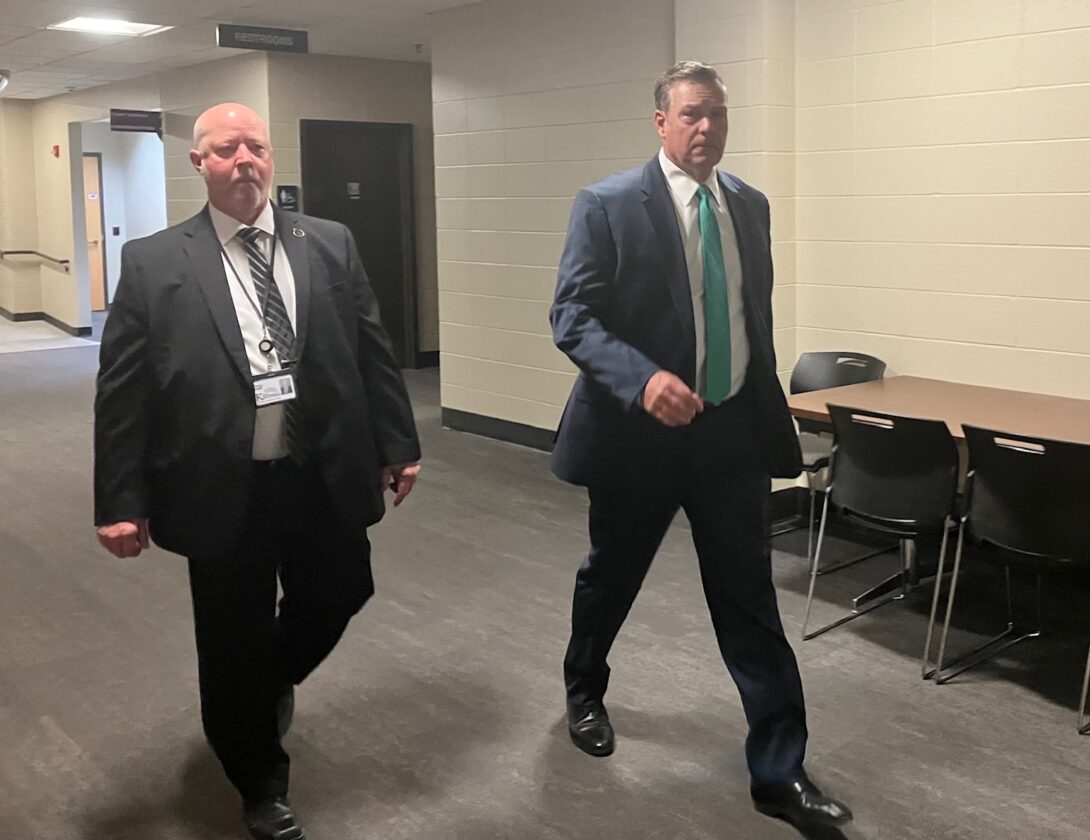
photo by: Kim Callahan/Journal-World
Kansas Attorney General Kris Kobach, right, is pictured Thursday, Nov. 20, 2025, at the Judicial and Law Enforcement Center.
Kobach countered that the law did not discriminate against anyone based on sex or gender — it applies to everyone — and that the state had an important interest in protecting children from the risks associated with gender-affirming medical interventions. He argued that the Kansas Constitution is “co-extensive” with the U.S. Constitution and does not confer an additional right, such as the right of a parent to obtain whatever medical procedure they want for a child.
Kobach maintained that a recently decided U.S. Supreme Court case “controlled” now. That case is United States v. Skrmetti, which held that a Tennessee law banning puberty blockers and hormone therapy for minors did not violate the 14th Amendment’s Equal Protection Clause.
In his Friday ruling, Folsom said the plaintiffs were substantially likely to prevail on their claim that SB 63 violates the Bill of Rights in the Kansas Constitution, which he said protects the fundamental right of personal autonomy, including the right of parents to make medical decisions for their children.
Kobach, in a news release, accused Folsom of inventing “a new constitutional right out of whole cloth.”
“Even though the Kansas Constitution says nothing about it, the judge created a new right of parents to obtain otherwise-illegal treatments for their children,” he said in the release.
Folsom wrote that because SB 63 likely infringes on a fundamental constitutional right, the state had to show that it had a compelling government interest in SB 63 and that its actions furthered that interest in a narrowly tailored way. Folsom found that the state had failed to do so.
Folsom also found that plaintiffs’ medical experts who testified in November about gender dysphoria, its treatment and the harm caused by SB 63 were knowledgeable and credible, but he mostly faulted the defense team’s parade of witnesses as lacking relevant expertise, particularly in caring for minor patients.
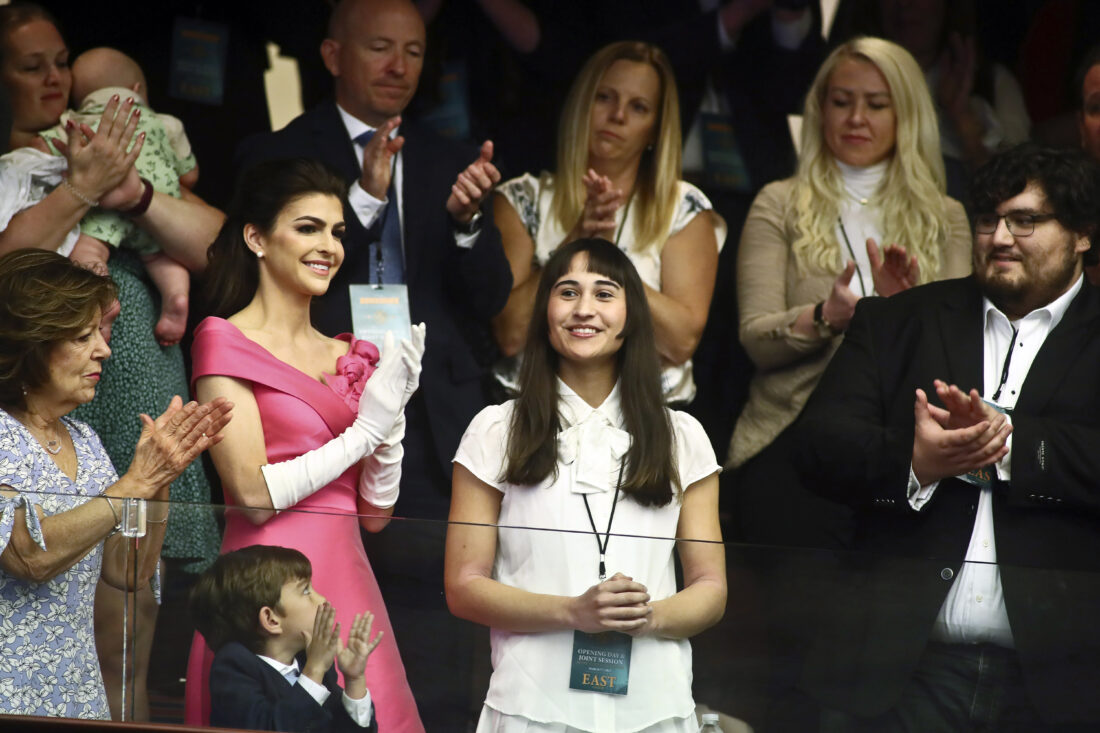
photo by: Phil Sears/AP File
Chloe Cole, center, is recognized by Florida Gov. Ron DeSantis during a joint session for his State of the State speech at the Capitol in Tallahassee, Fla., March 7, 2023. Cole received puberty blockers when she was 13, and underwent a double mastectomy at 15. Now she is an advocate against allowing those procedures on children.
Folsom called Chloe Cole, a California woman who testified about regretting her transition to male as a minor, a credible witness, but he gave her testimony little weight because she did not receive care in Kansas and acknowledged that the care she had received in California, including a mastectomy at age 15, did not align with accepted medical practice and was not condoned by gender-affirming professionals in Kansas.
The temporary injunction issued by Folsom is not a final determination of the case.
Douglas County has been a focal point for legislation and lawsuits involving transgender individuals. In March, Douglas County Judge James McCabria ruled that a new Kansas law restricting bathroom use and ID changes for transgender people could remain in effect rather than being paused while plaintiffs’ lawsuit plays out. That case is not scheduled to be heard until September. In April, a transgender Lawrence woman filed a lawsuit against the state after it invalidated her driver’s license under that same state law, which is known as SB 244.
Folsom is one of seven candidates seeking to fill a vacant seat on the Kansas Supreme Court. He is scheduled to be interviewed by the nominating commission on May 21.
State Government
Voters Guide: A look at the candidates seeking to become Kansas Insurance Commissioner
The Kansas Department of Insurance regulates insurance companies that sell policies in Kansas. Voters will decide ...
Voters Guide: A look at the candidates seeking the job of Kansas State Treasurer
In the Nov. 3 election, Republican Kansas Treasurer Steven Johnson faces two challengers for his job as the chief ...
What to know about amendment seeking to restrict noncitizen voting in Kansas
2 Douglas County District Court judges up for retention on November ballot
General Election Voter’s Guide