New legislation will allow providers to administer drug used to reverse opioid overdoses past its expiration date

photo by: AP File
The overdose-reversal drug Narcan is displayed during training for employees of the Public Health Management Corporation, Dec. 4, 2018, in Philadelphia.
First responders in Kansas will be allowed to use a drug that can be used to rapidly reverse opioid overdoses past its printed expiration date thanks to recently passed legislation.
That’s no small change given that one organization alone distributed more than $1 million worth of the drug to local law enforcement, first responders and other such agencies in Kansas last year.
The legislation, House Bill 2250, updates the state’s Good Samaritan law to clarify that expired emergency opioid antagonists like naloxone, often known by its brand name Narcan, may be used to treat an opioid overdose for 10 years past their printed expiration date. The changes will go into effect on July 1, 2026.
Rep. Suzanne Wikle, a Democrat from Lawrence, introduced the legislation after the involvement of the Lawrence-based nonprofit DCCCA. Wikle said that there is “a plethora of evidence” that naloxone kits work to reverse opioid overdoses for at least 10 years past the printed expiration date.
Wikle said DCCCA was the group that first raised the issue because it “is really costly” to dispose of naloxone past the expiration date despite the fact the product “is still effective and works to save lives.” She said law enforcement groups also became interested in the legislation since they carry naloxone as well.
George Diepenbrock, the public information officer for the Douglas County Sheriff’s Office, said all its deputies and corrections officers carry naloxone. He said the Sheriff’s Office is fortunate to be part of a community that supports the use of naloxone and includes agencies that work constantly to increase access to it.
DCCCA has operated the state’s naloxone program since 2020, and it has distributed over 130,000 naloxone kits to individuals and organizations throughout the state. Chrissy Mayer, the chief community-based services officer for DCCCA, told the Journal-World via email that the organization distributed over 50,000 kits in 2025, which equates to over $1 million worth of naloxone.
Mayer said the new legislation means DCCCA anticipates receiving fewer requests from organizations because the ones who haven’t used their product can now keep it beyond the expiration date and use it safely, saving money by purchasing fewer new kits. The organization’s CEO, Lori Alvarado, said in a statement allowing the use of expired kits will “not only preserve resources with our statewide distribution but also extend access to save lives.”
Wikle said that unfortunately there has been a large number of overdose deaths across Kansas in recent years. According to data from the Kansas Department of Health and Environment, overdose deaths hit a peak in 2022, with 739 drug poisoning deaths across the state, with 497 of those deaths attributed to an opiate overdose. Despite a recent decline, there were 559 drug poisoning deaths across the state in 2024, with 349 of those due to an opiate.
Wikle said the new legislation helps keep more naloxone in the community that can be used to help reduce those deaths and save lives, with an added benefit of reducing costs by needing to restock on the drug.
“Anything we can do to make access to this lifesaving medication easier (is) a good thing,” Wikle said. “The bonus is it saves organizations money.”
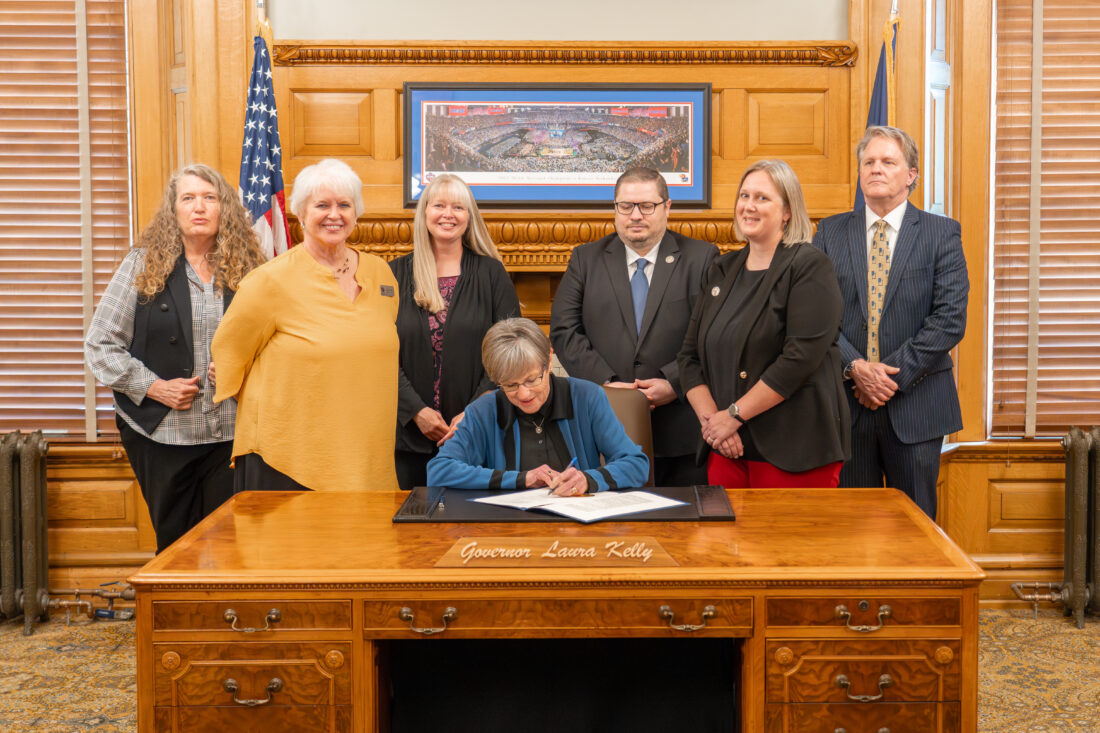
photo by: Contributed
Rep. Suzanne Wikle, second from right, and officials with DCCCA stand at a signing event on May 1, 2026 for legislation that allows naloxone to be used for 10 years past its expiration date.
State Government
Voters Guide: A look at the candidates seeking to become Kansas Insurance Commissioner
The Kansas Department of Insurance regulates insurance companies that sell policies in Kansas. Voters will decide ...
Voters Guide: A look at the candidates seeking the job of Kansas State Treasurer
In the Nov. 3 election, Republican Kansas Treasurer Steven Johnson faces two challengers for his job as the chief ...

What to know about amendment seeking to restrict noncitizen voting in Kansas

2 Douglas County District Court judges up for retention on November ballot
General Election Voter’s Guide