De Soto expresses interest in nuclear power as company searches for potential plant site in Kansas
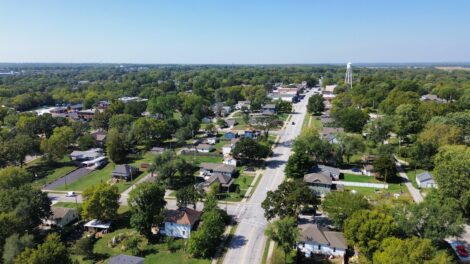
photo by: Shawn Valverde
Downtown De Soto is pictured in September 2023.
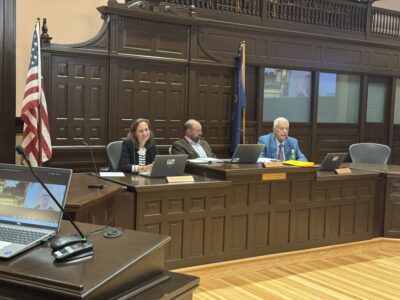
De Soto city leaders are looking for a seat at the table as discussions begin around a potential nuclear project in Kansas.
TerraPower – a nuclear innovation company founded by Bill Gates – announced a partnership with utility company Evergy and the Kansas Department of Commerce in September 2025 to explore sites for its next potential commercial-scale nuclear power plant in Kansas.
Last November, the De Soto City Council sent a letter of interest for the project to the Kansas Department of Commerce. De Soto is one of multiple communities that have already submitted letters or interest or support – including Coffey County, Lyon County and Hutchinson.
“At this time, the City Council and community are interested in learning more about TerraPower’s project and its potential fit within our region,” the letter said. ” … We would welcome a continuing dialogue with the Kansas Department of Commerce, Evergy, and TerraPower representatives to evaluate potential benefits, impacts, and community alignment.”
This doesn’t mean another nuclear power plant is guaranteed to come to Kansas, though. The memorandum of understanding the three parties signed only creates a framework for evaluation and discussion regarding whether or no the technology fits within Kansas’s long-term energy objectives.
B.J. Bayer, vice president of engineering at Kansas’s only nuclear plant, said there’s a major push to expand nuclear capacity at a Thursday event hosted by the Douglas County Rural Preservation Association and Evergy. The U.S. Department of Energy said on its website it’s aiming to quadruple its nuclear energy capacity from approximately 100 gigawatts to 400 gigawatts by 2050.
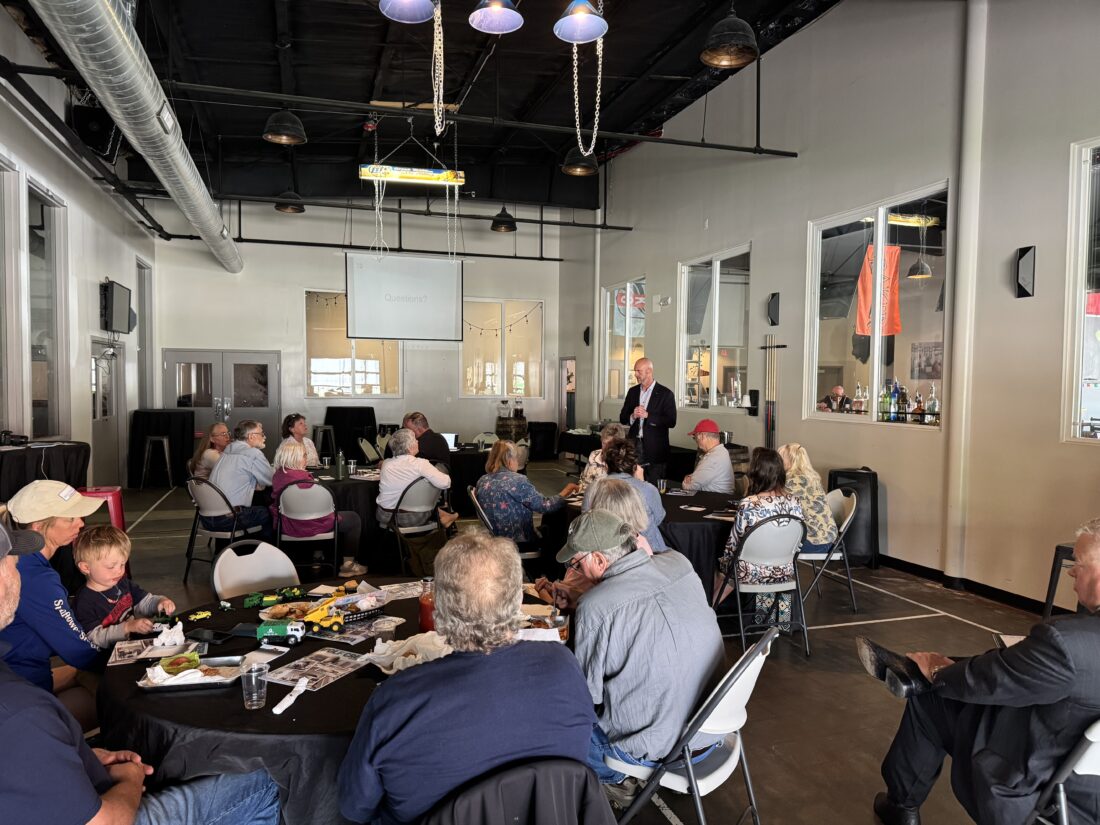
photo by: Josie Heimsoth/Journal-World
The Douglas County Rural Preservation Association invited the community to an event discussing nuclear power on Thursday, April 30, 2026.
Nuclear power has been making a global comeback because it provides reliable, large-scale energy and can act as a stable partner to a community’s energy portfolio. It could also be a solution to help meet the rising demand for artificial intelligence as data center and high-energy user projects are introduced in communities, providing low-carbon electricity.
Kansas has been an attractive location for nuclear power, mainly because Evergy already has a nuclear power plant, the Wolf Creek Generating Station, and there are smaller projects underway. California-based Deep Fission is currently developing an underground reactor at an industrial park in southeast Kansas in Parsons.
While there’s still limited details on where the nuclear power plant could go, according to a press release from TerraPower, the three groups will select a site based on a variety of factors. This includes community support, the physical characteristics of the site, the ability of the site to obtain a license from the U.S. Nuclear Regulatory Commission and access to existing infrastructure.
Even though the future of nuclear power in Kansas is still being evaluated, Bayer demonstrated how the energy is already being produced on a daily basis at Wolf Creek.
Side-by-side of Wolf Creek and TerraPower
Power to Wolf Creek comes from millions of small uranium pellets, each no bigger than the size of a fingernail.
One of these pellets is equal to the energy that comes from one ton of coal or 17,000 cubic feet of natural gas, according to the Center for Nuclear Science and Technology Information.
Wolf Creek – which provides 1,250 megawatts of electricity – is a pressurized water reactor. It generates electricity by heating water to produce steam. The steam is used to turn the blades inside the plant’s turbines, which spins in the turbine shaft. This also spins a magnet inside an electrical generator, and that produces the electricity.
The heat is produced by splitting the atoms inside the uranium dioxide ceramic pellets. These pellets are stacked into fuel rods, combined into assemblies and submerged in water, where fission produces intense heat to create electricity. It takes millions of those pellets to fully power the Wolf Creek station.
Wolf Creek is considered to be a more traditional nuclear plant with technology still widely used today. Meanwhile, TerraPower has next-generation nuclear designs and they haven’t been widely built yet.
TerraPower’s project would use Natrium technology, which features a 345 megawatt electrical sodium-cooled fast reactor that uses sodium instead of water as a coolant. It separates the nuclear steam generation from power generation using a molten salt energy storage system. This allows the plant to store heat and increase output to 500 megawatts to meet peak demand, often accompanied with renewable energy sources.
TerraPower broke ground on its first Natrium project in 2024 in Wyoming, and it is the only reactor actually under construction at this time.
Environmental concerns
Environmental organizations like the Sierra Club’s Kansas chapter have been more skeptical of nuclear projects, citing concerns about leaks of radioactive waste, water use, and long-term environmental risks.
At Wolf Creek, some of these concerns are addressed through a combination of federal regulations and engineered safety systems. The plan operates under the oversight of the U.S. Nuclear Regulatory Commission, which requires constant inspections – and there are two full-time inspectors on site at all times, Bayer said.
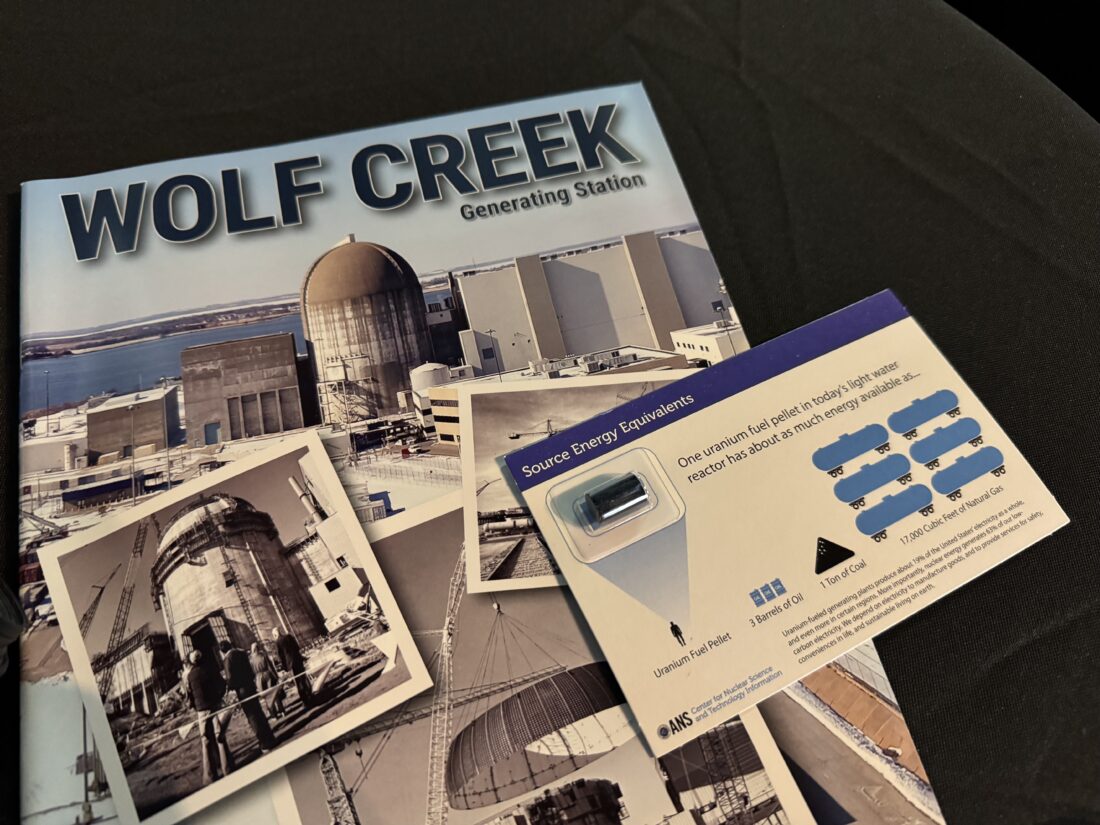
photo by: Josie Heimsoth/Journal-World
Millions of uranium pellets are used to power the Wolf Creek Generating Station near Burlington.
Wolf Creek also relies on continuous environmental monitoring conducted by state agencies, which regularly test air, water, and soil around the plant for any signs of radiation. Its cooling system relies on a large cooling lake and circulates water from that body of water.
The engineered systems at Wolf Creek are designed to prevent radioactive leaks and contain any potential release inside the plant. The central idea is not just one “barrier,” but multiple layers of protection so that even if one system fails, others still prevent anything from reaching the environment.
One of the most important features is the reactor containment building. This is a massive, reinforced concrete structure with thick walls and a steel liner inside. Its job is to completely seal off the reactor and related systems.
What about Douglas County?
Bayer said the area could benefit from a nuclear power plant, especially as data center projects are being proposed in eastern Kansas. As the Journal-World reported, there are two large-scale data center projects proposed just outside of the Douglas County line near Tonganoxie and De Soto.
The Journal-World also reached out to communities in Douglas County about the possibility of an advanced nuclear power plant being located in or near the community and whether they’ve been contacted by Evergy, the Kansas Department of Commerce, or TerraPower.
A Douglas County and the City of Lawrence both said that they are not aware of any inquiries or discussions pertaining to nuclear power with either of the three entities.
In addition, Baldwin City and Eudora city officials said they have not heard or had conversations regarding the potential for nuclear power plants.
“The City has not had any official discussions about this, though we are open to talks with any group who wants to bring this level of investment to the community,” Zack Daniel, city manager for Eudora, said via email.
Other News

U.S. Army says cleanup at Sunflower Army Ammunition Plant is ‘slowing down’; PFAS investigation at site still needs funding

‘One of a kind’: Sale at the Lawrence Arts Center will find new homes for late musician’s unique custom guitars

Go, See, Do: KU homecoming, Halloween happenings and other events

Student-run coffee shop opens at Community Connections at Pinckney, teacher receives surprise $1,000 award
‘This is for all of us’: Midco Prairie, an oasis of native plants in downtown Lawrence, opens to the public