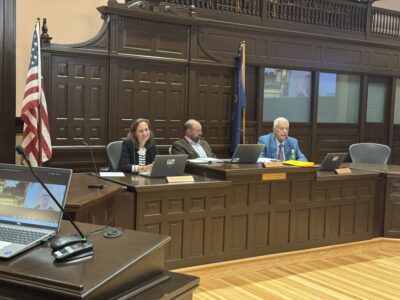
Proposed data centers near Tonganoxie and De Soto raise questions about power, water and community impact
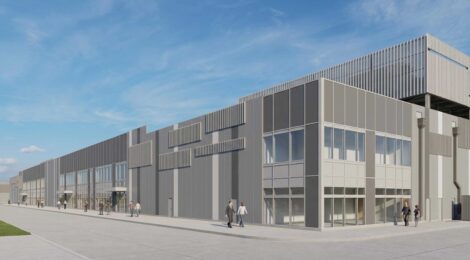
photo by: HDR Engineering, Inc.
A construction rendering of a proposed data center facility, Building 2, in De Soto. The project will eventually feature four data center buildings.
Two large data center projects near Tonganoxie and De Soto could become Douglas County’s newest neighbors, bringing energy demands scalable to cities far larger than either town.
Ever heard of San Francisco?
The data center near rural Tonganoxie, Project Bluestem, would be about 15 minutes away from Lawrence. While the project is still in its early stages, the project’s developer, Cloverleaf Infrastructure, told the Journal-World that if all goes according to plan, the data center could require up to 1.2 gigawatts of power.
Indeed, that is almost equivalent to how much it takes to power the entire city of San Francisco.
“That’s what we’re considering for the site in terms of size,” Aaron Bilyeu, chief development officer of Cloverleaf, said. “But until we confirm that with the utility, we won’t know for sure.”
Another sizable project is the digital infrastructure campus being developed on a 290-acre site less than a mile outside the Douglas County line in De Soto. While the site will eventually feature four large data center buildings, the city has already started reviewing a site plan for two of those buildings – and if all the necessary approvals go through, construction could begin in May.
Electric utility Evergy would supply power to both the Tonganoxie and De Soto projects and has already begun preparing for power-hungry data centers in its service area, especially after Kansas passed Senate Bill 98 last year, offering state and local sales tax exemptions for qualifying data centers.
That anticipated surge in data centers has already started reshaping how Evergy plans for — and charges — these massive facilities.
The Big Data Debate:
A three-part series from the Journal-World on whether big data centers are likely to become a big part of our local communities.
• Sunday: Douglas County’s “de facto pause” on data centers and crypto mines
• Monday: What the City of Lawrence already has decided about data centers
• Today: Big ideas for big data centers in nearby De Soto and Tonganoxie
Last fall, a large-load power service tariff was approved, and it applies to data centers and facilities requiring more than 75 megawatts of energy per month. It’s in place to protect ratepayers by ensuring large users pay higher rates, finance their own infrastructure upgrades and commit to long-term contracts.
While there’s limited information about the electricity and water demand of the proposed De Soto facility, the Journal-World was told it would be susceptible to Evergy’s tariff, a threshold Project Bluestem is expected to easily exceed.
As plans for Project Bluestem are being discussed with Leavenworth County commissioners, residents opposed to the development say the fight is about protecting the land to keep the small-town identity they fear could be changed for good.
“It’s about water, it’s about electricity, it’s about our land, it’s about our health, and ultimately, it’s about who gets to decide the future for this community,” Jim Karleskint, a former state representative, told a crowd largely opposed to the development on Sunday.
Meanwhile, Bilyeu and De Soto leaders said the investments will reward communities by putting money in their pockets and opportunities right in front of them. They say these projects will generate millions in revenue and hundreds of jobs for the communities they’re housed in, and therefore, worth the additional infrastructure to make them happen.
“Data centers pay a tremendous amount of taxes,” Bilyeu said. “They have huge community investment benefits … (And) the jobs that get created at the data centers are very high paying jobs, and it’s not so many jobs that it overwhelms small communities.”
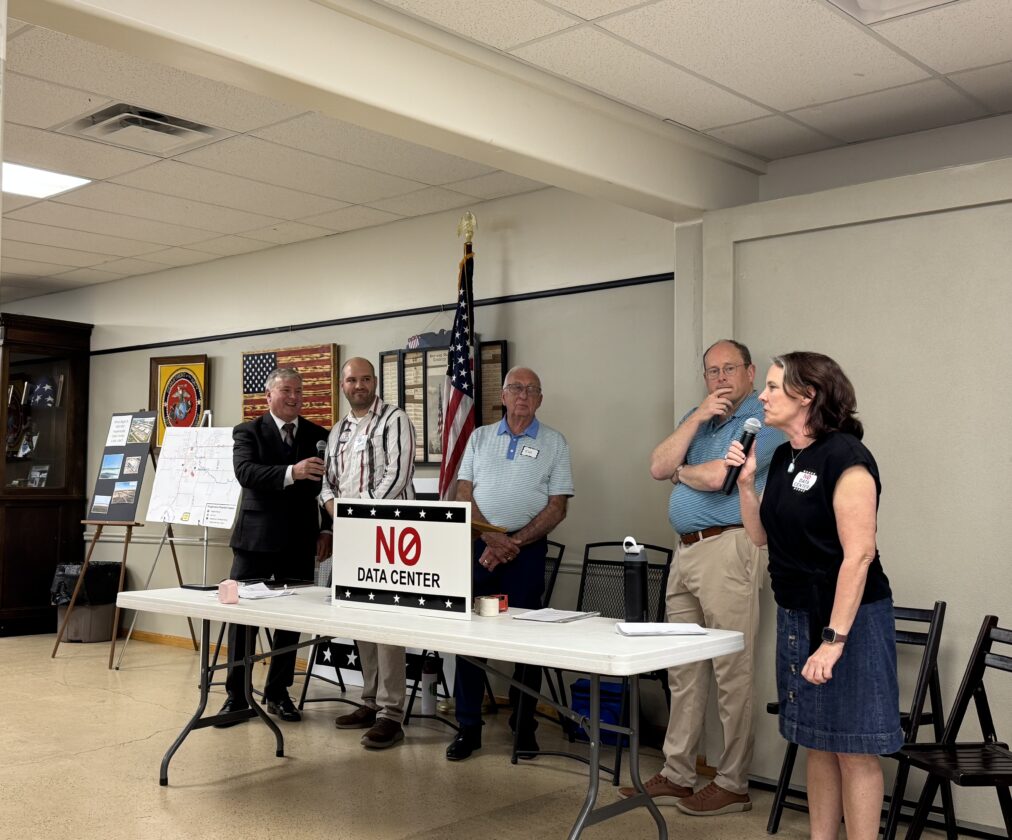
photo by: Josie Heimsoth/Journal-World
From left to right, Leavenworth County Commissioner Mike Stieben; Zack Pistora, Kansas chapter director of the Sierra Club; Jim Karleskint, a former state representative; Tonganoxie school board member Evan Dean; and Tonganoxie resident Rebecca Davis are pictured on Sunday, April 26, 2026.
Leavenworth County’s ‘Project Bluestem’
Cloverleaf is a two-and-half-year-old land development company that prepares land for technology companies that build and operate data centers. Once sites have all the needed local approvals for construction and power confirmed to the site, Cloverleaf will seek a company to build and run the data center.
Cloverleaf has worked with firms such as Amazon, Microsoft and OpenAI, giving residents an idea of what could potentially be built near Tonganoxie Business Park.
Bilyeu said the 1.2 gigawatts goal is around the industry standard right now for data centers, adding that those facilities typically have a range between 1.2 to 1.5 gigawatts.
“If we were able to get that, we would probably end up with a couple million square feet of buildings,” Bilyeu said.
The facility will also use a closed-loop cooling system requiring a one-time fill design. While the water demand of data centers has been a primary concern among people opposed to these projects, Bilyeu said he anticipates during construction, 50,000 to 60,000 gallons of water will be added and circulated around the facility during its lifespan. Otherwise, the building will only use as much water as an office building on a day-to-day basis.
“The liquid stays in the piping system, so that there’s no water consumed for cooling at the data centers,” Bilyeu said. “It is true that existing data centers and the way data centers used to get designed, there was considerable water consumption. But that will not be the case with this project.”
At this time, the development is conceptual, and there have been no formal requests submitted to Leavenworth County for project approvals or permits. If the project is fully built out, it could employ over 200 full-time workers – nearly double the number of jobs created by Tonganoxie’s Hill’s Pet Nutrition plant when it opened.
“We will be bringing our community engagement team to the county in the coming weeks to make sure that as we’re developing this project, we’re doing it in a very responsible way,” Bilyeu said. “In a way that not only benefits Cloverleaf and our customers, but most importantly, benefits the communities that we’re going to be part of.”
First proposed plans on De Soto project
A separate large-scale data center campus, which is northeast of the intersection of 103rd Street and Evening Star Road in De Soto, is already moving further through the approval process.
The site plan from Beale Infrastructure is for the first phase of the larger project, with two large data center buildings. The first building is the smaller one, at approximately 300,000 square feet, or about 6.9 acres. Building 2 is more than double the size at about 863,000 square feet, or about 19.8 acres.
The site will also include associated infrastructure such as 150 parking spaces, three loading dock areas, construction staging areas, and two new private electrical substations, with one substation planned as part of a later phase.
No details were shared regarding either of the buildings’ water and electricity use, but Evergy has already submitted a site plan for one of the new substations, saying it will include tall infrastructure, roughly 30-40 feet high with transmission lines up to 85 feet. The data center’s water and sewer needs will be fully funded by the developer and its partners, and infrastructure improvements will be paid for privately and phased in as the project grows.
In August 2025, De Soto city commissioners approved a development agreement with Mount Sunflower LLC and a resolution authorizing Industrial Revenue Bond incentives to support a new data center project. The plan allows for up to four large data center buildings to be constructed in phases.
In addition to state incentives passed last year, the city approved up to 10-year property tax abatements per building. The agreement also includes a utility/franchise fee structure tied to electricity use so the project contributes to local revenue based on power consumption, and it requires a minimum private investment of about $700 million within the first seven years to maintain eligibility for the incentives.
Regardless, city manager Mike Brungardt said this project is going to significantly benefit the city in the long run because it’s expected to generate franchise revenues – a type of sales tax or fee charged on utilities – of $5.5 million annually.
“To put that into perspective … our total tax collections from (property) taxes is only $1.9 million for 2026,” Brungardt said. “So we’re expecting it will be five years, maybe six, maybe longer, but once it’s up and it’s fully built out, we expect franchise revenues of $5.5 million.”
Brungardt said it will reduce taxes and utility rates for De Soto residents, increase services provided by the city, and potentially even property tax relief programs. When the project becomes fully online, it’s estimated to provide 200-300 permanent jobs, he said.
“There’s no doubt this is going to increase the quality of life,” Brungardt said. “It’ll add quality of life for people in De Soto, specifically, but also in the region with this type of capital investment taking place.”
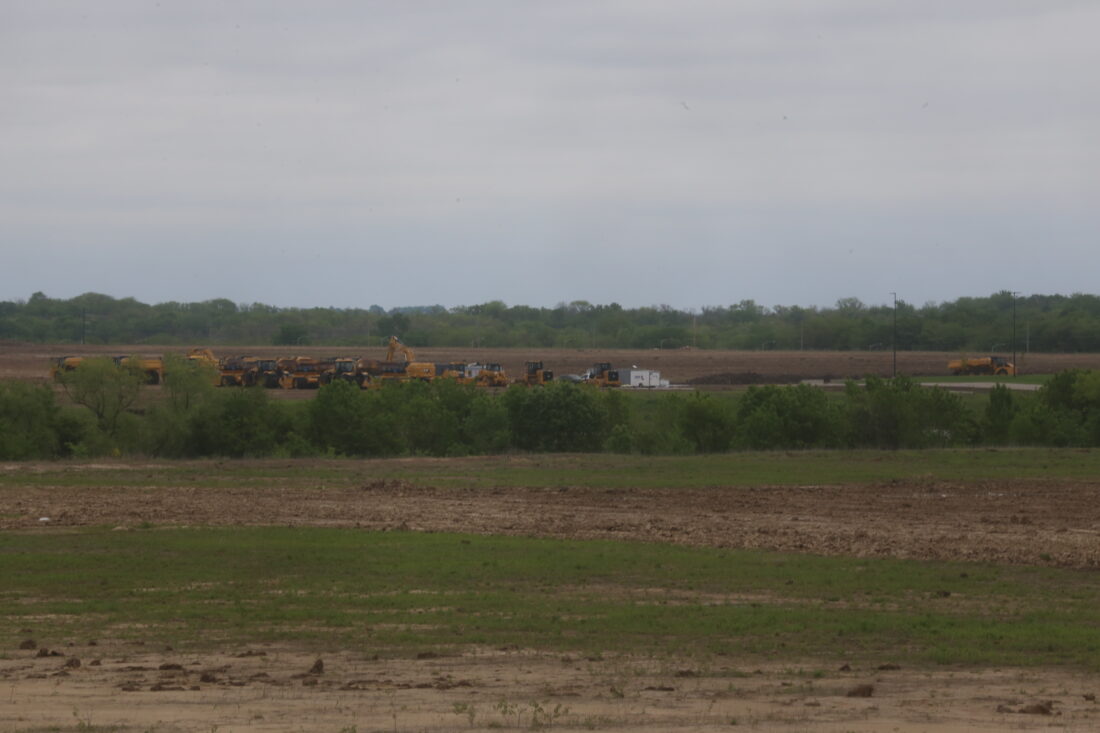
photo by: Chad Lawhorn/Journal-World
Construction equipment sits idle on a large site at Evening Star Road and Kansas Highway 10 between Eudora and De Soto on April 28, 2026. The site is proposed for a large complex of data centers.
Tonganoxie’s concerns
At the community meeting on Sunday – organized by the Tongie Data Center WatchDog Group – Tonganoxie and Leavenworth County residents were concerned about Project Bluestem’s environmental and community impacts.
Organizers were also passing around a petition calling for at least 300 signatures to implement an 18-month moratorium on key infrastructure decisions until the community can gather more information about the data center project. As the Journal-World reported, several communities in Kansas have these moratoriums in place as their community crafts regulations for these large-scale developments.
“Most communities don’t fully understand what they’ve agreed to until, unfortunately, it’s already too late,” Karleskint said. “That’s why we’re here today, because we still have a choice … We’re not asking right now to ban data centers, we’re asking for something more reasonable, for a temporary moratorium, a pause that gives us time to understand what these facilities actually require.”
The concern over moving too quickly into agreements without fully understanding the consequences was echoed by local residents, who say the issue is not opposition to development itself, but the pace and scale at which it is advancing.
“We want to slow this down,” Rebecca Davis, a Tonganoxie resident, said. “We are not anti-business, but we want good neighbors. And we want to keep the rural community that we love.”
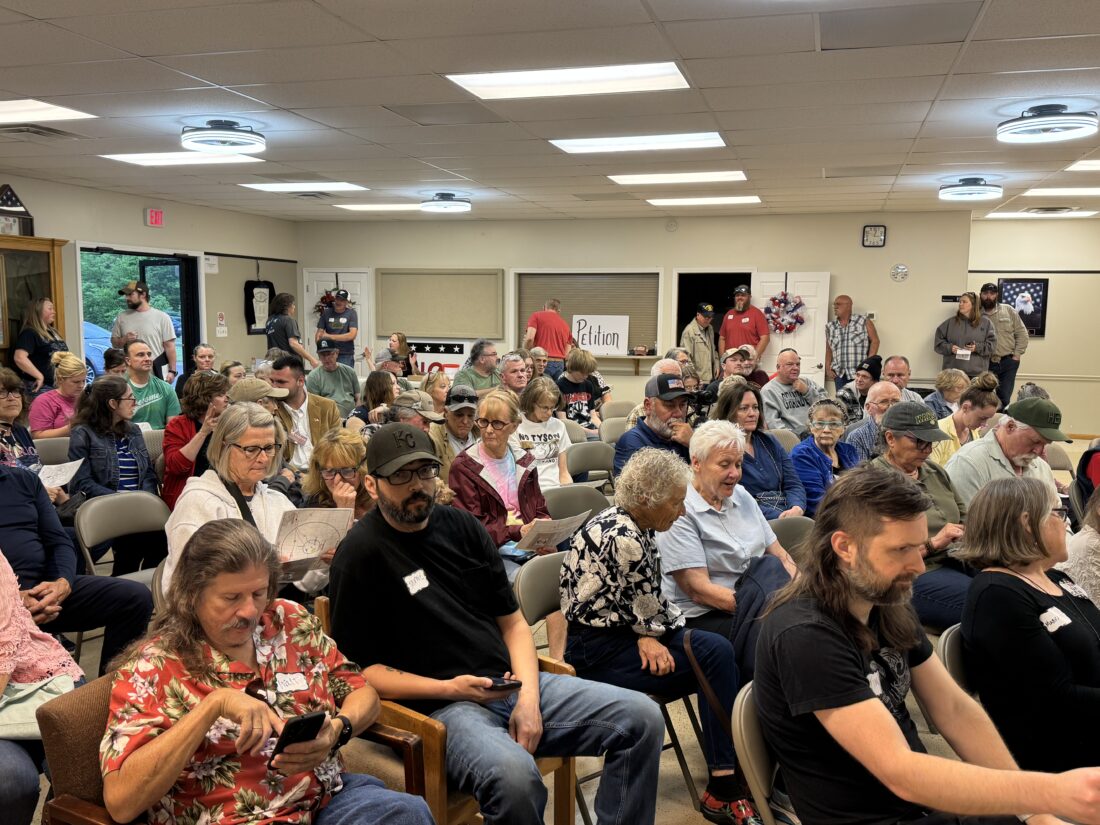
photo by: Josie Heimsoth/Journal-World
Several Leavenworth County residents attended a community meeting opposing the proposed data center development, Project Bluestem, on Sunday, April 26, 2026.
Other News

U.S. Army says cleanup at Sunflower Army Ammunition Plant is ‘slowing down’; PFAS investigation at site still needs funding
‘One of a kind’: Sale at the Lawrence Arts Center will find new homes for late musician’s unique custom guitars

Go, See, Do: KU homecoming, Halloween happenings and other events
Student-run coffee shop opens at Community Connections at Pinckney, teacher receives surprise $1,000 award
‘This is for all of us’: Midco Prairie, an oasis of native plants in downtown Lawrence, opens to the public