County leaders express an interest in increasing motor vehicle fees; decisions to be made during 2027 budget talks
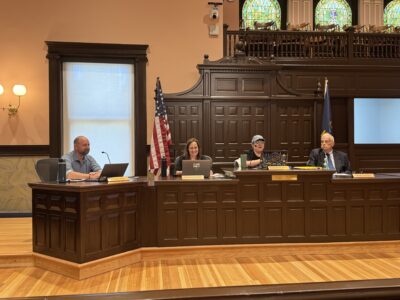
photo by: Josie Heimsoth/Journal-World
Douglas County commissioners meet on Wednesday, June 10, 2026.
Douglas County commissioners expressed an interest in raising motor vehicle fees in 2027, but just how high will be determined during budget discussions next month.
Commissioners are wanting to take advantage of a new Kansas law passed this year, Senate Bill 325, that authorizes them to increase vehicle registration transaction fees up to $10 to help fund motor vehicle services. While the county treasurer can increase the fee to $5, any amount greater than that needs to be approved by the County Commission.
Currently, the county charges a $3 fee for all transactions handled in person at the Treasurer’s Office. The new law will now apply to all transactions, whether county residents renew their vehicle registration tags online or in-person.
Commissioners directed county staff on Wednesday to determine what an increase to $5 might look like in the 2027 budget. While commissioners could approve up to a $10 fee, all four commissioners at the meeting – with Commissioner Karen Willey absent – said they thought it was too high of a jump for residents to go from paying $3 to $10.
County Administrator Sarah Plinsky said staff could provide commissioners with several fee options and corresponding revenue estimates during the upcoming budget process. This is beneficial if it turns out commissioners want to utilize a larger fee increase because they want to allocate property tax dollars somewhere else.
As the Journal-World reported, before the new law, many counties found that the fees collected from renewals, title and registrations and personalized plate transactions did not fully cover the cost of operating their motor vehicle departments. There is currently general fund dollars – which are largely supported by property taxes – being used to make up the difference.
“We could put a revenue estimate around the $5 fee and then add in what is the max we could do,” Plinsky said. “And then, as you’re making budget decisions, and if things are tight … you could make the decision at that time to increase the fee to a higher number,” Plinsky said.
Commissioner Patrick Kelly said he wants to make sure there isn’t a significant increase in the fee that will impact people seeking motor vehicle services. He also wants to use it as an opportunity to explore where commissioners could ease the burden on county taxpayers.
“I do like the opportunity to looking at, as we work through the budget, is there an opportunity to provide more tax relief by increasing the fees?” Kelly said.
If commissioners do increase the fee amount over $5, it would only be implemented for two years, beginning in 2027. The change would expire Dec. 31, 2029. This is an option for counties so the Kansas Legislature can see if the increase is actually needed for motor vehicle operations and what counties do with the additional funding. In 2030, transaction fees cannot exceed $5, according to state law.
Commissioner Shannon Reid said if commissioners increase the fee above $5, the county may have to reabsorb those costs previously covered by the fee in two years.
“The guidance for Sarah and her team to be able to budget for the $5, the revenue generated from a $5 fee, is a solid starting point,” Reid said. “And then, we’ll have the opportunity when we have the totality of the budget in front of us next month to consider whether or not a higher fee is a worthwhile strategy.”
County Treasurer Adam Rains told commissioners the change to $10 would keep motor vehicle operations from operating in a deficit.
If the fee stays at $3, it is projected to generate about $1.09 million in total revenue in 2027, and the motor vehicle division is facing $1.68 million in operating expenses. This would result in a $597,283 deficit. An increase to $5 would shrink the deficit to about $389,033. At $10, the total revenue would be approximately $1.74 million.
IN OTHER BUSINESS, COMMISSIONERS:
• Held a work session to discuss efforts to expand supportive housing options for women and children experiencing homelessness or housing instability in Douglas County. Supportive housing is an area of the city-county ‘A Place for Everyone’ plan to end chronic homelessness, which set a goal of adding 120 additional units of permanent supportive housing for priority populations and 15 units of transitional housing for individuals with substance use disorder and/or mental illness.
In March, county commissioners contracted with nonprofit consulting team Amethyst Amplified – which is affiliated with Amethyst Place, a long -term supportive housing program for women and children recovering from poverty, substance use and trauma – in the amount of $48,000. The team has been providing strategic guidance and technical assistance to a project team in Douglas County looking to improve access to supportive housing.
Over the past six months, the project team was tasked with three goals: creating a funding model to support housing programs for women and children, designing an evidence-based supportive housing program and building community support for future projects. The county and community partners shared the progress to date on these efforts.
• Executed an agreement with Foley Equipment Company for a Caterpillar 275 XE compact track loader and attachments in the amount of $189,568 to replace an existing compact track loader in the Public Works department.
Other News

Douglas County commissioners to discuss whether to increase the number of days fireworks can be sold in the county
Lawrence’s first bike lanes with physical barriers are installed on Ninth Street
Data center company plans up to $1,000 a year in tax, utility credits for De Soto households
Supernatural thriller filmed in Lawrence to have multiple showings at Liberty Hall
Eudora voters to decide sales tax election to fund increased fire protection in the city