Prairie Park’s artificial floating island is cleaning the water and hosting all kinds of wildlife
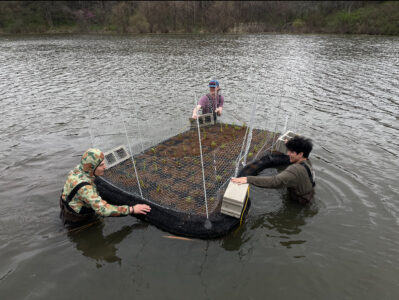
photo by: City of Lawrence
Prairie Park Nature Center staff install a floating wetland island in Mary's Lake in early 2026.
It must have been a strange sight for the birds, frogs and fish at Prairie Park — this raftlike plastic object that appeared in the center of Mary’s Lake earlier this year.
But a few months later, many of them think it looks like home.
This structure is an artificial floating wetland island, and it’s something that Prairie Park Nature Center has been working on for a while. It’s funded by a grant from the Douglas County Heritage Conservation Council, and as it grows, it will create habitats for all kinds of animals, give pollinators and migratory birds a safe place to stop, and even clean up the lake water itself.
“It’s been in the water about four months now, and we’ve seen tremendous progress already,” said Clayton Detherage, one of the staff members involved in the project.
The 10-by-8-foot island is anchored in Mary’s Lake, the 7-acre lake on the south side of Prairie Park. It’s made of recycled plastic water bottles and marine foam, and it has about 100 plugs in it for native plants.
To design it, Detherage said the nature center worked with a company called Midwest Floating Island, which has experience in helping city and state governments put islands in stormwater treatment ponds, golf course ponds and other urban bodies of water.
Detherage wanted Prairie Park’s island broken into three sections, each with different types of plants that do different things.
The shoreline section includes common rush, fox sedge and woolgrass and is meant “to create lots of habitat and structure, so it invites lots of wildlife to come.” Farther inside are flowering plants like lizard’s tail, blue flag iris, sweet flag and swamp milkweed.
“This is more for attracting pollinators that we have here in Lawrence, and it allows them to be safe and comfortable in an area that most other species cannot get to them,” Detherage said.
Then, the center section of the island has softstem bulrush, river bulrush and broadfruit bur-reed, he said. “Those three plants are primarily the sun-blocker, so if the sun is too strong that day, it allows animals to get in there and get shade.”
When the plants go dormant in the fall and shed their leaves, the biomass will gradually turn into soil, “so it just renews itself over and over.”
“This wetland island could be in the lake easily over five years,” Detherage said.
For about the first two months, the island was fenced to protect the young plants. It probably stuck out to the local wildlife at this point, Detherage said.
“At first, when the island is pretty bare with a lack of plants, it may be pretty noticeable for animals – undesirable, you may say,” he said. “But once these plants get established, there’s really no difference between real land and an artificial wetland island.”
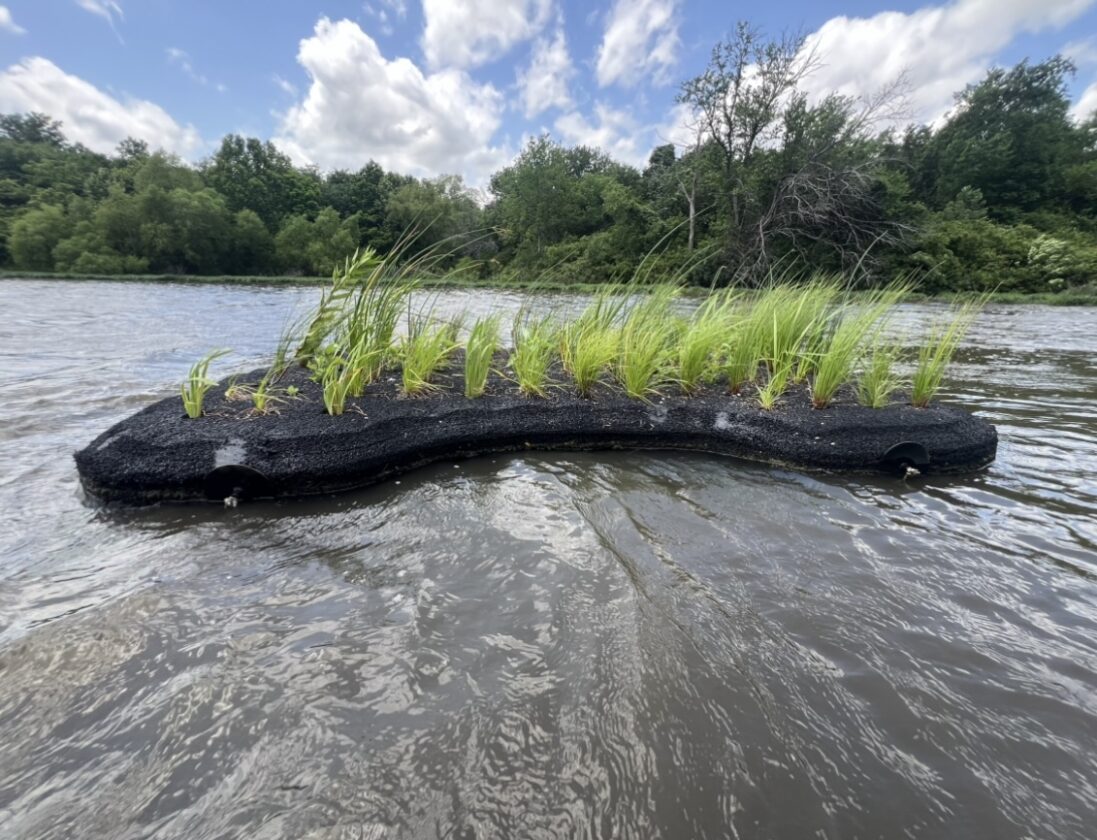
photo by: City of Lawrence
Plants have now sprung up on the floating wetland island at Prairie Park.
Sure enough, when the fence came down, the island started getting more attention.
Every day, naturalists at the center go out to the lake and check the island’s health, either observing it with binoculars or paddling out to it in a canoe or kayak. They’ve seen lots of turtles, amphibians, beetles and water insects there, as well as songbirds and an occasional duck. Over the long term, Detherage hopes the island will become more appealing to migratory birds looking to rest.
“But the real magic, I’d say, is actually underneath the island,” Detherage said. “It’s pretty on top with all the flowers and plants that we have, but underneath is where all the magic is actually happening.”
That’s because the island has formed a root system, with 3- to 4-foot-long roots extending into the water. Lots of fish, crawdads and other aquatic animals now live under the island in this root system, Detherage said.
The root system has another purpose, as well: cleaning the lake’s water.
Detherage said that the kidney-shaped island acts sort of like how a kidney in the body does. “Wetlands are known as the kidney of the ecosystem,” he said, “because they clean and filter out all the water that we have.”
When people use fertilizers and other chemicals on their lawn or garden, those substances eventually get into nearby bodies of water, and the excess nitrogen and phosphorus lead to what’s known as nutrient pollution. The extra nutrients cause algae blooms, which can be harmful to wildlife and even to humans and pets.
The island’s root systems are going to remove some of these nutrients from the water of Mary’s Lake, Detherage said. And even more will be removed by a “biofilm” of microbes that grows on the island’s surface. It’s called periphyton, and it’s very good at fighting nutrient pollution.
“If you do have those periphyton, it’s actually going to stop and mitigate the blooms from happening,” Detherage said.
So far, Detherage has heard lots of positive things from visitors about the floating island project. He doesn’t know whether more might be installed elsewhere in Lawrence, but he does want to expand this one after it’s had some time to grow.
“It may take two to three years for it to become fully functional,” he said.
Detherage also said that if you’re interested in the benefits of floating islands and you have a property with a backyard pond or other body of water, you could install a miniature one there. He suggested contacting a company like Midwest Floating Island (their website is midwestfloatingisland.com) to help plan a project that fits your space.
“You’ll see positive benefits happen very quickly at that level,” he said. “It’s just something that people can start looking into, because water is very important for humans.”
One thing Detherage wants people to understand is that urban bodies of water are some of the most consequential parts of the ecosystem, and floating islands are one way of protecting them.
“Urban waterways are worth protecting, just because urban waterways are the forefront of all the watersheds,” he said. “Water flowing into Mary’s Lake now eventually is going to reach the Wakarusa, which goes into the Kansas River, which goes into the Missouri, the Mississippi and back into the ocean, and then it recycles back here.
“So, if people want to start combating it now in their own yards, there will continue to be positive effects in different ecosystems farther away from where they are.”
Other News
RJ Mitte, ‘Breaking Bad’ actor and disability rights champion, dies at 34
Clinton State Park and other state parks will increase overnight camping, vehicle permit fees starting next month
‘No day is like the other here’: Students from Lawrence’s German sister city discover football, new foods and new friends on exchange

GCSAA celebrates 100 years with new plaza and statue honoring its founder and first president

Go, See, Do: Library book sale, candidate forum and more