

Gov. Kelly talks property taxes, AI, data centers in conference on Kansas economy
The term-limited governor also offered some advice for her replacement
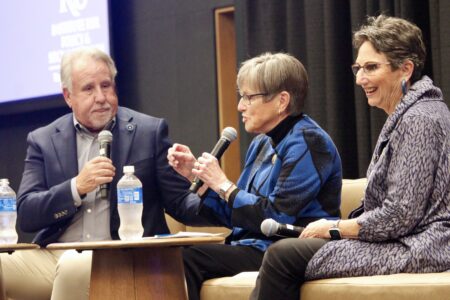
photo by: Dmitry Martirosov/Journal-World
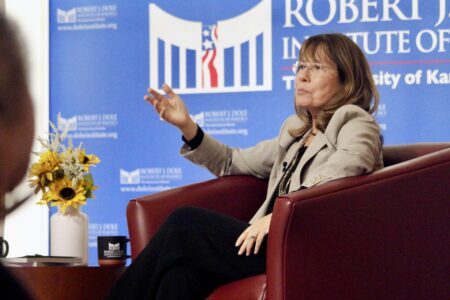
Gov. Laura Kelly, center, with Deb Miller, chair of the Kansas Turnpike Authority and Jim McLean, Kansas Public Radio senior contributor at the 2026 Kansas Economic Policy Conference at the University of Kansas Conference Center on Thursday, Oct. 29, 2026.
As she prepares to leave office after eight years, Kansas Gov. Laura Kelly on Thursday reflected on her tenure and offered advice on some the most pressing issues facing not only The Sunflower State, but the nation.
Property taxes, data centers, artificial intelligence and the current political climate were all top of mind for Kelly, who delivered her remarks at the 2026 Kansas Economic Policy Conference at the University of Kansas, where about 100 people were present.
Kelly, who is term-limited, echoed many of the same concerns others have about AI, property taxes and what the future holds for younger generations. She said people are “petrified” of the technology because of its uncertainty, and advised college graduates who are entering the workforce to embrace patience.
Kelly was elected governor in 2018 and reelected in 2022. Two state senators are vying to replace her in Tuesday’s election — Ty Masterson, a Republican, and Cindy Holscher, his Democratic opponent.
Property taxes — and how high they have gotten — were a major talking point on Thursday. Kelly, a Democrat, said one way to address the issue is through better partnerships between state and local governments. She said the state should pick up some of the burden that local governments are paying, such as corrections, mental health and public health services, and added that putting a law in place might also help alleviate the problem.
Property taxes are the largest combined state and local revenue source in Kansas, accounting for more than 30% of the total share, according to the Kansas Legislative Research Department. Kansas collected $6.6 billion in revenue from property taxes in fiscal year 2025, which is roughly one third of all local and state tax revenues collected that year. In 2025, Kansas brought in $323 million more in local tax revenue than it did during the previous year, an increase that was largely driven by higher revenues from property tax.
Annual property tax revenues continue to rise year over year, according to the legislative research department. In 2025, revenues rose 3.8% from 2024 and were about $1 billion more than three years prior.
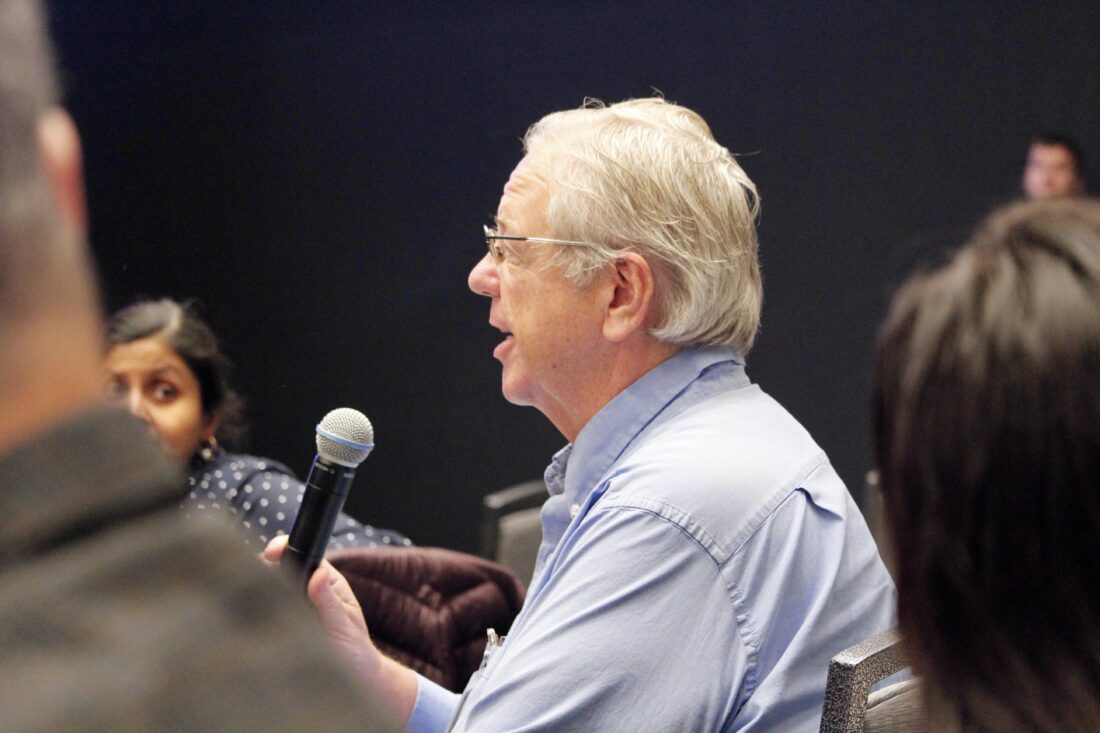
photo by: Dmitry Martirosov/Journal-World
An attendee asks Gov. Laura Kelly a question during the 2026 Kansas Economic Policy Conference at the University of Kansas Conference Center on Thursday, Oct. 29, 2026.
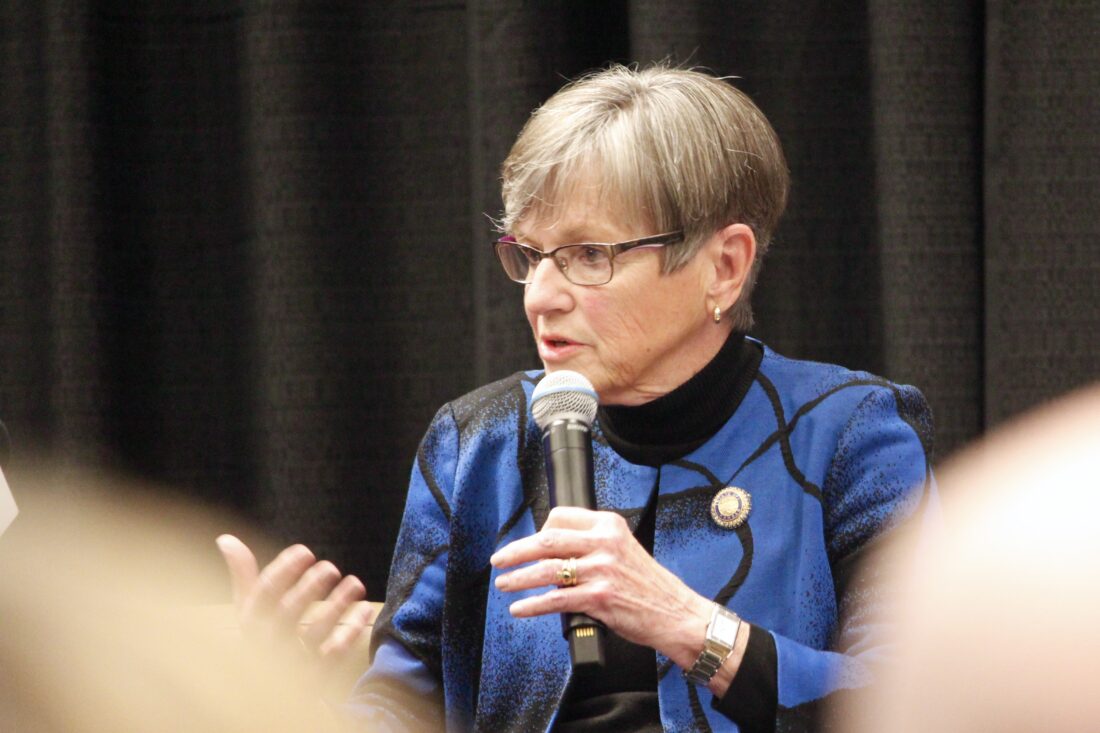
photo by: Dmitry Martirosov/Journal-World
Gov. Laura Kelly speaks during the 2026 Kansas Economic Policy Conference at the University of Kansas Conference Center on Thursday, Oct. 29, 2026.
Jim McLean, a correspondent at Kansas Public Radio and one of Thursday’s moderators, asked Kelly whether combining local districts into larger government units would be a good idea to grow their tax base. It would be difficult, Kelly said, and instead pushed for more incentives. She said lawmakers in those areas will likely receive pushback and will never vote to approve it.
“There has to be some structure (where) there is the burden on the state, but then also the responsibility on the local unit government to actually at least flatten, if not decrease, property taxes,” Kelly said.
Kelly on Thursday also acknowledged concerns around data centers. Their water and energy consumption should be considered, she said, and the cost generated by powering them should not be placed on everyday citizens, who should be the final arbiters on whether to allow them into their communities or not. She said data centers have become more of a political issue than anything else, and once the midterm elections are over things will hopefully slow down.
Speaking of the current political climate, Kelly didn’t mince words, calling it “polarized,” “ugly” and “nasty.” Responding to an audience member question about what would she advice the next governor, Kelly kept it simple: Be kind, she said.
“Whatever you’re doing is going to impact people in their real lives,” Kelly said. “Just be kind — and choose good.”
KU
Gov. Kelly talks property taxes, AI, data centers in conference on Kansas economy
‘We will respond with steadiness, not retreat’: KU’s Mafi highlights unprecedented times in higher ed in first State of Campus address
Former FDIC chair warns of AI bubble, another financial crisis during Lawrence visit

Girod concludes term in leadership role in nation’s top organization for research universities
KU Alumni honor 2026 Fred Ellsworth Medallion recipients
