New book to reflect on lessons from project that returned sacred boulder to Kaw Nation
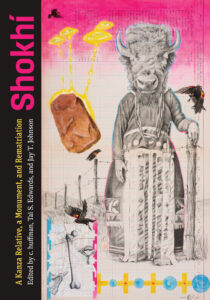
photo by: Contributed
The cover of upcoming book, “Shokhí: A Kanza Relative, a Monument, and Rematriation," is seen here. The book is a compilation of poetry, essays and other storytelling methods reflecting on the Sacred Red Rock Project, which returned a sacred 28-ton quartzite boulder from Lawrence to the Kaw Nation.
When Indigenous poet c. huffman and history professor Tai S. Edwards began working on a book describing the return of In’zhúje’waxóbe from Lawrence to the Kaw Nation, they did not know exactly who would make the cut.
Edwards and huffman had been a part of the Sacred Red Rock project, a multiyear effort to return the 28-ton red quartzite boulder from Lawrence’s Robinson Park to the Kanza people. It was officially returned to the Kaw Nation in April 2024. They were aiming to tell the story of what the rematriation process meant to people. Huffman said they were focused on letting the “land tell the story,” and eventually the right participants revealed themselves along the way.
Edwards and huffman, along with Jay T. Johnson, a KU professor of geology and director of the Center for Indigenous Research, Science and Technology, compiled the insights for the upcoming book “Shokhí: A Kanza Relative, a Monument, and Rematriation.” The book, which will be published by the University Press of Kansas on Aug. 26, is a collection that combines essays, poems, oral history and art to tell the story of the grandfather rock and the people who brought him home.
Edwards and huffman created a curriculum as part of the Sacred Red Rock project that almost became a prompt for people to reflect on the boulder’s journey. While they did not know all the “facets of the story” in starting the project, Edwards said the participants brought together many different histories, perspectives and ideas that allow a deeper conversation on Indigenous sovereignty and historic reflection.
“We didn’t know who would be in the text when we started it, but we learned it was the right people because of what we learned from them,” Edwards said.
One of the key lessons learned through the rematriation process, which officially started in October 2020 by the Kaw Nation General Council, was the importance of education for the community. Huffman said throughout the process, there were countless public forums and community meetings meant to share the history of In’zhúje’waxóbe, both in how it came to Lawrence and how that grandfather rock has been “known to our people for eons,” according to huffman.
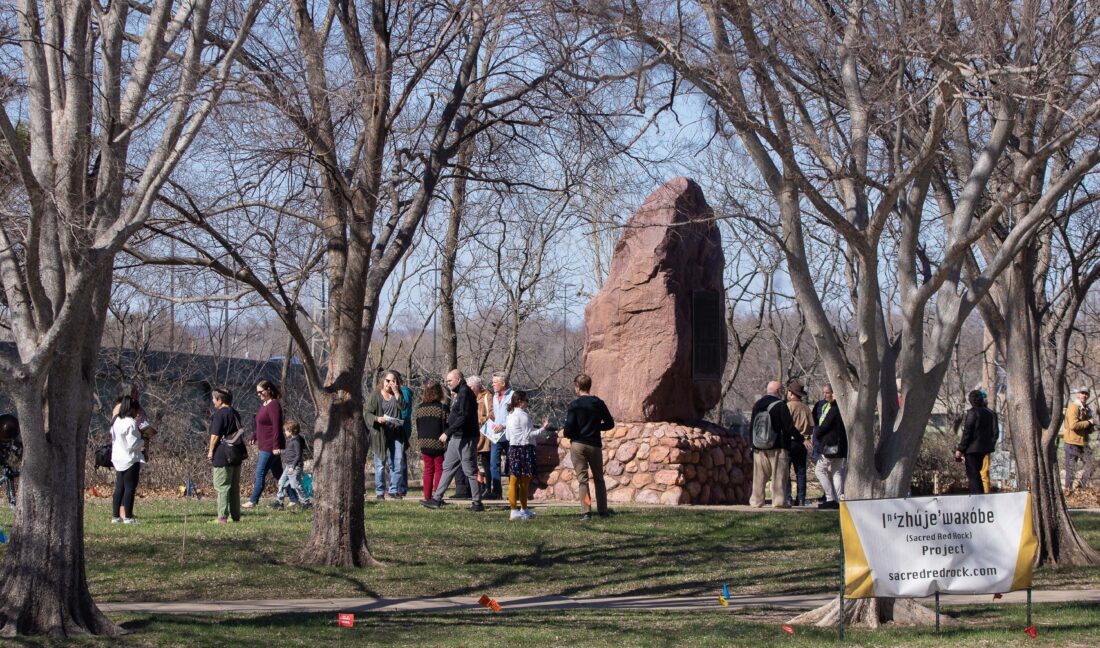
photo by: Mike Yoder
People visit Iⁿ’zhúje’waxóbe, which means “sacred red rock,” in Robinson Park on Saturday, April 1, 2023. Members of the public attended an informational event at the Lawrence Public Library on Saturday that focused on the long-running project to return the sacred boulder to the Kaw Nation. The $5 million, 30-month project is led by members of the Kaw Nation in collaboration with the City of Lawrence, University of Kansas, Spencer Museum of Art, Kanza Heritage Society and others.
Huffman, herself a member of the Kaw Nation, said she reviewed a middle school history textbook that had “barely half a page” about the Kanza people where Kansas got its name from — a fact she notes many Kansans aren’t aware of. Those educational opportunities helped explain the boulder’s significance to the Kanza people, but it also created more understanding across communities.
“My hope is for more education (efforts) because I think that’s how we get to know each other, and we help each other,” huffman said.
Many of the people whose works are featured in the collection were a part of the project already, but Edwards said other voices were not intimately involved with the work. Some Lawrence voices that feature in the project include local artist Dave Loewenstein, Joni Fornelli of Lavender House and Ursula Minor, the president of the Lawrence NAACP chapter.
Edwards said the essays highlight multiple intersecting histories. Minor’s chapter details the lynchings that occurred near Robinson Park in 1882, while Fornelli reflects on how the removal of the Kanza people happened one year before her immigrant ancestors moved to the land. The book also includes reflections from Toni Wheeler, the city attorney for Lawrence and an enrolled member of the Turtle Mountain Band of Chippewa. Edwards said she and huffman believe Wheeler wrote possibly the first ever formal apology by a city to a tribal nation in March 2021.
Through the research of the book, Edwards said the overall story was unique but also quite common. It is common that communities across the country have experienced cultural appropriation, colonization and violence; however, it is unique that a grassroots movement worked to return the boulder. Edwards said similar efforts for truth and reconciliation are taking place across the country and across the world, like the Canadian Truth and Reconciliation Commission aiming to document the impact from the country’s residential schools, but American scholars suggest that reconciliation or rematriation is better “at the local level.”
“People are most invested in their local community and most able to make change there,” Edwards said. “That grassroots direction is often more successful than necessarily a federal thing pushed down (on people).”

photo by: Chris Conde/Journal-World
The red prayer boulder is shown Tuesday morning, Aug. 15, 2023, after being lifted from its base at Robinson Park.

photo by: Mike Yoder
The relocated Iⁿ’zhúje’waxóbe is pictured Friday, April 12, 2024, in Allegawaho Heritage Memorial Park just southeast of Council Grove. In the background is the park’s Kanza dance arbor used for intertribal powwow dances and activities.
Huffman agreed, but said it is important that the efforts are Indigenous-led, like the Sacred Red Rock Project. Although efforts for returning In’zhúje’waxóbe had gone on a long time — Edwards noted Jim Pepper Henry, a Kaw Nation member involved with the project spoke with the Journal-World about the efforts in the 1990s — it would be hard to have reconciliation without first creating a relationship that had “good ground to stand on in the first place,” huffman said. That understanding explains why the community meetings that educated the public on this history were crucial to help others recognize that this process “isn’t about losing anything,” but instead “getting to know each other … without fear.”
Edwards said the grassroots efforts like the return of In’zhúje’waxóbe end up building key community relationships that become beneficial for everyone involved. Edwards said people often describe these moments not as a loss of a monument, but as a gift.
As “Shokhí” details how this local effort produced a successful outcome, Edwards and huffman said it does not mean the story is over. Edwards hopes these reflections can highlight how these efforts are possible, but this story should not be “a one time thing.” She hopes there is continuing effort to find ways to correct historical wrongs while commemorating local history.
“(Returning the rock) is something our community should be really proud of, but (the work) is not finished,” Edwards said.
“Shokhí: A Kanza Relative, a Monument, and Rematriation.” will be available for purchase in September 2026, according to the University Press Kansas. For more information about the book and author events happening in Lawrence, including a reading on Oct. 13, at the Haskell Indian Nations University Auditorium, 115 Indian Ave., you can visit the press’ website, kansaspress.ku.edu.

photo by: City of Lawrence
In ́zhúje ́waxóbe is pictured in its current location in Robinson Park.
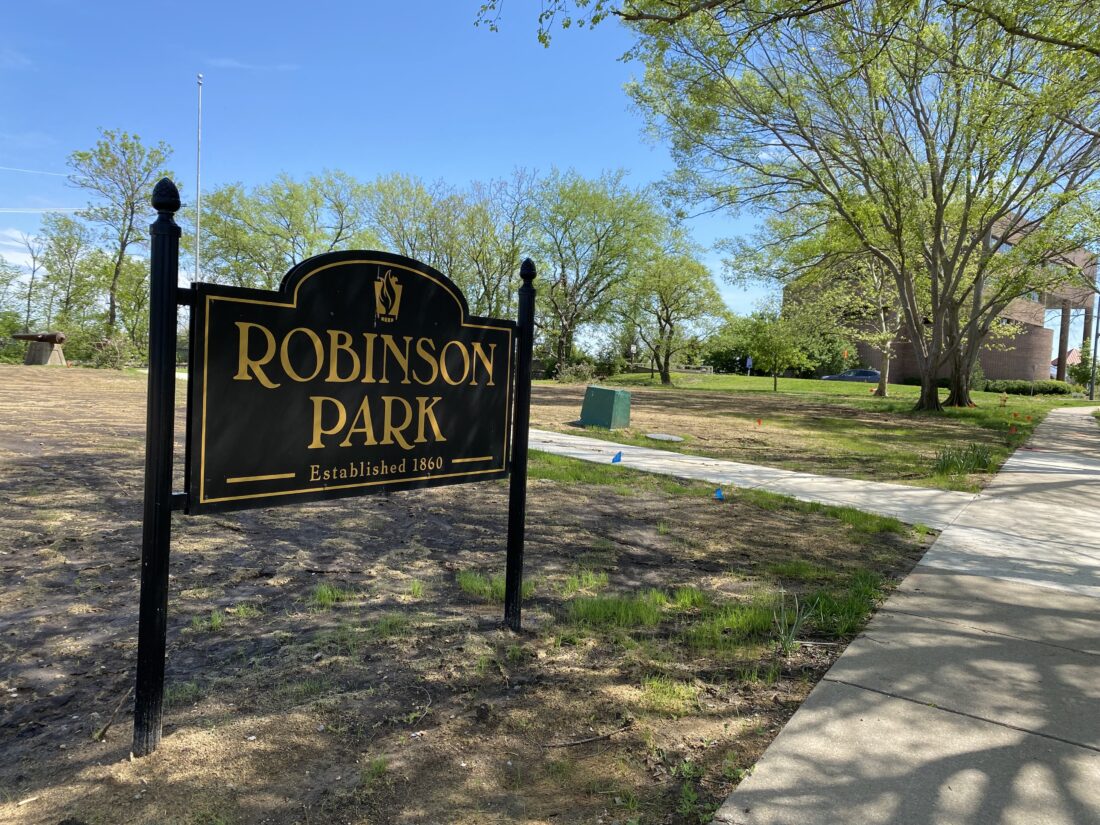
photo by: Austin Hornbostel/Journal-World
Robinson Park, located near the intersection of Sixth and Massachusetts streets, is pictured Friday, April 19, 2024.
Arts and Entertainment
Duane ‘Keffe D’ Davis gets 40 years to life for orchestrating Tupac murder
RJ Mitte, ‘Breaking Bad’ actor and disability rights champion, dies at 34
Thanks to a nonprofit that pairs artists and landlords, the Lawrence Potters’ Guild gets a temporary space of its own
Go, See, Do: Library book sale, candidate forum and more
From a German pulpit to an indoor pool, old church building brings new visitors to downtown Eudora