

Patrick Stewart, legendary actor of ‘Star Trek’ and ‘X-Men’ fame, dies at 86
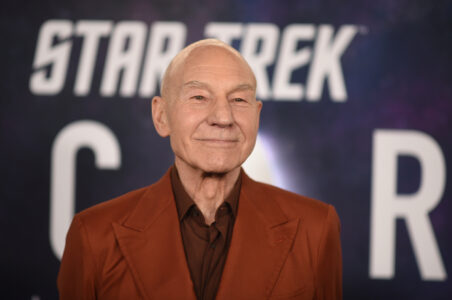
FILE - Patrick Stewart arrives at the premiere of the third and final season of "Star Trek: Picard" on Feb. 9, 2023, in Los Angeles. (Photo by Richard Shotwell/Invision/AP, File)
Patrick Stewart, the classically trained actor who added Shakespearean gravitas to the “Star Trek” and “X-Men” franchises, has died. He was 86.
Stewart died Wednesday in Los Angeles, following “a brief and poignant journey” with Alzheimer’s disease and Lewy Body Dementia, spokesperson Kelly Bush Novak said. Stewart’s diagnoses had not been previously disclosed.
“We lost one of the greats of stage and screen today,” Hugh Jackman, a frequent Stewart co-star in the “X-Men” universe, said on social media. “And, in my book, a tremendous friend and man. I learned so much from him. I will miss you, Patrick Stewart, all of my days.”
While best known as Professor Charles Xavier and Captain Jean-Luc Picard from the “X-Men” and “Star Trek: The Next Generation” series and films, Stewart spent more of his career onstage than in the X-Mansion or on the USS Enterprise.
Besides playing everyone from Claudius to Macbeth, he often performed a one-man rendition of “A Christmas Carol” and did West End and Broadway runs of Harold Pinter’s “No Man’s Land” and Samuel Beckett’s “Waiting for Godot” in repertory with buddy Ian McKellen.
He achieved some of the best reviews of his career when he finally tackled Macbeth for the first time. The production, under the direction of Rupert Goold, debuted in May 2007 at England’s Chichester Festival Theatre, switched to London’s West End and then moved to the Brooklyn Academy of Music before transferring to Broadway in 2008.
Stewart’s performance earned him his sole Tony Award nomination. The Times of London said his Macbeth was “an enthralling creation of frailty, appetite, egotism and grim humor.” The Daily Telegraph said he had turned in “a truly great performance” and The New York Times said it was “a must-see.”
“Nearly 50 years I’ve waited,” Stewart told The Associated Press in 2008. “I learned it when I was 14. I memorized all the soliloquies just because I thought they were great. And they stuck, so I didn’t have to learn those bits of the play, which is a blessing, because learning lines has now become the one curse of this job.”
EARLY LIFE
Raised in Mirfield in Yorkshire, a working-class corner of northern England, the future 24th- century commander of a starship grew up without a bathroom in his house. He had been bald since he was 19 — alopecia runs in his family.
His father, a former regimental sergeant major in the British Army, was prone to outbursts of “repeated violence against my mother,” as Stewart wrote in a newspaper piece. “Violence is always a choice a man makes and he alone is responsible for it.”
In his memoir, “Making It So,” Stewart wrote about how he and his older brother Trevor braced for the nights when their dad came home drunk and angry, and attacked their mother. “Sometimes it was with an open hand, other times a closed fist. Always he aimed for her head.”
The son would later become a patron for Refuge, an organization that provides shelter for domestic abuse victims.
THE ROAD TO PICARD
Stewart was accepted into the Royal Shakespeare Company and stayed for 14 years, playing everything from Mark Antony to Henry IV to Shylock to Oberon. “People who were not in the company would say to me, ‘Give it a break. Why don’t you go somewhere else?’ And I would say, ‘To do what?'” he told the AP. “Telly?”
Stewart eventually left to look for more varied work, including the 1981 film “Excalibur.” He had just done a production of “Who’s Afraid of Virginia Woolf?” in 1987 when an interesting offer came along. “I found myself in Hollywood shooting a syndicated science fiction series, which I was assured would fail.”
It didn’t, of course. Thanks to Stewart’s rich baritone and noble bearing, the “Star Trek” franchise ran for seven years, 178 episodes and produced four feature films. He was known for his slogan “Make it so.”
His adoration for Shakespeare would serve him well when he began to play Jean-Luc Picard, a 24th century starship commander.
“There is a formality to the way they speak and comport themselves that remind me of numerous Shakespearean situations I’d been in onstage. I should play Jean Luc, I realized, as if he were a character in ‘Henry IV,’ which is about brave men,” Stewart wrote in his memoir.
Despite the Borg and Klingons, Stewart still managed to make room for blank verse. He established the Paramount Shakespeare Company, a workshop on Saturday and Sunday mornings for any actor interested. (Stewart revisited Picard in the TV series “Star Trek: Picard.”)
Stewart died just a few days after Walter Koenig, another “Star Trek” icon, who played Ensign Pavel Chekov on the original NBC TV show from 1966 to 1969.
“What a heartbreaking week it has been,” William Shatner, who played Captain James T. Kirk in the franchise, wrote on Instagram. “Sir Patrick Stewart was a friend, a colleague, and a magnificent actor. From the stage to the bridge of the Enterprise, he brought intelligence, grace, and a deep sense of humanity to everything he did.”
Arts and Entertainment
Patrick Stewart, legendary actor of ‘Star Trek’ and ‘X-Men’ fame, dies at 86

Go, See, Do: Trick-or-treating, Blintz Brunch, performances and more
‘One of a kind’: Sale at the Lawrence Arts Center will find new homes for late musician’s unique custom guitars
Go, See, Do: KU homecoming, Halloween happenings and other events

Theatre Lawrence’s ‘LIZZIE’ puts a Riot Grrrl edge on infamous ax murders