

Farmland’s legacy: How what used to be the largest farmer-owned co-op left contaminated sites in Lawrence and beyond

photo by: City of Lawrence
A portion of the former Farmland Industries fertilizer plant is seen in this City of Lawrence photo from 2021.
For almost 50 years, the eastern edge of Lawrence was home to a plant that helped fuel America’s agricultural boom.
Today, there’s been a lot of activity at the former nitrogen plant site. It is being transformed into an industrial park and a future city campus — but beneath the new development are the remnants of its fertilizer-making past.
What was left behind remains a cleanup challenge, despite the city already removing hundreds of millions of gallons of contaminated groundwater. The cost of remediation efforts have already exceeded $10 million, with another $10.5 million projected to be spent over the next five years.
The former plant was operated by Farmland Industries Inc., and it was situated on the eastern edge of Lawrence, just east of Highway 10. The plant operated from 1954 to 2001, and contaminated soil and groundwater with high levels of nitrogen and ammonia, the primary building blocks of synthetic nitrogen fertilizers.
The Lawrence plant shut down due to the downturn in the U.S. fertilizer market and after Farmland Industries faced significant long-term financial struggles. Those challenges resulted in the company going bankrupt shortly after the plant’s closure.
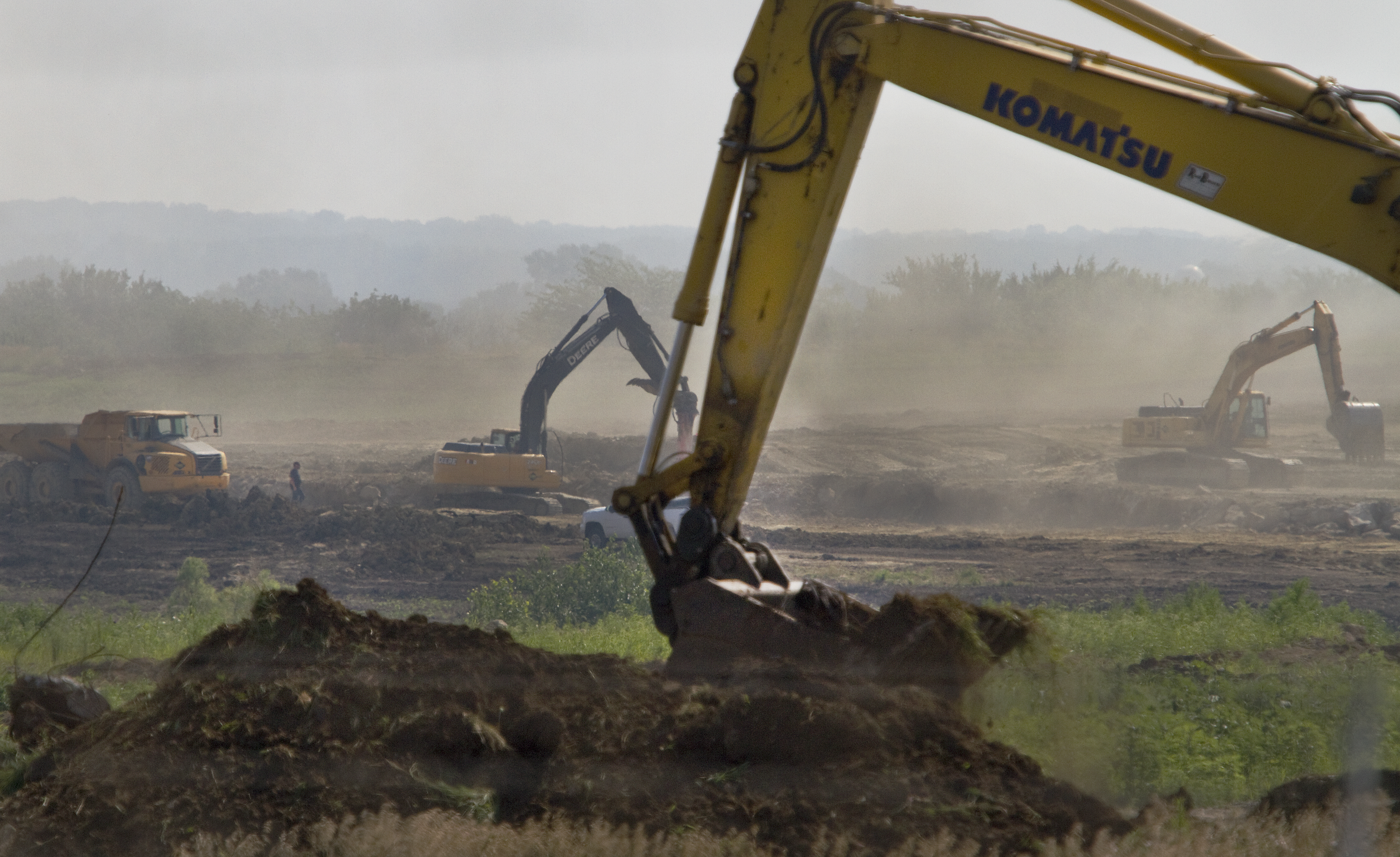
photo by: Mike Yoder
Clouds of dust are kicked up by trucks and bulldozers excavating at the site of the former Farmland Industries nitrogen fertilizer production plant in 2013 on K-10 just east of the city.
The Lawrence site has evolved significantly since the city acquired the property in 2010. Today, it is home to the Lawrence VenturePark industrial business park and will soon include the city’s new $130.1 million Municipal Services and Operations Campus.
However, the city is still working to address the Farmland contamination left behind — and the cleanup is far from complete.
Meanwhile, the Journal-World learned that Lawrence was not the only community affected by the operations of what was once the largest farmer-owned cooperative in North America.
It turns out, Farmland Industries operated anywhere from steel fabrication all the way to agricultural chemical manufacturing facilities throughout Kansas and Missouri. And a lot of those communities are still picking up the pieces. One of those former plants is even part of a larger, highly contaminated area designated as a Superfund site by the Environmental Protection Agency for cleanup.
Pollution and money spent
Remediation efforts have reduced pollution at the Lawrence site, however, the cleanup has required continuous groundwater recovery, ongoing monitoring, and so far, millions of dollars in public and trust funding.
The city and the Kansas Department of Health and Environment told the Journal-World that 655.5 million gallons of contaminated water have been pumped off of the site by recovery wells since 1997. In addition, it’s estimated that 38.5 million gallons have been discharged since April 2020 to be treated at the Kansas Wastewater Treatment Plant.
It’s estimated 162,647 pounds of nitrate and 23,710 pounds of ammonia have been removed from the groundwater at the site.
After Farmland Industries went bankrupt, a trust was formed with $8.5 million funded to address the environmental impacts at the site. The city said it has spent $7.5 million of the trust funding as of the end of 2025. Jeff Scott, the city’s environmental remediation manager, said that doesn’t mean there’s only $1 million left in the trust, as the account earns interest over time.
“Those dollars can only be spent on remediation activities, so they can’t be spent for anything else within the city,” Scott said.
In addition, cleanup efforts have been funded with the city’s Capital Improvement Plan. As of the end of 2025, the city has spent $2.7 million from the CIP, and according to the city’s latest capital plan, $10.8 million in costs is outlined to be spent from 2027 through 2031.
The city said it doesn’t have an estimate for the total future costs or the exact amount of contamination remaining at the Farmland Industries site.
However, according to 2022 documents reviewed by the Journal-World, the highest concentrations of nitrogen and ammonia have fallen substantially since remediation began — but concentrations are still high compared to regulatory standards. For example, the residential groundwater standard for nitrate is 10 milligrams per liter. Ammonia has no established drinking water standard.
The historical maximum concentrations documented in wells at the site were 33,300 mg/L for nitrate and 51,640 mg/L for ammonia. In 2022, those maximum concentrations reported in wells decreased and were 18,700 mg/L for nitrate and 22,500 mg/L for ammonia.
“Cleanup is ongoing and is dependent upon changing site conditions, regulatory requirements, and long-term monitoring data,” Michael Leos, a city spokesperson, said via email. “We continue to evaluate the site through monitoring of the groundwater network and are confident in the selected remedial strategy.”
Remediation plan changes
The highest reported groundwater concentrations of nitrate on the former Farmland Industries site can be found right underneath where the city’s new Municipal Services and Operations Campus is currently being built.
The MSO campus plays an important role in the city’s remediation efforts at the site. The campus buildings and parking lots will provide a capping mechanism for limiting infiltration of rainfall into the contaminated soils. Additionally, there will be an improved stormwater sewer system designed to route contaminated runoff to containment ponds and non-contaminated runoff to a nearby regional detention pond.
“The campus plays a big role in one of our strategies out there. It’s kind of a capping mechanism,” Scott said. ” … We’re doing a containment plus some cleanup as well.”
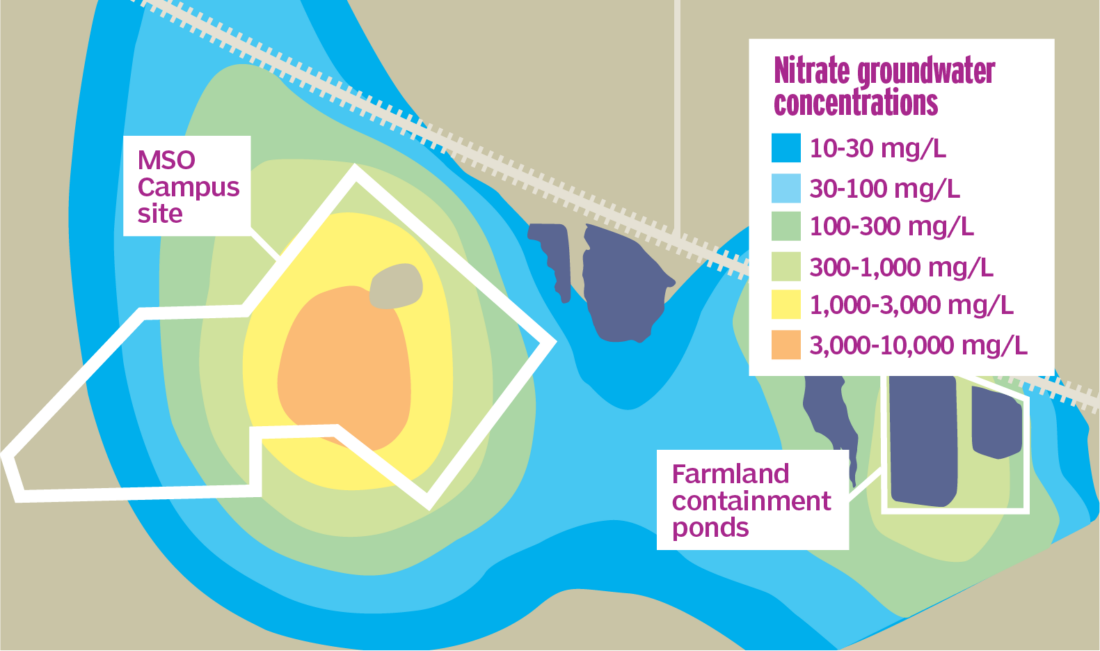
photo by: Sylas May/Journal-World
This map demonstrates where the city’s new Municipal Services and Operations Campus will go on the former Farmland Industries site. The outline is from a Lawrence City Commission presentation in 2024. The colors reflect the levels of nitrate groundwater concentrations in 2006, reported by engineering company GHD.
The site will also eventually implement phytoremediation – where vegetation will uptake the nitrogen as well as reduce the amount of rainwater that would carry the nitrogen compounds down into an aquifer, Trevor Flynn, the city’s assistant director of environment, health, science & treatment operations functions, said.
“It’s going to just kind of add a little bit more contingencies to that containment of what’s on site as well as (absorbing) the nitrogen,” Flynn said, adding that it will speed up the process of naturally removing the nitrogen through vegetation.
While these are the current plans for remediation at the site, they’re different to what the city was doing when it first acquired the property, Scott said.
“The two main components of that was extracting contaminated groundwater and using that in a land application system,” Scott said. “We would send water to the farm ground and apply it as supplemental fertilizer for that … Then, (in 2017) that land application system kind of became unsustainable just because we were collecting more water on the site than what we could apply to farm ground.”
Scott said that led to an emergency discharge of approximately 30 million gallons of nitrogen-containing water into the Kansas River over a period of five months, as the Journal-World reported.
“That kind of spurred the city to kind of rethink our remediation plan out there and come up with a new, more long-term, sustainable plan,” Scott said.
Other communities
The Lawrence site is not the only former Farmland property to face contamination concerns. Documents obtained by the Journal-World from Kansas and Missouri environmental regulators detail similar issues at several other former Farmland Industries Inc. sites, and many of them didn’t include fertilizer production.
One of those sites is a former Farmland metal fabrication facility in Hutchinson, Kansas, where the company manufactured steel buildings, grain bins, livestock feeders and other farm equipment between 1959 and 1986. The property became part of the larger Obee Road Superfund site after investigations found groundwater contamination from trichloroethene, an industrial solvent commonly used to degrease metal parts, as well as other pollutants.
While a remedy strategy has been implemented at the Farmland-Obee site and it is actively being monitored, the most recent five-year review also identified PFAS, or “forever chemicals,” in groundwater samples collected in 2023 and 2024. Even though the source of the PFAS contamination is unidentified at this time, the site’s history of multiple industrial operations could provide plausible sources.
The Journal-World reached out to the City of Hutchinson for comment about remediation efforts, and the city’s spokesperson said their attorney has declined to comment.
In addition, Farmland operated a chemical plant – known today as the Omnium LLC facility – in St. Joseph, Missouri, producing pesticide, herbicide, insecticide, and fungicide products. A variety of hazardous wastes were produced as part of the facility operations from the 1960s to 1995.
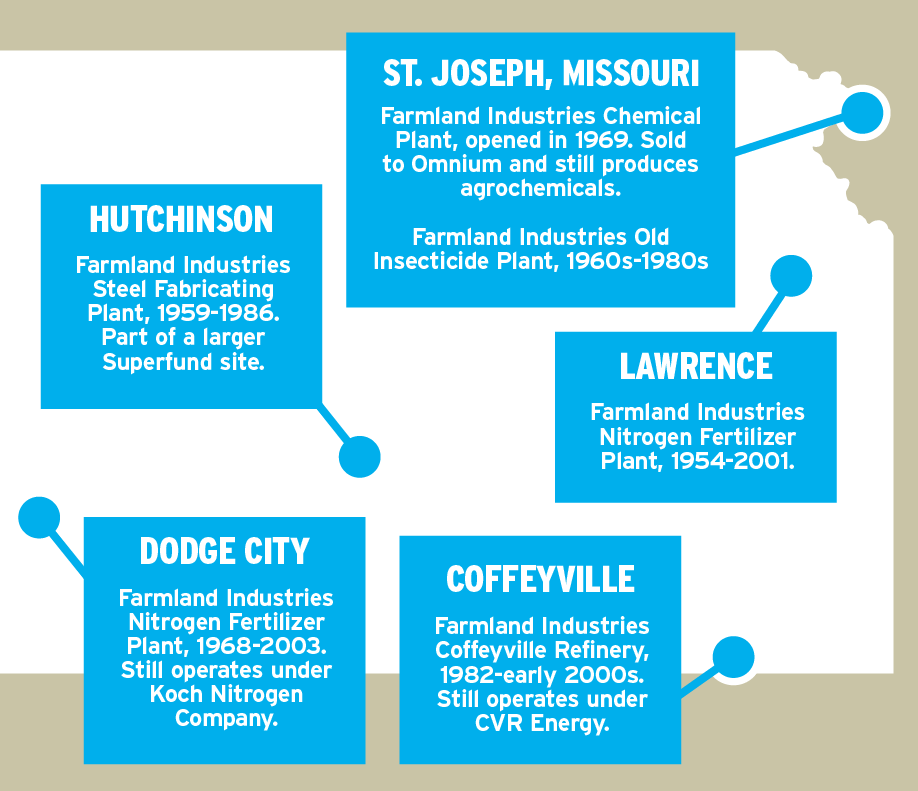
photo by: Sylas May/Journal-World
This map of former Farmland Industries Inc. properties includes the sites that have required remediation and clean up efforts by local, state and/or federal regulators after contamination was discovered.
The Missouri Department of Natural Resources became involved with the site after the Resource Conservation Recovery Act – the primary federal law in the United States governing the disposal of solid waste and hazardous waste – was passed. This law required companies to obtain a permit if they were going to produce hazardous waste.
“A lot of facilities decided that they didn’t really want to go through this whole rigmarole,” Abby Sawyer, an environmental engineer with the department, said. “So essentially they said, ‘We’re not going to do a permit. We’re just going to shut down, and we’re going to kind of go into a corrective action sort of pipeline.'”
Because multiple chemicals were detected in groundwater at levels exceeding applicable cleanup standards, MDNR began collecting additional data to guide decisions about the site’s cleanup. Sawyer said that work is still underway, and additional monitoring wells were installed last year to determine whether contamination is moving beyond the site and toward the adjacent Missouri River.
Sawyer said this data from the new wells will need to be collected over the next few years, then it will help inform a final remediation plan for the site – over 30 years after Farmland stopped operations there.
With Omnium using the facility while remediation efforts continue at the site, Sawyer said the company only temporarily stores hazardous waste in drums on the property, then it’s taken to another location to be disposed of.
“Because they don’t have any long-term storage or treatment, we’re not as worried about anything happening, just because there aren’t drums sitting there for a long period of time,” Sawyer said.
Moving forward
Jill Bronaugh, the spokesperson for the KDHE, said the city communicates with KDHE whenever there is activity at the site, particularly when projects require impacts to soils or involve property parcels along the southern edge of the site that are now part of Lawrence VenturePark.
She said KDHE also maintains communication with a private well owner to ensure the well is sampled and that residents receive the results so they know their water is safe for use.
That private well owner is receiving bottled water after high levels of nitrogen were found in the well water. Scott said that while the levels of nitrate in the private well water have been below the 10 mg/L threshold, the city will continue providing bottled water to the property owners.
“The city will continue to provide an alternate drinking water source to this nearby private residence until authorization is received from the (KDHE) to discontinue this service,” Scott said.
The city’s work at the site has been closely coordinated with KDHE as officials continue to evaluate cleanup efforts while supporting future redevelopment.
“The City of Lawrence and KDHE continue to work together to show that redevelopment is possible within areas of environmental concern that can be protective to both human health and the environment, as well as economically beneficial.” Bronaugh said via email.
Although the cleanup process has taken years, Scott said the additional time has allowed the city to develop a more comprehensive plan for addressing contamination at the site.
“A project of this scale takes time,” Scott said. “But it’s allowed us to build a sustainable, long-term remediation strategy that protects public health and the environment while providing a beneficial use to the former Farmland site.”
Other News

‘One of a kind’: Sale at the Lawrence Arts Center will find new homes for late musician’s unique custom guitars

Go, See, Do: KU homecoming, Halloween happenings and other events

Student-run coffee shop opens at Community Connections at Pinckney, teacher receives surprise $1,000 award
‘This is for all of us’: Midco Prairie, an oasis of native plants in downtown Lawrence, opens to the public
Douglas County commissioners express interest in fireworks sales dates that include a weekend
