
Lawrence’s first bike lanes with physical barriers are installed on Ninth Street
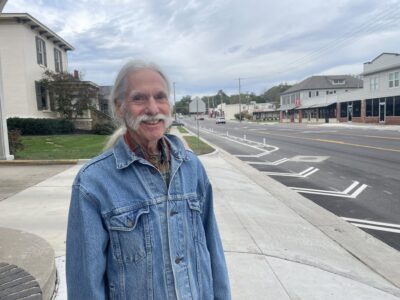
photo by: Sylas May/Journal-World
Michael Almon, leader of the Sustainability Action Network, stands beside the new protected bike lane on Ninth Street on Monday, Oct. 19, 2026.
It was on Ninth Street in the 1990s, Michael Almon remembers, that a movement for bike safety began in Lawrence – and it began with a tragedy.
Almon, leader of the Sustainability Action Network, recounted it on Monday morning: how, in 1998, Jon Hermes was riding his bicycle at Ninth and Mississippi and was struck and killed by a dump truck. It happened right in front of the Community Mercantile, which was then located in the building that now houses Cork & Barrel, and people there wanted to do something about it.
“As you can imagine, quite a few of those people were bicyclists or would like to be if they felt it was safe,” he said. So, a petition was started, and it got hundreds of signatures asking the city for bike safety improvements.
Today, Ninth Street is once again at the center of Lawrence’s bike safety efforts – but this time, it’s not because of a tragedy. It’s because Ninth is a testing ground for what bike-safe streets in Lawrence could look like in the future.
This week, the first physical barriers for bike lanes in the City of Lawrence were being installed on Ninth, between Illinois and Kentucky streets. They look like rows of small poles and zebra-striped humps, and Almon said they’re designed to be reflective and to deflect the tires of any cars that bump into them.
On Monday morning, the barriers had been installed on the south side of the street, and crews were working to put them in on the north side. Soon, Almon said, the gaps in the barriers where cars can turn into parking lots will be painted over in green, similar to how bike lanes on Massachusetts Street are currently painted at intersections.
And, at the southwest corner of Ninth and Mississippi, there’s a sign that marks this place as the Jon Hermes Memorial Bikeway.
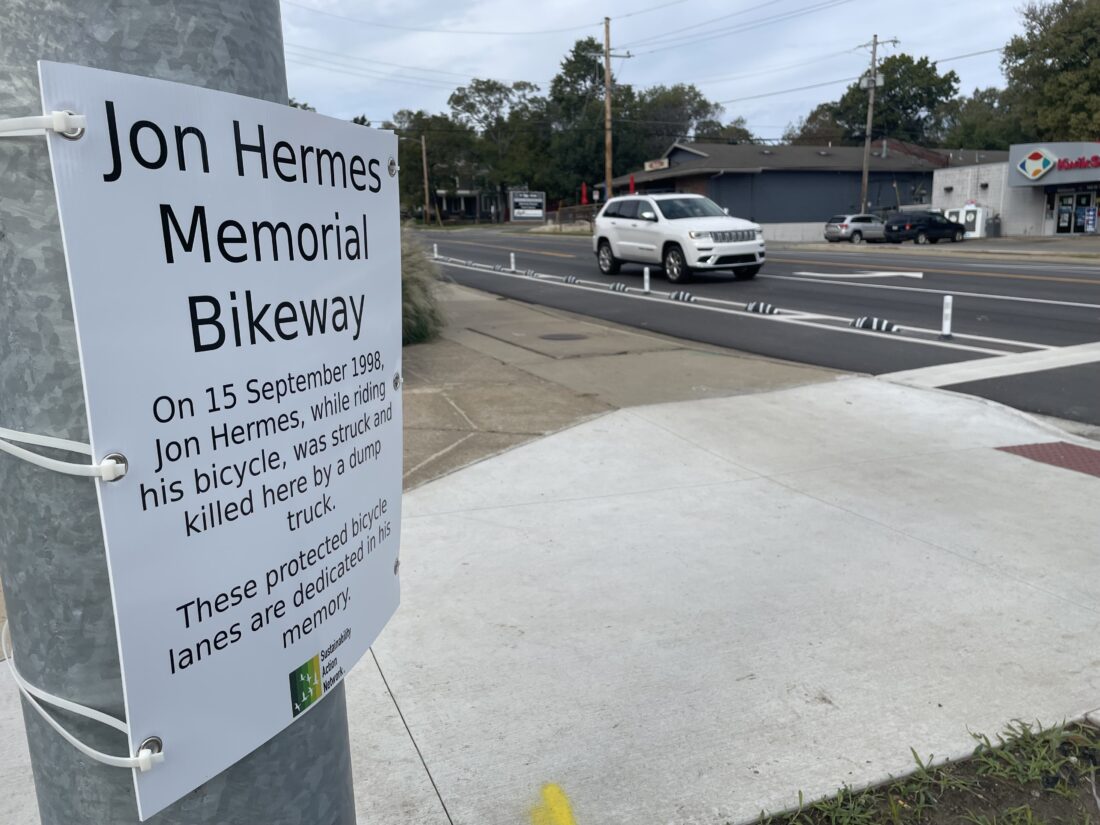
photo by: Sylas May/Journal-World
A sign on Ninth Street marks the bike lanes there as the Jon Hermes Memorial Bikeway on Monday, Oct. 19, 2026.
Almon said that Ninth had set the pace for bike safety improvements in Lawrence before. He remembers the old painted lanes on Ninth Street as the city’s first. “The very first [incidence] of bicycle lanes here in Lawrence, here on Ninth Street,” he told the Journal-World.
Based on old city documents and meeting minutes, it does look like there were a few bike lanes in Lawrence before them, but they weren’t a common sight.
In 1999, after advocates urged the city to act on bike safety, the city did a study with consultant Transystems and drafted a “Bicycle Work Program,” and this involved an inventory of local bike routes. The inventory found there were 1.25 miles of “on-road, marked bicycle lanes” in the city at that time: one stretch on Louisiana Street and one on Wakarusa Drive.
Ninth definitely was among the projects being proposed at that time, but people didn’t think it was feasible at first. Minutes from an August 1999 meeting of the Lawrence-Douglas County Metropolitan Planning Commission state that bike lanes were evaluated for Sixth and Ninth streets, but that they weren’t practical there “because of the high volume and speed of traffic.”
Eventually, though, Almon said the city committed to add bike lanes to Ninth the next time the street was repaved. That repaving didn’t happen until 2009, and when it did, Almon said, the plan for the striping on the road didn’t include the lanes that were promised.
So his organization asked the city why: “You know the history here, you know what your policy is, you’re supposed to be putting in bicycle lanes here; why not?
“And they said, ‘Well, there’s no room.'”
He thought the city could make room by removing the parking that was then on the south side of Ninth, which Almon said was hardly ever used. And the city agreed. It went back and redesigned the striping, and the bike lanes debuted in July 2009, as the Journal-World reported.
Even with the painted lanes, though, Almon said there were few cyclists using that stretch of road.
He said the same thing happens on other major streets with painted bike lanes: 19th Street, 15th Street, Wakarusa. “Rarely does a bicyclist use those bicycle lanes. When you have traffic at 45, 50 mph zipping past, people don’t feel safe.” And that’s especially true, he said, for “the average bicyclist, the family bicyclist.”
On Monday morning, with the new lanes in place, there was a cyclist on the north side of Ninth riding on the sidewalk instead of the marked lane on the street.
While cyclists are legally entitled to ride on the sidewalk, Almon said it can be unsafe there, too, both because of poor-quality pavement and because cyclists need to look out for pedestrians. A dedicated lane gives them the choice to avoid that, if it feels safer and more comfortable for them.
“The more choices you have as a bicyclist, the more likely you’re going to bicycle,” Almon said.
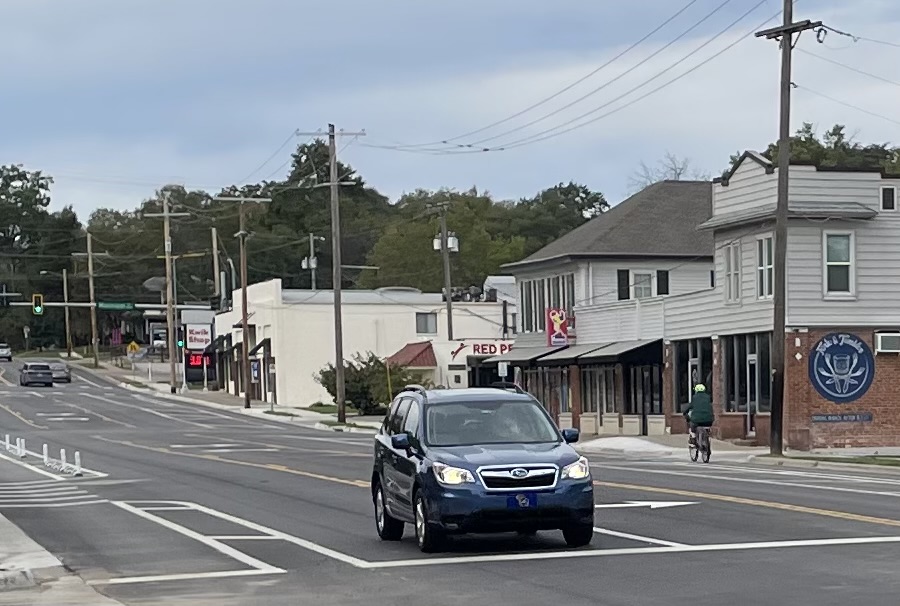
photo by: Sylas May/Journal-World
A cyclist rides on the north side of Ninth Street on Monday, Oct. 19, 2026. The lane on the north side hadn’t yet had its physical barriers installed.
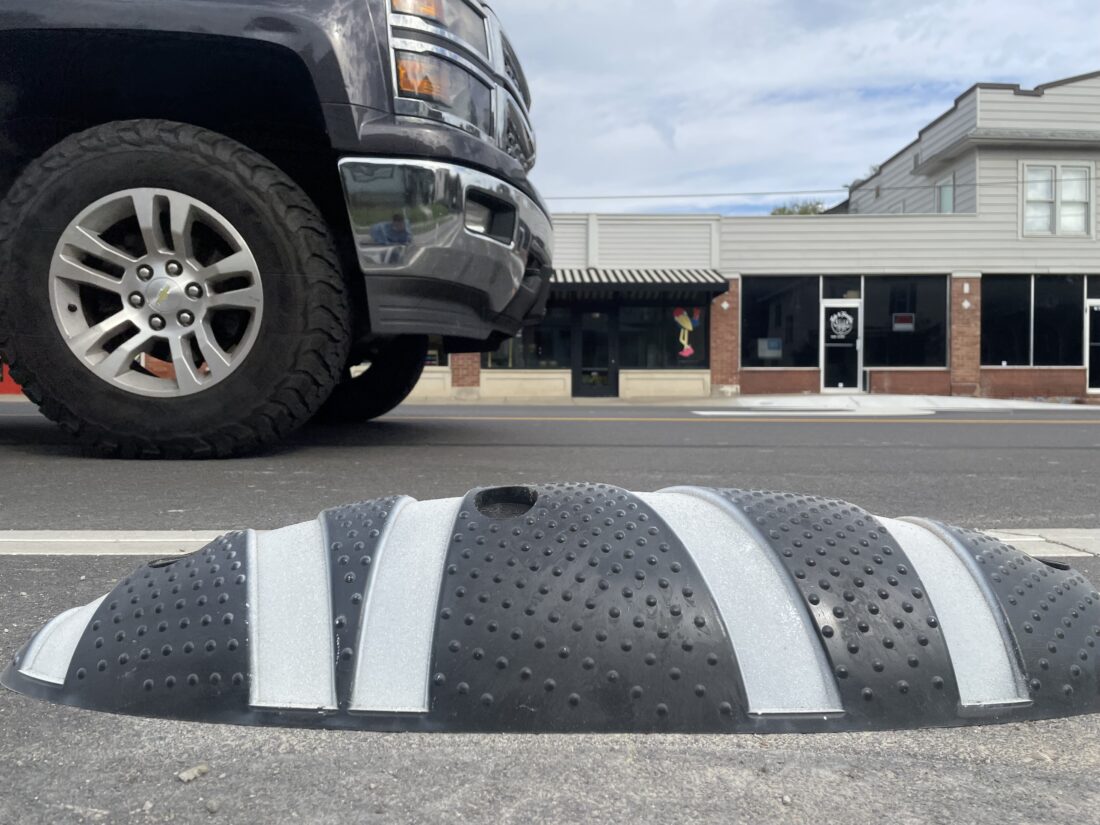
photo by: Sylas May/Journal-World
One of the striped dividers for the bike lane on Ninth Street is pictured on Monday, Oct. 19, 2026.
And the barriers on Ninth could be an important test run as the city works to expand cyclists’ options on other streets.
That’s because the City Commission has repeatedly signaled that it will be looking at the Ninth Street project and the reconstruction of southern Massachusetts Street to see how well protected bike lanes and lane reductions for cars are working.
Earlier this month, the commission approved the new Lawrence Bikes Plan, which includes a survey of hundreds of Lawrence bicyclists that shows strong support for protected lanes. But commissioners said they still needed more data before they could consider bike infrastructure on Kentucky and Tennessee streets, which is something Almon says is badly needed.
“Those two streets, typically called a paired couplet, they are some of the more dangerous streets in Lawrence, as well,” Almon said. He noted that the bikes plan identifies parts of Tennessee as high-injury areas, but doesn’t have them on its “priority networks” that guide funding decisions for dedicated bicycle infrastructure projects.
“It seems kind of ironic that they didn’t include that,” Almon said.
There are also things the city could do for cyclists that don’t involve reconfiguring roads. Almon said the most important thing was really reducing drivers’ speeds. He’s advocated for 20 mph limits in residential areas, and he said reducing the limits by 5 mph on arterial and collector streets would help, too: “Slower speed limits is safer on any street.”
As for the infrastructure, he’s “absolutely” optimistic that more projects are coming.
“Based on the history of other communities who’ve been way in front of Lawrence in doing this, the principles for the safety of bicyclists has been proven all over the place,” Almon said. “And Lawrence seems to think they can’t learn from others; they have to do it themselves and figure it out on their own.
“But, whatever it takes, if they can come to that conclusion, OK.”
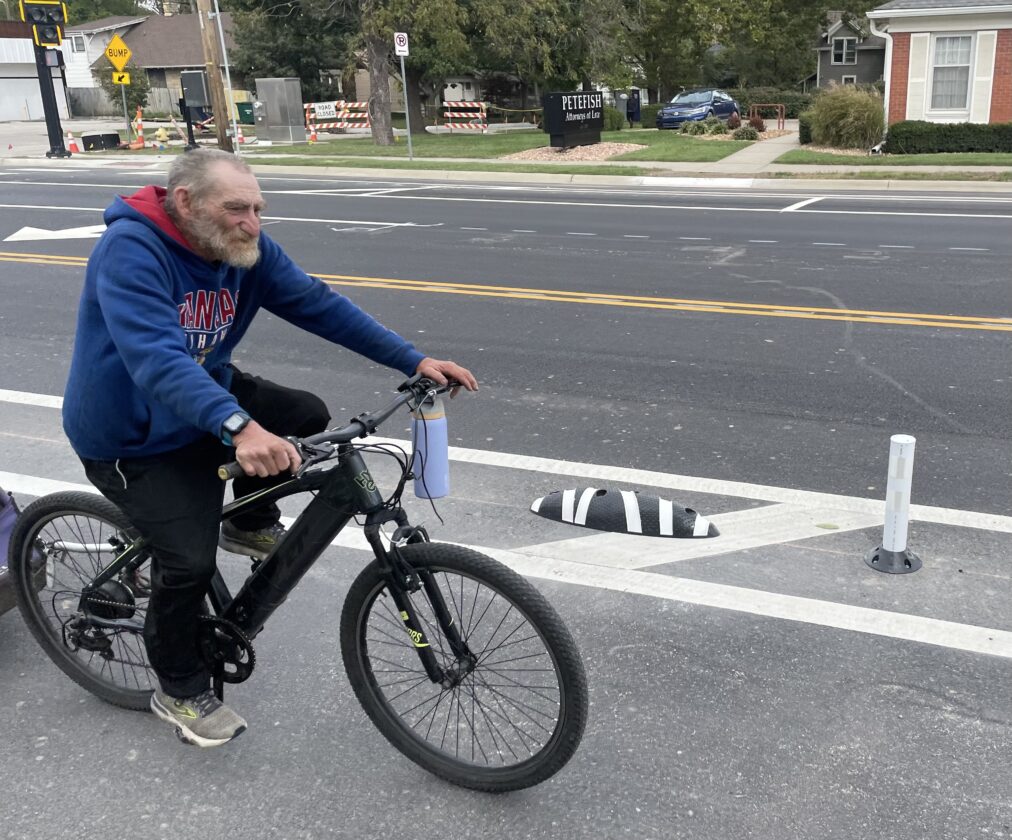
photo by: Sylas May/Journal-World
A cyclist rides down the new bike lane on Ninth Street on Monday, Oct. 19, 2026.
City Government
Lawrence’s first bike lanes with physical barriers are installed on Ninth Street
Opinion: Don’t give up on trying to use Costco to take tens of millions of dollars from the state of Kansas
Abandoned housing pilot program, data center rules, funding clawback for Bert Nash project on City Commission’s agenda
KU professors, middle school band director, radio personality among this year’s Phoenix Award honorees: ‘It’s a cool mix’
Housing Stabilization Collaborative’s request for city trust fund aid won’t be considered because it was filed late