

Opinion: How we pick the mayor is up for discussion again, but Lawrence’s DNA may not even want a mayor
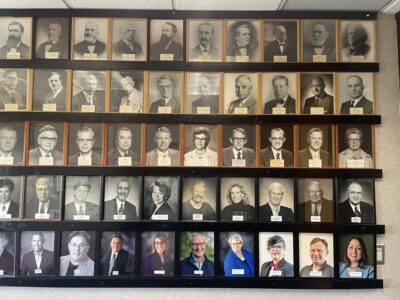
photo by: Sylas May/Journal-World
The wall of mayors in Lawrence City Hall is pictured on April 27, 2026.
Lawrence is again debating how its mayor should be selected. Should it be directly elected? Should it be for four years? Two years? One year? Would it get to vote on every piece of city business or just in the case of ties? And so on and so on.
Here’s one more for you: Does Lawrence even want a mayor?
Of course, Lawrence is going to have a mayor, but my point is that Lawrence historically has been a town that is wary of power. “The Man” does not win many popularity contests here. It shows in what we let our mayor do. Lawrence has been a place that, for the most part, would rather place its trust in professional administrators than a political boss type.
Opinion

Chad Lawhorn
Editor & Publisher
Have your own take? Send 250 words or less to letters@ljworld.com.
Have a column idea or a tip for Chad to investigate?
Send a message to clawhorn@ljworld.com.
I’m not going to spend many words trying to convince Lawrence to embrace authority. Instead, I’d argue let’s figure out if there is anything really new that we want a Lawrence mayor to do. If not, proceed with change carefully. The biggest risk may be some pretty serious unintended consequences.
Commissioners at their meeting last week kicked around the idea of abandoning their traditional way of selecting the mayor. That way is as follows: Whoever was vice mayor for the past year gets elevated to the position of mayor for the new year. This happens in December of each year.
Thus, the key question is how is the vice mayor picked? OK, buckle up. In November voters go to the polls to select either two or three commissioners. (The exact number depends on the year.) Whoever wins the most votes in the November election traditionally has been chosen by the City Commission in December to serve a one-year term as vice mayor. That person then would serve a one-year term as mayor the following year. Whoever received the second-most votes in the November election traditionally would be selected by commissioners to serve as vice mayor two years after the election, thus putting that person in line to be mayor three years after the election.
The No. 1 reason to change the current system is so that when someone asks how you become mayor in Lawrence, we simply could say: “We elect one every four years,” instead of giving a two paragraph explanation.
Of course, we could have a system where the answer would be: “Commissioners just pick whoever they want to do it for a year.”
There was some talk at last week’s City Commission meeting of moving to that system. No, commissioners didn’t quite say it that way. They talked about having a public discussion of what makes a good mayor and picking one of the five commissioners based off of those guiding principles.
But make no mistake, the system soon enough would become picking whoever they want. Who they want might be based on what they get. We just chose a U.S. Speaker of the House and soon will choose a Senate Majority leader that way. Behind-the-scenes discussions of “if you vote for me, I think I could do this for you.” That’s just politics, and such a system would be politics without any meaningful — or transparent — guardrails.
Despite its convoluted nature, the current system is better than that. It is at least indirectly tied to the will of voters. I’d codify the current system (right now it is based on tradition rather than code) before just opening it up to commissioners picking who they want. Such a wide open system will create unintended rivalries and teams. Again, the U.S. Congress should prime your imagination.
That said, I think it would be worthwhile to have a citywide election to see if residents would like to have a system that simply elects a mayor every four years. Residents narrowly rejected a related but more complicated plan two years ago. It asked to create a system to directly elect a mayor, add seats to the commission, require some seats to be district-based rather than at-large, and would have prohibited the mayor from voting on items, unless there was a tie.
That was a lot. It may be fruitful to just ask voters: Would you like to elect your mayor?
Now, if you wanted to stir a pot, you could also ask if you want to give the mayor new powers. Here are some pot-stirring possibilities:
• The mayor gets to hire and fire department heads. Currently, only the city manager does so. That would change Lawrence’s entire form of government. Probably a nonstarter for lots of reasons.
• The mayor gets to create the recommended budget, rather than the current system where the city manager provides a recommended budget to the commission. That also would be a huge change away from a city manager style of government. But if you want one elected leader directly pushing for ideas from the public, this would be a way to get the ball rolling on lots of topics. This one is kind of intriguing — a recommended budget owned by the mayor but prepared with the professional assistance of a city manager. City commissioners would still have to approve the budget. I’m not sure it would help the stress levels of a city manager, but it would be a way to make the mayoral position special without making it absolute.
• The mayor gets complete authority to make appointments to city advisory boards and operating boards. Currently, such appointments must be approved by the full commission. Over the course of four years, a mayor could appoint a lot of people who could push a lot of initiatives and work to instill a certain philosophy. Is that the type of power we would like a mayor to have?
I’m dubious a majority of Lawrence residents want any of those things. But I might be wrong, and the conversation would probably be productive nonetheless.
A simpler conversation would be: Do we want to have one person for an entire four years — the mayor — keeping decorum at meetings, managing public comment, and representing the city throughout the region? Those are basically the extra duties of the mayor currently. All that would change is that the term would last four years and voters would directly choose the person rather than using a convoluted system based on tradition.
I do think multiyear consistency on all those fronts could be beneficial. Having a mayor who has enough time to develop actual relationships with other elected leaders in the region might be the biggest benefit. Lawrence could benefit by being more regional in its thinking.
Those changes would give Lawrence more of a true mayor — which may be exactly what Lawrence’s authority-leery DNA will forever reject.
City Government
Opinion: How we pick the mayor is up for discussion again, but Lawrence’s DNA may not even want a mayor
Many of the metrics in Lawrence’s last strategic plan aren’t on track to meet their targets, city data shows; new goals will soon be set

City commissioners praise Wakarusa River valley plan, say it could help bring in grant funding
Commissioners discuss whether Lawrence should shake up its tradition for choosing its mayor
Lawrence City Commissioner Amber Sellers named as next president of National Black Caucus of Local Elected Officials
