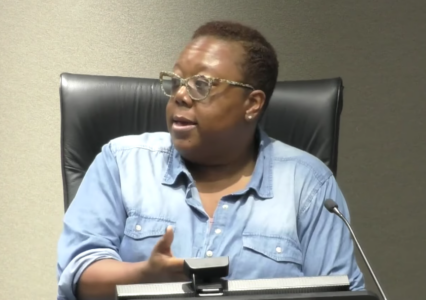

AS NBC-LEO president, Lawrence’s Amber Sellers wants to create ‘a safe space’ for Black leaders to learn from each other
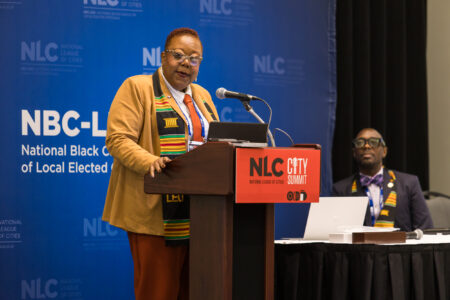
photo by: City of Lawrence
City Commissioner Amber Sellers speaks at the National League of Cities' 2026 City Summit in November in Nashville, Tennessee.
It’s taken years of work for Amber Sellers to become leader of a nationwide group of Black elected officials – and that work started in 2022 with a speech that she had an hour to come up with.
Sellers, then a relatively new elected official with just under a year of governing experience, had made the snap decision to run for an assistant secretary position at her very first meeting of the National Black Caucus of Local Elected Officials – a group that’s part of the National League of Cities and brings together Black leaders from around the country.
It wasn’t a position with a lot of responsibilities. But she didn’t want that yet – she just wanted to be a voice for the Midwest in a room full of elected officials from the South.
“I won,” she said. “And I won the attention of the president of NBC-LEO at that time, and just kind of made it my own.”
Now, four years later, Sellers has been elected as the organization’s president for 2027, and she’s already planning to make the role her own in new ways. She wants to introduce new programs to help Black leaders across the country on policy, professional development and even mental health. And she wants to build a more intentional strategy for the group so that it doesn’t lose any of its momentum when leaders come and go in future years.
It will all start in January, when she’ll go to NLC headquarters in Washington to work with staff and refine her platform.
“I’ve got my marching orders; I’ve got my worksheet, because I’ve got some homework to do before January,” Sellers said.
The Journal-World spoke with Sellers this week about what NLC and NBC-LEO have done for her, and what she hopes to accomplish as president in the coming year. Here’s what she had to say.
A Midwestern perspective
When Sellers introduces herself to people as an elected official from Lawrence, she adds: “#BirthplaceOfNLC.”
The National League of Cities, which is an organization that brings city officials from across the country together to network, was in fact founded here in Lawrence in 1924 at the University of Kansas. “I want people to know, like, yes, there’s a lot of great things that come out of Kansas, and NLC is one of them!” Sellers said.
She didn’t always know that, however. At her first NLC event in March of 2022, she didn’t yet know what to think about it: “Being new to the commission, that was a very overwhelming experience, so that was just me kind of taking everything in.”
But she did the research later that year, and, when she found out that NLC’s City Summit would be coming to Kansas City in November 2022, she came into it with “brighter eyes and intentionality about what I was hoping to get out of it.”
That’s when she attended that NBC-LEO meeting where they were electing an assistant secretary. And it was a meeting where Midwestern voices like Sellers’ were hard to hear.
NBC-LEO, Sellers said, largely draws its leadership from Southern cities, because the South has larger Black populations and more Black representation in government than other parts of the country. “The executive board was very heavy in Southern representation, and you didn’t really see any Northern or even Midwest representation,” she said.
But Sellers thinks Black leaders in the Midwest have different needs and different concerns than leaders in the South. You have to present yourself differently, she said, when you’re a Black commissioner governing a Midwestern community that’s predominantly white.
So, she decided to run. In the hour she had to prepare her speech, she drew on what she’d learned about Lawrence’s history as the NLC’s birthplace.
“I shared in my speech that I do believe that this time it was kismet for me to be here,” she said. “… I want to be able to link the history, the legacy of NLC to what I believe to be the history and legacy of what I tried to accomplish in Lawrence, and how I could bring that voice to NBC-LEO.”
After that, “it just kind of took off from there and caught fire,” Sellers said.
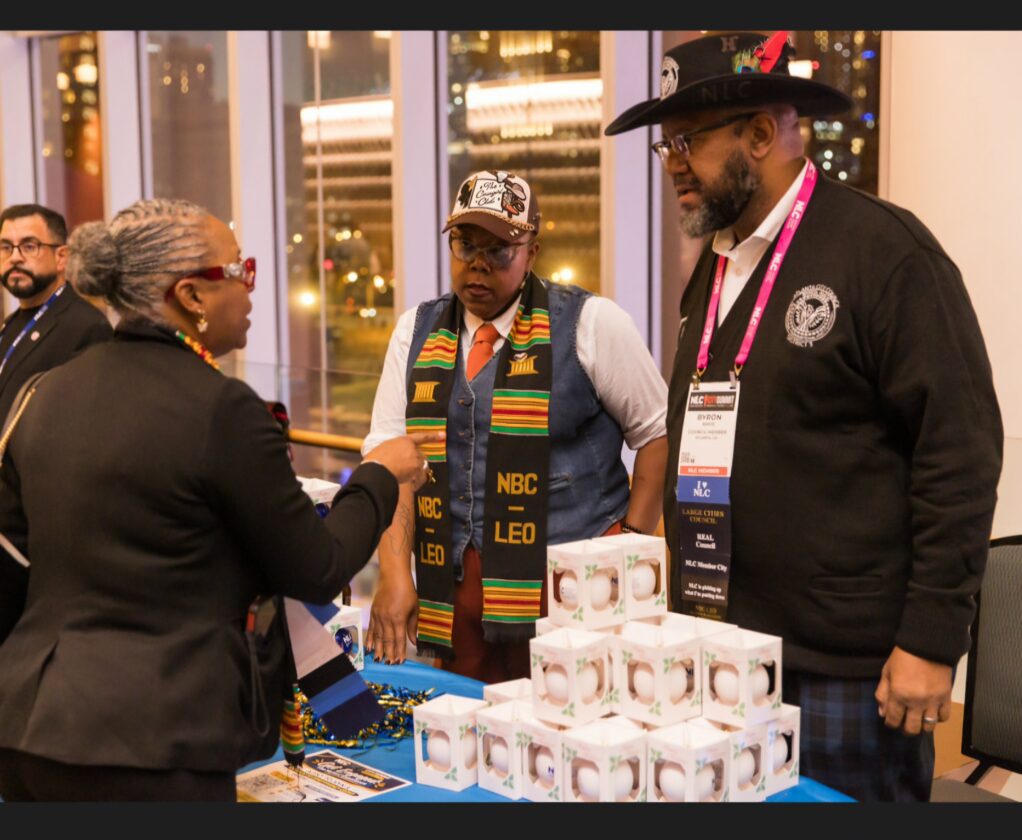
photo by: Contributed
City Commissioner Amber Sellers, center, meets with other elected leaders at a past National Black Caucus of Local Elected Officials event.
‘Plan, act, win’
The assistant secretary position, and the secretary role she won the following year, don’t have major roles on the executive board, she said. It was more about being present and adding her perspective back then.
But, eventually, Sellers wanted to be more than just a Midwestern voice. In 2024, she sought a bigger leadership role in NBC-LEO, that of second vice president.
She wanted to take on one of the major problems facing NBC-LEO: how to keep up its momentum.
At a conference in 2023, she heard about this problem from one of NBC-LEO’s past presidents, Wayne Messam, the mayor of Miramar, Florida. Messam said that NBC-LEO once had a strategic plan, but it lost that direction and momentum during the COVID pandemic.
“The leadership in NBC-LEO needed to get us back to that strategic framework,” Sellers said. “So, when I ran for second vice president, I ran with the vision of being a part of creating that framework.”
Her campaign was built on a three-word strategy: “Plan, Act, Win.”
Sellers said having a long-range plan is important, because local government positions can have a lot of turnover and elections can be unpredictable. Often, in NBC-LEO and NLC’s other constituency groups, people will be in a leadership role, then lose their local election and be unable to serve in their NLC role anymore. So, Sellers said, NLC’s programs sometimes stagnate or even take steps backward when new leaders take over.
“Each year, every president decides their platform,” she said. “… But that was done without any strategic framework of what we want.”
So, the first thing she wanted to do was find out, what do the members want?
She put together a lot of data on NBC-LEO’s membership, on how long its members had been in office, where they had the greatest representation, what the strengths and needs of these elected officials were – “What are the tools that they believe that they need to be sharper, more policy-minded elected members?” And then she presented it all to the other NBC-LEO members.
“That got the attention of the membership,” she said. “And so I knew at that time I had something that I can continue to build upon,” something she could use to rebuild the strategic plan that Messam talked about.
Before her term ends, her goal is to go before the other members and present that plan: “A strategic framework that they can vote on and say, ‘This is what we will use each year’ – that presidents can utilize to identify their platform and the things that they want to accomplish, so that we’re not starting back over again, we’re not taking five steps forward and five steps back.”
A safe space
What the other Black leaders wanted, Sellers said, was mostly advice on things anyone leading a city wants to be better at: civility and engaging with other elected officials; budgeting and economic development; policymaking and how policies work.
“These things are no different than any other elected official,” Sellers said.
But, she said, Black elected officials specifically may have felt uncomfortable just asking about these things. She wanted them to know that NBC-LEO was a place where they could talk about their challenges and get help from others without judgment.
“Sometimes, when you’re among like peers, that’s a safe space,” she said. “I wanted the membership to know that NBC-LEO was a safe space for them to be vulnerable and share these things.”
In the past year as first vice president, Sellers has been trying to give leaders a space where they can talk about that, and she’s tried to be an educator and an interpreter to help the members understand the many complex issues that elected leaders have to navigate every day.
Some NBC-LEO members have had questions about specific topics, like land development, zoning, water treatment, or what the different kinds of business incentives are. “When you come from different cities, different states, we all don’t have the same state statutes,” Sellers said, and it helps to be able to talk through things and understand how your situation is unique.
In 2025, Sellers said NBC-LEO organized “peer-to-peer learning” sessions for its members, where they set up tables for a variety of topics such as economic development and public safety. If anyone had a “case study” on these topics from their own community, they could go to that table and talk through it with other elected leaders in a “granular” way, Sellers said: “What is the problem, who are the players, what are the resources, what have been the pitfalls? And people talked it out, and then the table had dialogue and asked questions.”
When NBC-LEO’s leadership asked about the sessions afterward, she said, people at every table said they’d learned something new.
But the broader conversation, Sellers said, is getting people to understand policy – how to develop and implement good policies, and how they relate to state and federal law.
This is something that many people who run for office have little training in, she said.
“You have elected members that run on an issue,” Sellers said, or on something they’re passionate about. “That’s great. That’s what you need to do.” But, if you don’t understand the nuts and bolts of how to make policy, you’ll have a hard time delivering what you were elected to do.
“That was an overarching theme of a lot of the membership and what they were looking for,” she said. And, over the past year, as Sellers has facilitated these conversations about policy and the mechanics of governing, “you definitely saw the membership kind of perk up.”
What else she’s planning
In addition to the broad strategic plan, Sellers has some smaller-scale ideas for NBC-LEO that she’ll be refining in the coming months.
One of them is more collaboration between NBC-LEO and the other constituency groups under NLC’s umbrella. She is a member of two other NLC constituency groups, Women in Municipal Government and LGBTQ+ Local Officials, “not only just representing my community, but as a Black queer woman myself.”
She also wants to bring back the charitable foundation that NBC-LEO once had and figure out what kinds of philanthropy and programming it could support. And she wants a new resource for elected leaders called “NBCU,” a play on HBCUs, Historically Black Colleges and Universities. It would inform leaders about professional development topics that don’t come up as often, including what life after being an elected leader looks like.
“How do we give elected officials the tools for life as an elected official, but also life after being an elected official?” she said.
In a similar vein, Sellers will be pushing for more mental health programs for elected leaders. She wants the NLC to build a stronger relationship with the National Alliance on Mental Illness and challenge elected leaders to do “mental health boot camps” through NAMI.
“We wear multiple hats,” Sellers said. “We have other jobs, we have families, some of us are caregivers. So when you’re an elected official and you have all those other things in the background, it takes a toll on you.”
Mental health, she said, is a natural step from the discussions about civility that NLC had last year, which in Lawrence led to the City Commission making a civility pledge to set expectations for how commissioners should behave and treat each other.
In addition to all of this, Sellers will also be preparing for a special opportunity to showcase Lawrence on the national stage. This summer, NLC members will be meeting in Kansas City, and her counterparts around the country will be visiting Lawrence for a half-day tour.
“If I talk about Lawrence being the birthplace of NLC, I want to make sure that conference attendees to the summer conference are able to actually come and see what I’ve been bragging about,” she said.
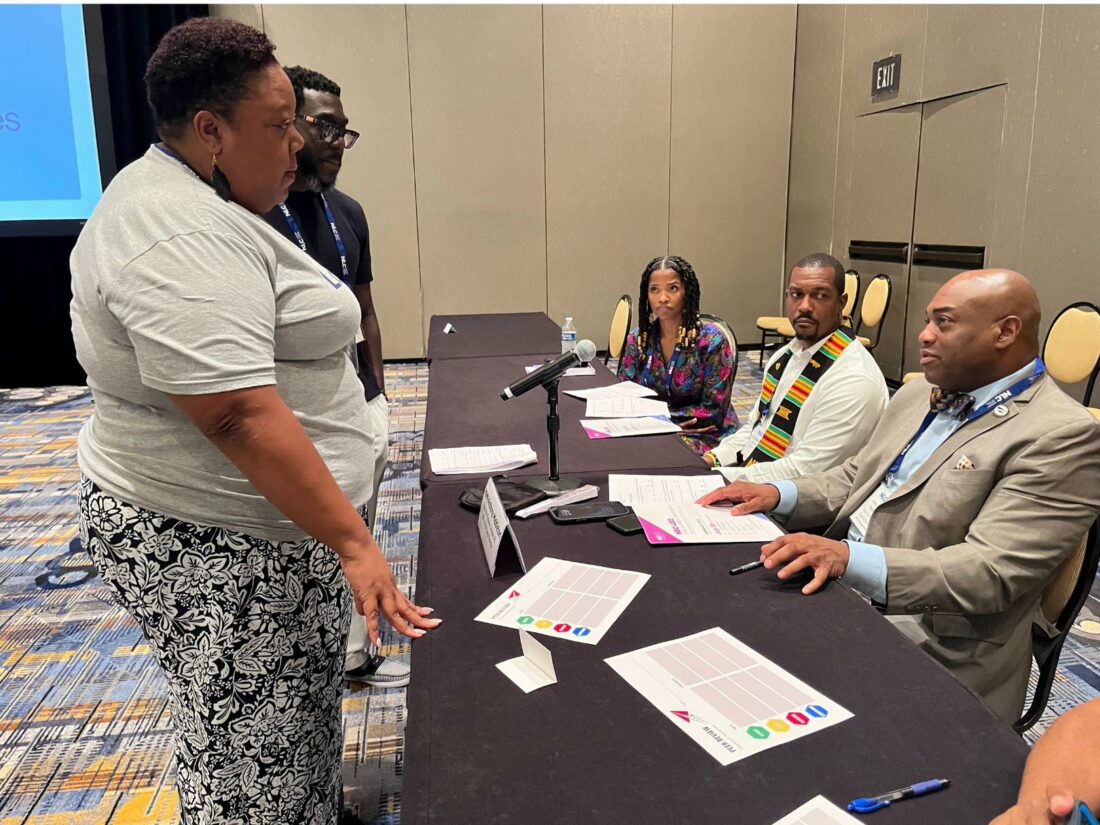
photo by: Contributed
City Commissioner Amber Sellers, left, meets with other elected leaders at a past National Black Caucus of Local Elected Officials event.
Model communities
Sellers realizes that some people outside of government have questions about the value of groups like NLC. She says “a lot of folks get tied up on the cost” of going to conferences and meetings, and that they don’t always know about the sharing of ideas that goes on.
“As an elected official, this has truly been value added,” she said. “NLC has been a value-add to me, and it has shaped a lot of my thinking about different topics and issues, and it’s given me a place to be able to share and think out lout and build a lot of connections and networks.
“It’s not personal,” she adds. “It’s for the sake of having those voices, those unique voices that you don’t sometimes hear in your community, that gives you a unique perspective.”
NBC-LEO organizes gatherings where elected officials can hear those different voices. This year, it hosted a series of “rapid fireside chats,” where leaders could share their communities’ initiatives in public safety, housing and economic development.
One leader from Miami Beach, Florida, was creating a small business summit where entrepreneurs can learn about what resources are available and how city processes such as requests for proposals work. Another, in Birmingham, Alabama, was repurposing Community Development Block Grant dollars to do housing rehabilitation projects. “We kind of do that here; it just looks a little bit different, but it was the same approach,” Sellers said.
During her time in NBC-LEO’s leadership, she has shared what Lawrence is doing, too, and her peers have been listening.
Some of them liked Lawrence’s Inclusive Winter Market, a sale that highlights artists of color and others who might not have been included in traditional art shows and galleries, and so they created their own. Others were preparing to update their land development rules like Lawrence recently did, and they wanted to know how the city informed the public and got feedback on the code. “Many people talked about that,” Sellers said.
She gets emails from other NBC-LEO members saying things like, “Commissioner Sellers, I appreciate you sharing that with me,” or asking her follow-up questions about things she’s talked about at conferences.
“I even had a fellow elected out of the DMV area [D.C., Maryland and Virginia] that was just like, ‘We don’t have accountability for our city manager. How do you do it? I’ve heard you talk about it,'” Sellers said. “And I shared some of the things that we’ve done as a commission to do our evaluations of our city manager, because they didn’t have anything. I was just like, ‘How are you measuring accountability and success?'”
Through her activities in NBC-LEO, she said, Lawrence is becoming a model community for leaders elsewhere in the country.
“I think it’s a way to tout ourselves,” she said.
She proudly talks about Lawrence’s successes, and about things where the community has had to experiment and keep trying new approaches. One of those is A Place for Everyone, the plan to end chronic homelessness, which has led to projects like The Village of Pallet cabins on North Michigan Street and the city’s new Affordable Housing Incentive Policy.
“I’ve talked about A Place for Everyone. I’ve talked about our Affordable Housing Advisory Board. I’ve talked about the work of Tenants to Homeowners. Things of that nature, how we’re kind of trying things out,” Sellers said.
But, if Lawrence is a model, it’s only one of many, she said, and it can learn from its peers, too.
One thing Sellers said Lawrence could learn from other cities is how to make the most of Opportunity Zones, a development incentive tool that was created by the 2017 Tax Cuts and Jobs Act to revitalize low-income neighborhoods. Lawrence has been awarded Opportunity Zones, including one that covers several neighborhoods in eastern Lawrence, and she wants to find ways to better market those zones to developers.
Another is Community Development Financial Institutions, or CDFIs, which help provide capital for people and businesses in lower-income areas that are underserved by traditional financial institutions. Douglas County has never had one of these, she said, and she’s heard about ways that other communities have worked with their own financial institutions to get them interested in becoming CDFIs.
On a tour last year at an event in Salt Lake City, she saw how that city fueled an affordable housing boom by weaving together local, state and federal dollars, including money from the American Rescue Plan Act, in novel ways. “They did some creative things with their ARPA dollars that we didn’t necessarily do,” she said, but she thinks Lawrence might be able to imitate that by finding new ways to use its Affordable Housing Trust Fund or its Community Development Block Grant funding.
“Every community has the ability to be a model city,” Sellers said. “I do push it, because I am proud of the work that we’ve done. We’ve come a long way since I joined the commission in 2021, and I want to be able to celebrate that.”
City Government
AS NBC-LEO president, Lawrence’s Amber Sellers wants to create ‘a safe space’ for Black leaders to learn from each other
Opinion: How we pick the mayor is up for discussion again, but Lawrence’s DNA may not even want a mayor
Many of the metrics in Lawrence’s last strategic plan aren’t on track to meet their targets, city data shows; new goals will soon be set

City commissioners praise Wakarusa River valley plan, say it could help bring in grant funding
Commissioners discuss whether Lawrence should shake up its tradition for choosing its mayor