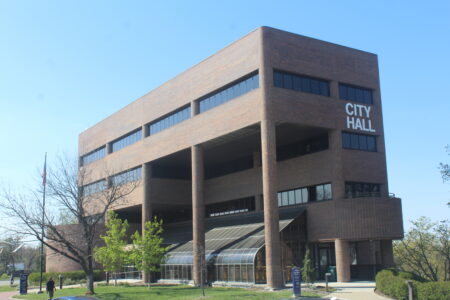
Leaders ask how Lawrence’s historic ‘environs’ rules are working – and what would happen without them
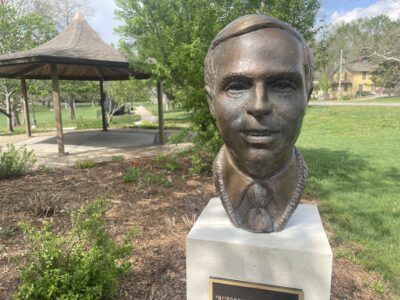
photo by: Sylas May/Journal-World
A bust of former City Manager Buford M. Watson is pictured Wednesday, April 15, 2026, in Watson Park.
Two years after Lawrence streamlined its rules for building projects near historic properties, city leaders want to know how the changes are working – and what would happen if the rules went away.
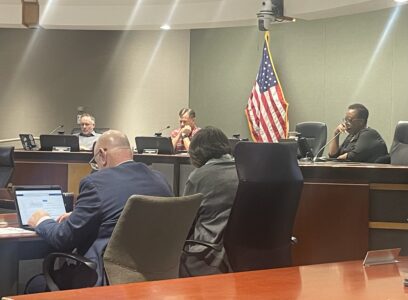
At their meeting on Tuesday, Lawrence city commissioners had a discussion with Brenna Buchanan and Joy Coleman, chair and vice chair of the Historic Resources Commission or HRC, and much of it centered on a concept called “environs” or a “context area” – the radius around a historic site, currently 250 feet, that can sometimes trigger an HRC review.
The commissioners heard that the context area is something that many Kansas cities no longer have, and some had concerns that it could be hindering development in the denser parts of the city.
“I specifically wanted to speak to the environs as one thing I’d like to try to remove or at least get clarification on its need and why we as a community do it when very, very, very few others do,” said Commissioner Mike Dever.
Ultimately, the commission told the HRC and staff to bring back more information on its approval processes for development near historic places. We don’t know when their next discussion on this will happen, but Tuesday’s meeting gave a glimpse of where it might be headed.
“This is a big topic,” as Commissioner Kristine Polian put it. Here’s a closer look.
‘The same flavor’
Tuesday’s discussion began with a concern about Watson Park, and Polian said that “the environs are a big part of it.”
Discussions started last year over whether to list Watson Park, which was originally called Central Park in Lawrence’s 1855 plat, on the Lawrence Register of Historic Places. Buchanan said it wasn’t the HRC that started the process – a resident filed an application for the park to be listed.
The HRC is still looking into the request; Buchanan said they wanted the applicant to do more research on it before they could make a recommendation. But Polian said she’d already heard from nearby homeowners who were worried about the effects a historic listing would have on their properties.
“There’s a preconceived notion that if you’re part of the context area – this would have come from the folks that live around Watson Park – that they would really, really be limited in what they could do to their property,” Polian said.
As far as properties that would be affected by Watson Park specifically, Coleman said the HRC had found only four privately owned properties that would be affected if the park were listed. Those would be homes to the east of the park, directly across from it and close to Sixth Street.
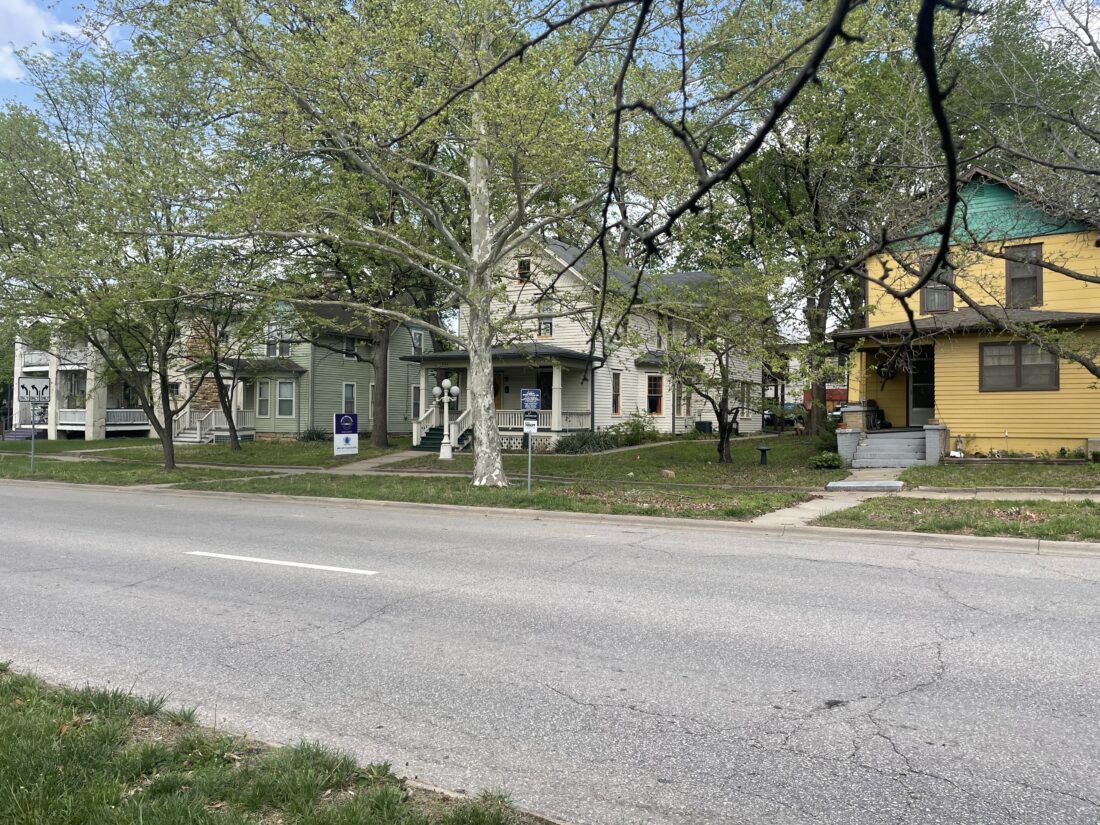
photo by: Sylas May/Journal-World
These four homes east of Watson Park are the ones that the Historic Resources Commission has found would be affected if the park were listed as a historic site.
But Polian’s question was more about how the process itself worked.
Coleman said it worked like this: “Show us what you want to do, and we will review it using the other areas within that circle as the context.” She said that could include things like “size, scale, mass, materials.”
Buchanan summarized it like this: “Is it overall the same flavor?”
Polian wondered if the criteria were clear enough.
“It feels subjective,” she said. “… Can you guys insert your opinion, or is there a very specific policy you have to follow?”
Coleman said there wasn’t a list of things you can’t have. “It doesn’t say you can’t have a porch. It doesn’t say you can’t have pink siding. But it does say follow the forms of the neighborhood.”
What Coleman did say was that certain changes aren’t subject to the rules, like changes to landscaping. And she and Buchanan said that denials weren’t frequent at the HRC.
But what Polian had heard from property owners was that their concerns were more about the process than the likelihood that their projects would be denied.
“There are just so many steps to the process, and are we accomplishing what we want to accomplish?” she said.
The history of the environs
Commissioner Amber Sellers asked whether an environs rule was required by the state of Kansas. The state used to require it, Buchanan said, but now it leaves it up to cities.
“We’re one of the few that have one,” Finkeldei added.
The environs – technically now called the context area, but the commissioners used the terms interchangeably throughout the meeting – is just a way of saying a certain radius around a historic site. Until the city revised its historic preservation rules, the idea was that any project in that radius had to undergo a review to see how it would affect the historic structure and the character of the area around it.
But in 2024, the city changed the rule. Instead of having every project in the environs go through the HRC, the city said that many smaller things within the 250-foot context area could be approved administratively by city staff.
Big projects, like demolitions, still require the HRC to review them, as the Journal-World reported. But Coleman on Tuesday described some of the things that can be approved administratively. If a property were within the context area but had “just a corner, or just the edge” within it, for instance, rather than the building itself, that wouldn’t trigger an HRC review.
Finkeldei wanted to know how much of an impact the change had made.
“Have you seen a significant change in the number of environs cases you’re seeing, or is it about the same?” Finkeldei asked.
“Yeah,” Coleman said. “We’re seeing fewer cases, and there are more that are reviewed by staff and they don’t make it to the full commission for a public hearing.”
The City Commission wanted harder data on this, and that was one of the things it asked the HRC and staff to bring back.
But it also wanted to know what the effect would be if the context area requirement were simply removed. Dever said he was concerned that the area requirements were “self-inflicted” barriers to development, and that they especially affected areas in the urban core where the city wanted to add density.
When the commission was asking for more information, he specifically requested the impact of not having the context area, and the commission added it to the list.
Who can serve?
One more issue the commission wanted more information on is who can serve on the HRC, and what qualifications they must have.
City code requires some seats on the HRC to be occupied by members with specific professional credentials. Two of the members have to be professional architects; two have to be professionals in “preservation-related fields,” such as historians, architectural historians, archeologists or landscape architects; and the remaining three seats are for people with a “demonstrated interest, knowledge or training in a profession or field closely related to historic preservation.”
Finkeldei said it could be difficult to find people who fit those qualifications and were willing to serve on the HRC. And Coleman, while she said there was value in requiring the qualifications, agreed with that.
“We have a requirement for two currently licensed architects on the board,” she said. “There just aren’t that many architects in Lawrence.” The standards also require historians on the board to have a graduate degree in history, plus two years of practice, she said, and “again, there just aren’t that many in Lawrence.”
One group the rules currently cut out is retirees. It used to be that retired architects could fill the architect roles on the HRC, and Buchanan said they were “fantastic,” but they can’t do that anymore because the rules now require a license.
Another group that’s at a disadvantage, Buchanan said, is people who have a lot of knowledge but no relevant professional experience.
“There’s a lot of people in Lawrence that know a lot about Lawrence history but do not have a degree,” she said.
The HRC members at the meeting both said this had led to commissions that weren’t fully staffed. Currently, the HRC’s roster online shows just six members, rather than the seven that city code prescribes.
Loosening the qualification standards a bit could be a way to fill the roster, Coleman said. “If it could be ‘demonstrated experience is equivalent to a degree,’ that would be very helpful.”
“I would assume we’d like to have a full commission,” Buchanan said.
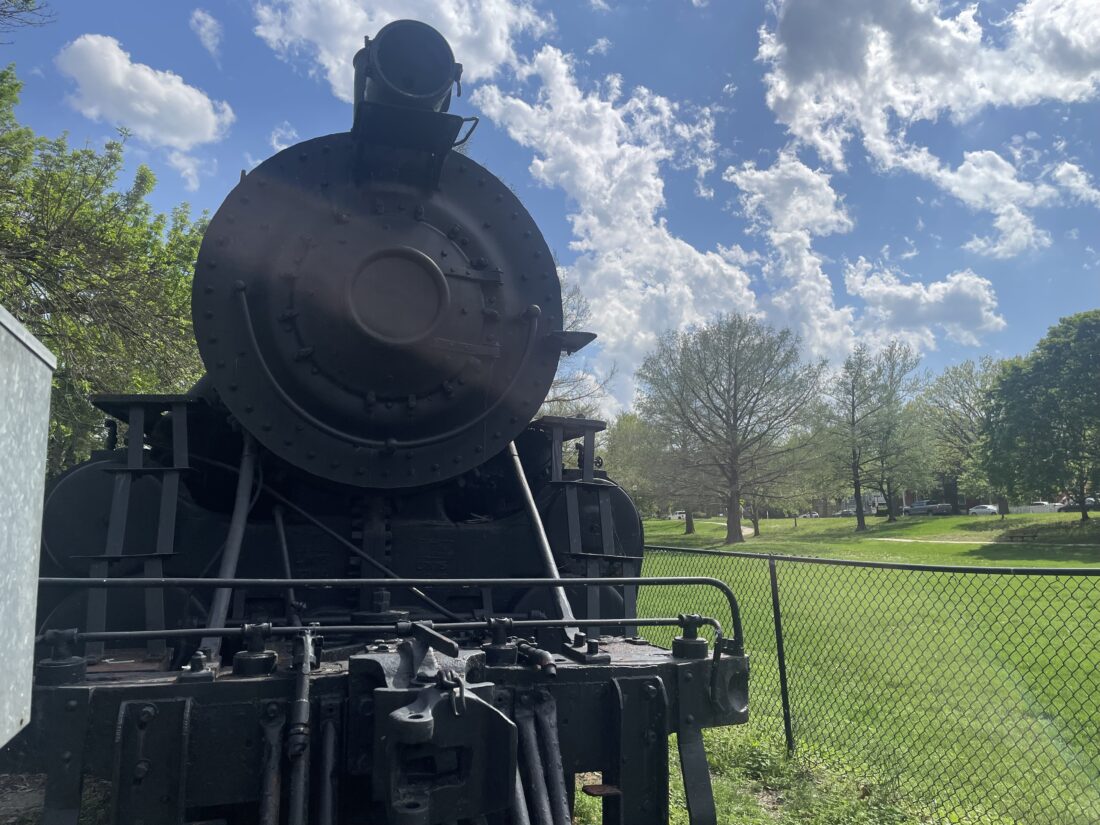
photo by: Sylas May/Journal-World
The locomotive in Watson Park is pictured Wednesday, April 15, 2026, in Watson Park.
City Government
Lawrence City Commission to weigh whether Costco should be included in STAR bond district
As they approve bikes plan, Lawrence city leaders ask about data collection, Kentucky and Tennessee streets
Lawrence city leaders want to toughen tobacco licensing rules ‘sooner than later’
Algerian government invites Mayor Brad Finkeldei, Lawrence delegation for a visit
Construction on Wakarusa Drive to resume; city manager says KDOT’s secretary has apologized for delay