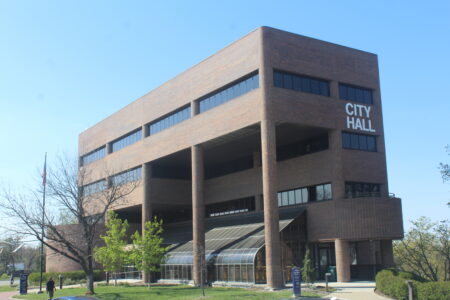
These officers play many roles on downtown patrol in Lawrence, and they don’t want to see it cut
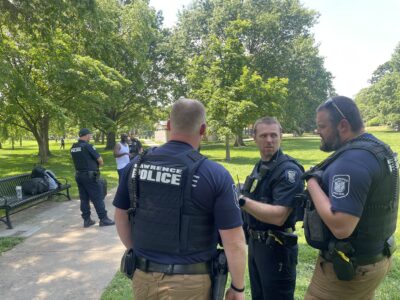
photo by: Sylas May/Journal-World
Lawrence police officers Eric Dawson, front left, and Taylor Zook, front right, speak with another officer in South Park at a disturbance call on May 15, 2026. The suspect on the call, in white shirt, is in the background.
On the best days, downtown patrol officers Eric Dawson and Taylor Zook have a simple job: “Just wander around and say hello to people,” Zook says.
How common are those best days?
“Maybe once every couple weeks?” Zook estimates. “Does that sound right?”
“Maybe,” Dawson replies.
Friday, May 15, is certainly not one of those days. It starts with a report of someone burning clothes in a park bathroom, and they’ve been looking for the suspect all morning with no luck.
Then, right as they come back from lunch, there’s trouble in South Park: a person they’ve encountered before, who was reportedly throwing things at an off-duty officer and trying to instigate a fight.
There are business owners to check in with, homeless people out in the sun who might need help. At a street corner, a pedestrian stumbles, and the officers, stopped at the intersection in their truck, roll down their window and ask if she’s OK.
Dawson and Zook aren’t the only officers who can respond to situations downtown, of course, but they’re the only officers whose patrol is dedicated to the downtown core of Massachusetts, Vermont and New Hampshire streets. They’re sometimes called “foot patrol,” but police spokeswoman Laura McCabe said that’s a misnomer, as they use “whatever travel means necessary for the day’s task,” including bikes or a patrol truck.
The complexity and sensitivity of their work is why the officers are concerned that their unit is one of the things the Lawrence Police Department identified as a potential budget cut for 2027.
The city’s budget process is still in its early stages, but city commissioners have already had discussions about what it will take to fund an expansion of Lawrence-Douglas County Fire Medical. City staff has proposed an approximately 3-mill property tax rate increase, but departments were also asked to identify potential cuts if the commission decides against the tax hike.
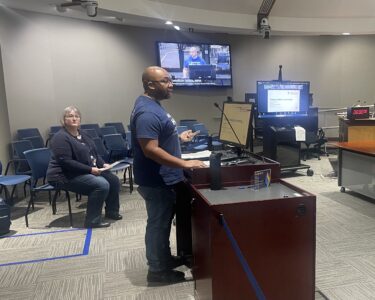
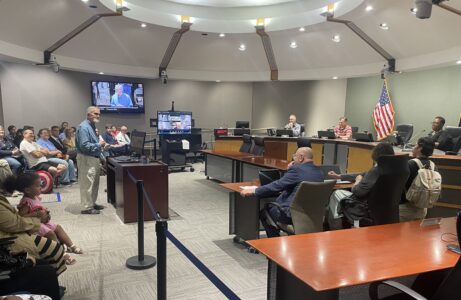
Although staff described the proposed cuts as “high level” and “preliminary,” a dozen or so Lawrence police officers showed up to City Hall on May 5 to voice their concern. They said the potential cuts found for LPD, which would also include cuts to school resource officers, would put community safety at risk.
McCabe said she “can’t really quantify” how much money cutting the downtown patrol unit would save. If it were cut, she said, these two officers would return to a more traditional patrol assignment, “since that is our base-level service requirement to the citizens of Lawrence.”
But she said that with rising expenses in many other things the department has to do, “salary expenses in specialty units are effectively the only option left to reach the requested cuts.”
“Think of the past few years from your personal expense perspective,” she said. “Inflation has hit our expenses, just as it has yours.” She mentioned the expense of maintaining the department’s body-worn cameras, which is a “relatively new and large expenditure” that the department does not want to cut.
Dawson and Zook are concerned about what would happen to downtown without their roles. With no dedicated patrol, “I think it would just become like it was a few years ago, before we started doing all this proactive work,” Zook says.
Earlier this month, the officers gave the Journal-World a closer look at that work and talked about the unique challenges of policing Lawrence’s downtown core.
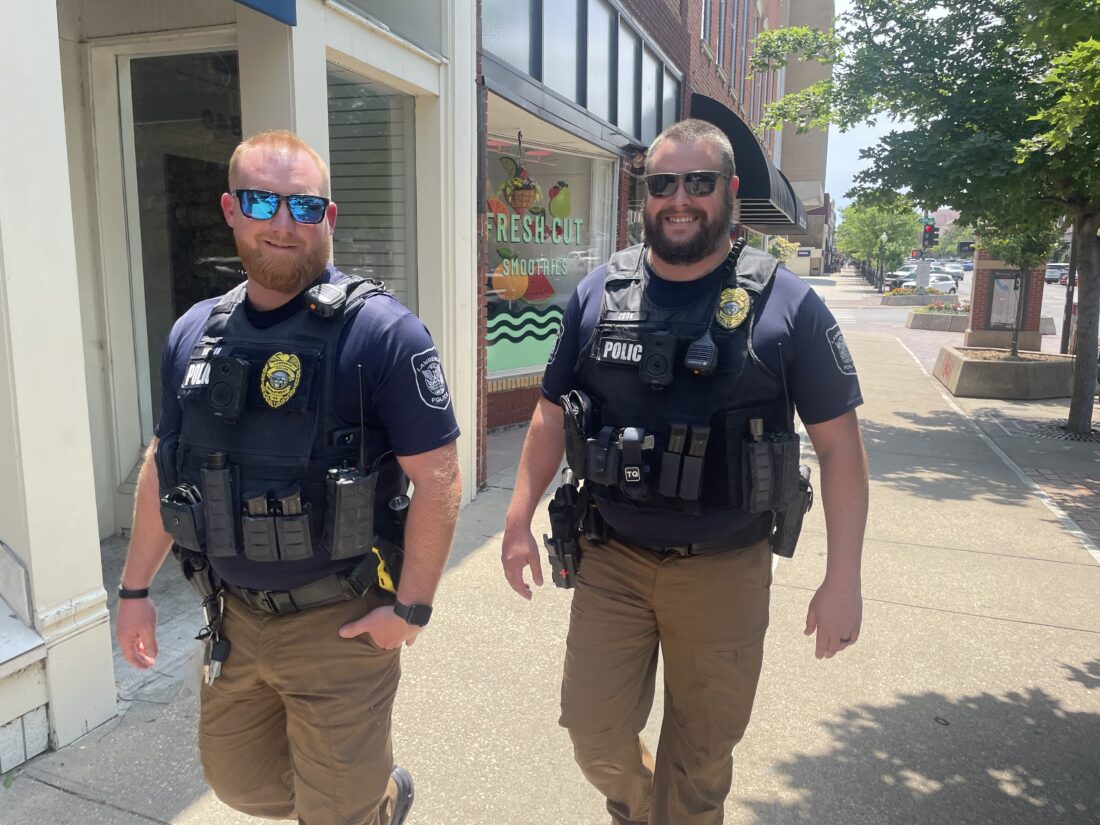
photo by: Sylas May/Journal-World
Lawrence police officers Eric Dawson, left, and Taylor Zook walk down Massachusetts Street on foot patrol on Friday, May 15, 2026.
Incidents every day
As they drive around downtown on May 15, the officers’ big project for the day is clear. “We’re looking for an arson suspect,” Zook says.
There aren’t many clues to who set the fire in the park bathroom. What they have to go on for the person’s appearance is a photo of someone in a hoodie with a big backpack. It has so little detail that Zook jokes it was “taken on a potato.”
And there are plenty of places they have to check.
“We have checks that we have to do throughout the day,” Dawson says. “In the alleys – like, there’s crevices in between some buildings. … There’s a lot of spots.”
Some days, the officers are constantly going from call to call, they say. The most common situations they respond to are disturbances and trespassing calls.
“Disturbances, people yelling at each other – every day,” Zook says. “Without question, every day.”
A physical fight or battery, they say, happens a couple of times a week, most of the time in the 700 block of Vermont where the buses stop. This is one of the biggest problem areas downtown, in their experience.
The officers realize how quickly things can escalate in a place as dense and busy as downtown Lawrence. If there’s an incident in South Park in the middle of the day – like the one after their lunch break, where they said the man would probably just receive a notice to appear for disorderly conduct – there’s a lot at stake if things go wrong.
“The reason we come to these calls,” Dawson says, even though there are other officers on scene, “is because it’s in a park, with a bunch of kids.”
This is also the reason why Dawson and Zook share a patrol truck, as opposed to being on their own.
“We’re probably the only ones in the department that actually roll two deep in a car, because things can escalate so fast downtown,” Dawson says.
Though it fell outside the downtown unit’s hours – typically, they work from 6:30 a.m. to 5 p.m. Wednesday through Saturday – there was a reminder of that danger this month.
In the early morning hours of May 9, a fight outside the Replay Lounge turned into gunfire. Nobody was shot in that incident, but it brings to mind past violent incidents in downtown, like a 2017 shooting on Massachusetts Street at bar-closing time that killed three people.
During their work hours, though, Dawson and Zook say violent crimes with weapons are much rarer than when they started.
They see them from time to time; they recall a man recently pulling a knife on someone at the bus stop, and a robbery about a month ago where someone was beaten with a metal water bottle. But Zook says that overall, “truly, those are getting fewer and further between.”
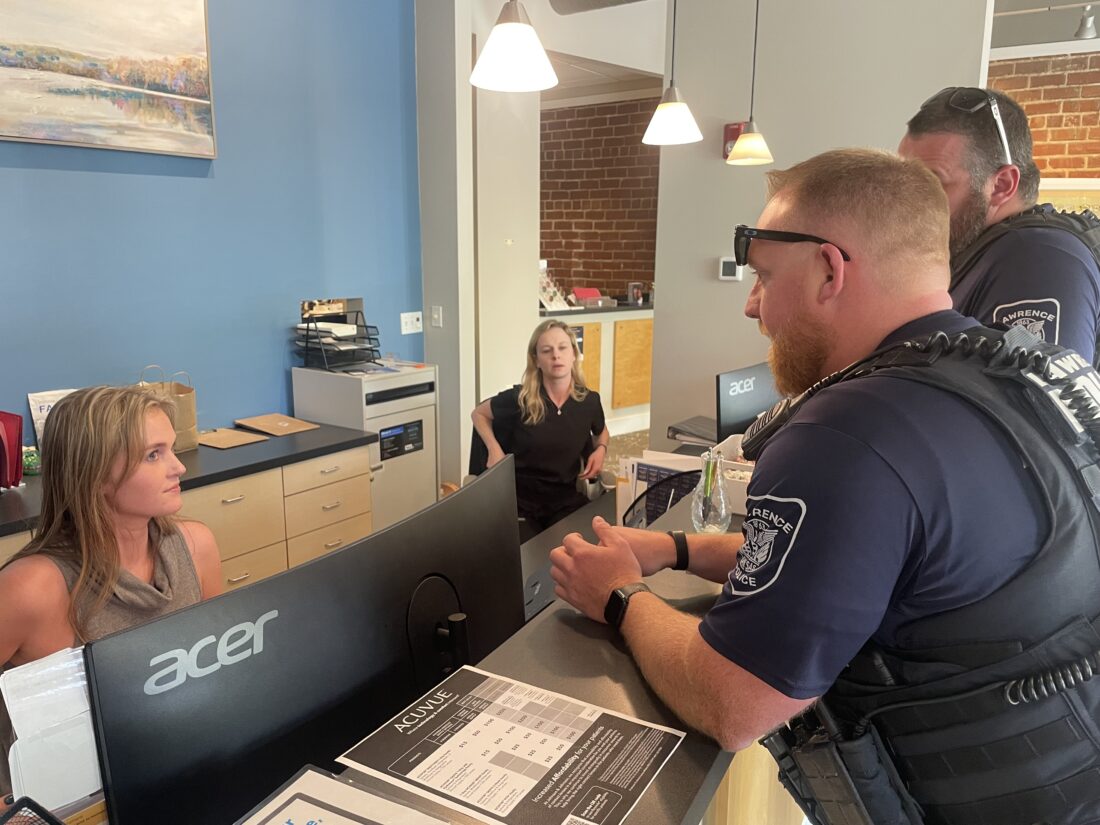
photo by: Sylas May/Journal-World
Lawrence police officers Eric Dawson, foreground, and Taylor Zook talk to employees of a downtown business on May 15, 2026.
Walking the beat
On a typical day – to the extent that those exist – the officers will be doing laps around Vermont, Mass. and New Hampshire streets. Sometimes, these are in the truck – with their heavy gear, they appreciate the air conditioning.
But if you want to really interact with the community, you have to do it on foot.
“We need to walk around and be a visual presence, and obviously the business owners are definitely about that,” Zook says. The officers have good relationships with the majority of business owners in downtown, he says, to the point that business owners will call them personally about problems. “Someone will just call us and be like, ‘Hey, Taylor, this is what’s going on.'”
Normal patrol officers, with all of their responsibilities in different parts of town, can be too overwhelmed to do that relationship-building work, Zook says.
“When you’re on patrol, dude, it can be a grind,” he says. “You’re just taking reports and reports, and then you’re just happy to go hide in a parking lot and type as fast as you can before you get the next one. Obviously we have to answer calls for service, of course, but oftentimes that, funny enough, kind of keeps you out of the community.”
That means these officers can typically do much more to help downtown businesses than other patrol officers can.
“If we have a business owner that’s complaining about a problem that they have, we will dedicate inordinate amounts of time,” Zook says. A classic example, he says, is a business owner concerned that someone is sleeping behind their business. Ordinary patrol officers might tell the business owner to call if they see the person again, but the downtown patrol unit might actually look for the person themselves.
McCabe said the officers have a lot of latitude to tailor their activities to business owners’ needs — that “they hand out their cell phone numbers and are available, if needed, outside of their normal schedule. They also then have the flexibility to change their own schedule, if they believe it would help address a certain issue or solve a problem.”
Although you’ll normally find Dawson and Zook patrolling between Sixth and South Park, there are a couple of places outside of downtown that they check in with regularly because of frequent complaints from business owners, like the bus stop farther south on Mass. by the Dillons, or a liquor store on Sixth.
And, because they are still police, they will respond in an emergency wherever they’re needed.
“If somebody needs help, we’re going to go help them,” Dawson says.
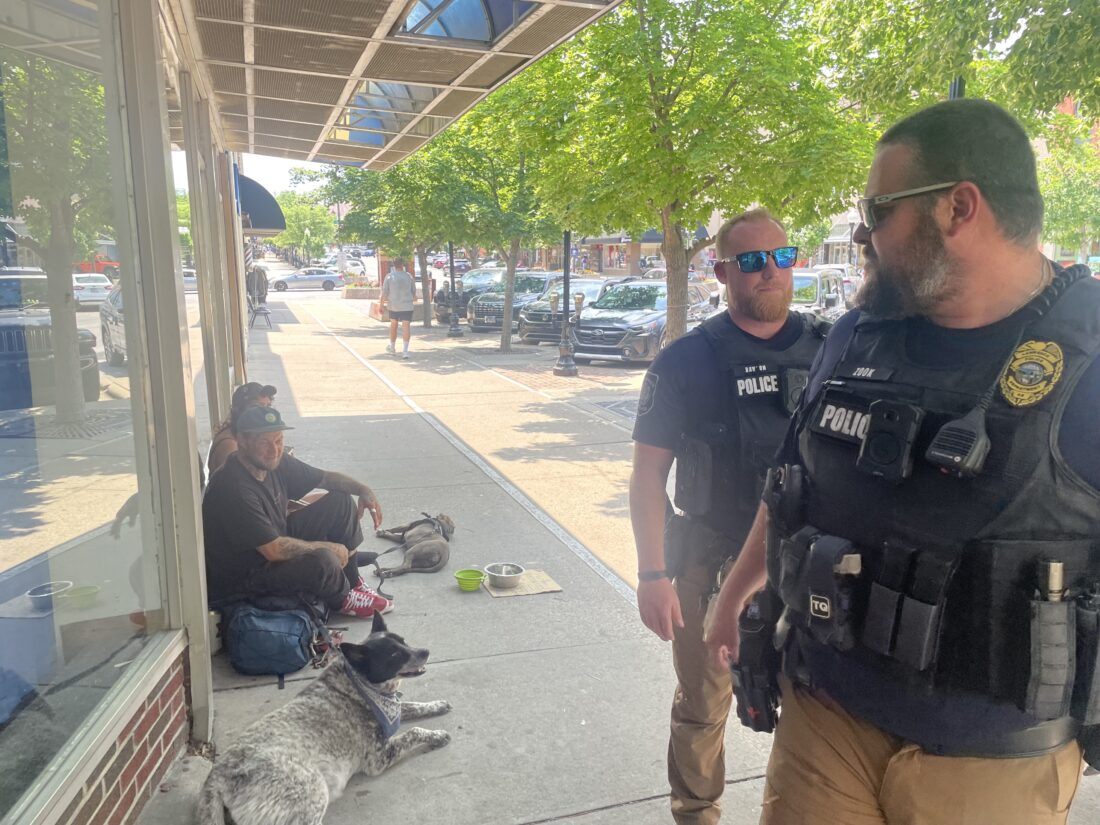
photo by: Sylas May/Journal-World
Lawrence police officer Taylor Zook, foreground, talks to a couple of people sitting in the shade in downtown Lawrence on May 15, 2026, while on foot patrol. Behind him is his colleague on foot patrol, Eric Dawson.
The most vulnerable
It’s not just business owners the officers get to know personally – it’s the local homeless population, who often split their time between downtown during the day and the Lawrence Community Shelter at night.
Driving around a parking lot at Eighth and Vermont, the officers encounter a man they recognize, because he’s been in trouble before for kicking people’s cars. He’s standing by a car now, but as the officers near, he backs off from it.
“He changed his mind,” Zook says. “Good for you!”
They roll down the window and call to the man by name.
“Are you OK? All good? All right, take care, brother. Nice to see you!” Zook tells him. “Hang in there, OK?”
As they drive off, they pass the bus stop across the street from the library, where a number of people are resting.
“I’ve learned almost all of the homeless community’s names,” Dawson says. “And they like us, too. The rapport we’ve built with them, it’s been good. Some of them are pretty funny. They’re good guys.”
Walking down Mass. Street later, they pass a homeless man sitting on the U.S. Bank plaza. “Doing all right?” they ask him, and note that he’s out in the hot sun and not in the shade. In the 800 block, they stop and talk to two transient people sitting in the shade with their dogs.
These people have been in Lawrence for two weeks, Dawson says. “Not a single call related to them, nothing more than a ‘Hey, how are you?'”
Zook says that in more than a decade in policing, he’s seen the fear the community sometimes has of the homeless. There are bad actors in the homeless community, just like everywhere, he says. Of the people they encounter regularly, they can think of around a dozen who are like that, give or take a few.
But the homeless are also “the most vulnerable people here,” Zook says, “and it’s not even really close.” So, when the officers can get someone help – for instance, through Douglas County’s mobile mental health response team or the Treatment and Recovery Center – that’s what they try to do.
When the officers pass by the U.S. Bank plaza half an hour later, the man who was sitting there has relocated. They hope he’s found somewhere cooler to sit, and they wonder if their pointing it out made a difference.
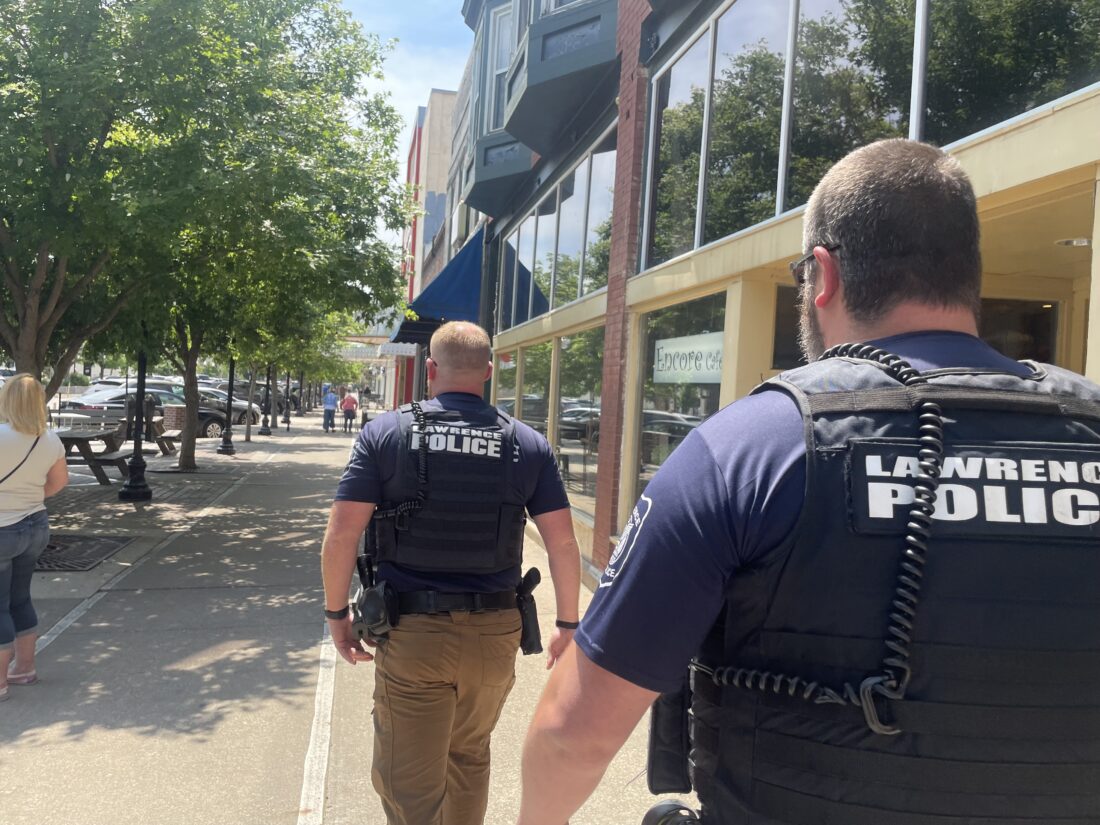
photo by: Sylas May/Journal-World
Lawrence police officers Eric Dawson, front, and Taylor Zook walk down Massachusetts Street on foot patrol on Friday, May 15, 2026.
Not for everyone
The department had been planning the two-man unit for a while after COVID hit. But a violent crime near the bus stop on Vermont Street sped up the process considerably.
That crime was the murder of Vincent Lee Walker in front of the Lawrence Public Library in March of 2024. Walker and the man who fatally shot him, Nicholas Laron Beaver, were both homeless, and Beaver was sentenced in December 2025 to more than 51 years in prison.
“We started this, it was the week or two after that Vincent Walker shooting,” Zook says. “We were planning on this anyway, and then that happened, and then the chief was like … ‘How about you start now?'”
Zook has been on the unit since the beginning, and Dawson replaced an officer who moved to the department’s training unit.
It takes a different kind of person to do this work than to do normal police work, Zook says.
“Typically, your best cops have a lot of life experience,” he says. “They also aren’t super, super excitable.” And that is even more important in downtown. “If you don’t have the temperament where you can kind of keep your cool, this is not a good spot for you to be.”
It also takes creativity and good communication skills. The situations here require a lot of teamwork with other city departments, such as Parks, Recreation and Culture or Solid Waste, that officers don’t normally have to do.
“It’s just a lot of unconventional problem solving,” Zook says.
One man the officers saw at South Park while responding to the disturbance is someone they’ve interacted with a number of times. Dawson says this man often goes through trash bins around town, takes things out of them and leaves them lying around. When the department sees this, it’s easiest to just call Solid Waste: “Hey, we’ve got this going on,” Zook says, “… a dragon’s hoard worth of garbage,” and they’ll come pick up the abandoned trash.
What would happen if the officers suited for this work were reassigned to something else?
“It’s not that I would stop caring about downtown,” Zook says, if he weren’t doing this. “But with regular patrol, you simply just don’t have the time to spend all this effort on, you know, whatever this business owner’s complaint might be.
“So, yeah, my feeling would be, not good,” he went on. “I mean, not overnight, probably, but it would be like it was three or four years ago.”
“Which I don’t want,” Dawson added.
City Government
Lawrence City Commission to weigh whether Costco should be included in STAR bond district
As they approve bikes plan, Lawrence city leaders ask about data collection, Kentucky and Tennessee streets
Lawrence city leaders want to toughen tobacco licensing rules ‘sooner than later’
Algerian government invites Mayor Brad Finkeldei, Lawrence delegation for a visit
Construction on Wakarusa Drive to resume; city manager says KDOT’s secretary has apologized for delay