Planning Commission discussion on revised wind rules extends late into Monday night

photo by: Austin Hornbostel/Journal-World
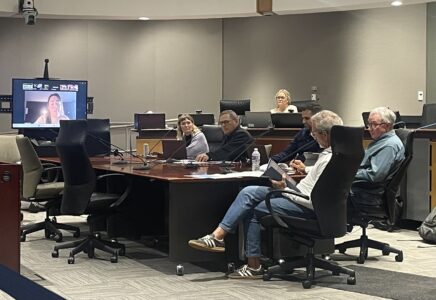
Members of the Lawrence-Douglas County Planning Commission listen to county planning staff during a meeting on Monday, Jan. 22, 2024.
The Lawrence-Douglas County Planning Commission was still working toward a consensus about a revised — and more detailed — set of rules for wind energy projects in the county late Monday night.
The Planning Commission was once again considering whether to approve the revised rules and send a recommendation for final approval to the Douglas County Commission. But that decision seemed to be far off by the Journal-World’s print deadline Monday, at around 10:30 p.m.
As the Journal-World has reported, the revised regulations establish substantially more rigorous application requirements compared to the rules on the books from 2016, in the form of nearly a dozen separate assessments and plans for visual, noise and environmental impacts, lighting, stormwater management, decommissioning and more.
Late-night meetings are part of a familiar pattern for this group, and others, when it comes to discussion about any topics related to renewable energy development. The last time the revised wind rules were taken up by the Planning Commission in October 2023, it was during a public hearing — attended by enough community members to fill the entire first floor lobby of Lawrence City Hall — that ultimately lasted until around 2:30 a.m., thanks in part to more than four hours of public comment from 80 community members.
But that substantial amount of public participation wasn’t a factor at Monday’s meeting because it was effectively a continuation of October’s meeting, starting after the public hearing was closed. This time, planning commissioners instead spent a lot of time discussing technical questions about the revised wind rules. They’d only just begun discussing setback distances not long before 10 p.m.
During the first couple hours of the meeting, the majority of those technical questions came from Planning Commissioner Chelsi Hayden, who early in the meeting said she had nearly two dozen questions to address based on a side-by-side assessment of the revised document and the county’s new rules for solar energy projects. The new wind rules are intended to align more closely with the county’s solar rules.
Most of those questions, Hayden said, were related to method — that is, the process by which a smaller ad hoc group of planning commissioners tackled the work of writing the rules and bringing them back to the full group. For example, she was curious which rural fire department leaders the group may have spoken with while crafting the regulations, and how closely the group worked with county zoning and codes staff.
“I’m asking the questions about method to try to get myself comfortable with the methods that were used, and to get myself comfortable with who was at the table, and to get myself comfortable with what voices were heard and considered,” Hayden said. “Not just heard in general, but who crafted language? …That matters to me, and the voices at the table matter to me.”
Some of Hayden’s questions were related to concerns with some elements of the documents not being listed where she thought they ought to be. For example, Hayden said a list of “key factors” that would be evaluated for a commercial-scale wind project application didn’t include items like more specific assessments related to mitigating or lessening the adverse impacts of a project on the environment. Those specific asks are in the document, though, just listed a few pages later in a section dedicated to describing the elements of a satisfactory project application.
Hayden also said she was concerned to find that assessments of the surrounding well water supply and endangered and threatened species and wildlife habitats were not listed under the concept plan subsection of that application contents section. Those elements are listed a few subsections later, under the environmental impact assessment subsection.
Hayden also voiced some concern about a shorter subsection in this part of the document requiring a decommissioning plan. At the end of the new rules, there is a three-page section detailing abandonment, decommissioning and reclamation plans for completed projects.
Other planning commissioners, like Planning Commission Chair Gary Rexroad, said they appreciated how thorough Hayden was when reviewing the regulations ahead of Monday’s meeting.
“…This level of detail and attention is much appreciated,” Rexroad said. “Because that’s what gets us to a better product.”
No matter which way the Planning Commission votes Monday night, the revised regulations will move to the final step of the process: another public hearing, this time with the Douglas County Commission. That body is responsible for making the final decision on items like this, while the Planning Commission functions only as a recommending body for the City of Lawrence and the county.
County Government
Housing Stabilization Collaborative’s new system directs rental and utility aid to more vulnerable households, review finds
Housing Stabilization Collaborative’s request for city trust fund aid won’t be considered because it was filed late
Douglas County commissioners discuss tracking results of awarded funding to community partners

General Election Voter’s Guide

An incumbent Douglas County commissioner faces no opponent in general election