Douglas County commissioners allocate $700,000 to address Treatment & Recovery Center shortfall
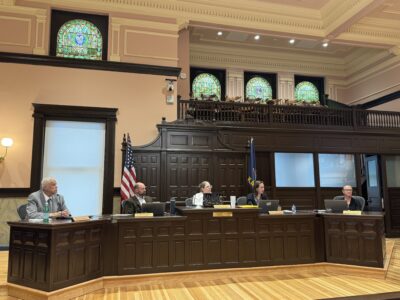
photo by: Josie Heimsoth/Journal-World
Douglas County commissioners met on Wednesday, May 20, 2026.
Douglas County commissioners allocated $700,000 to address a shortfall at the Treatment & Recovery Center for 2026 operations on Wednesday.
The Bert Nash Community Mental Health Center asked the county commissioners for the one-time funding after changes to Medicaid and other funding reduced the expected revenue for the TRC. This is a reduction from Bert Nash’s previous request in December 2025, where they asked for $1 million in additional funding.
This figure of $700,000 represents a 44% increase to the county’s total allocation to the TRC, but it is significantly lower than what was discussed at budget deliberations for 2026 last year.
“We checked and rechecked our numbers,” Kirsten Watkins, CEO of Bert Nash, said. ” … We are pleased today to be able to adjust our ask to a lower amount … based on many active efforts on our part to manage the costs and to run the TRC effectively.”
Commissioners didn’t approve the funding request last December because they wanted an external review of operations and finances at the TRC to be completed. Bob Tryanski, director of behavioral health projects, said that review is nearly complete.
Bert Nash staff presented budget data from the first quarter of 2026, data that demonstrated a smaller funding request would be possible. Commissioner Shannon Reid said she appreciated the diligent work that went into the $700,000 number.
“I feel much more confident about my understanding of how and where dollars are going,” Reid said. ” … The fact that I think that our conversation has gotten … sincerely transparent throughout this process.”
The one-time funding to the TRC will be covered by money commissioners set aside in the 2026 budget for crisis system contingency funding. In 2025, commissioners set aside $1 million total.
In March, Bert Nash shared program-level budgets, which showed some programs having leftover funds, while others, especially crisis services, have major shortfalls, like the mobile response team. County staff are considering whether some of the surplus funds could be used to address those deficits.
“Although there are many challenges and opportunities for growth and evolution, at this point, it’s very clear from the feedback from our community partners, from clients and families who utilize services at TRC … that the TRC is working, and that it’s an essential option for the health of our community members,” Watkins said.
IN OTHER BUSINESS, COMMISSIONERS:
• Authorized a grant agreement with the U.S. Department of Housing and Urban Development, or HUD, to aid in providing permanent supportive housing to 12 chronically homeless individuals.
Douglas County applied to receive $321,032 from the grant in 2024, but HUD later notified the county it would receive a smaller amount than what was awarded in the past. The county was awarded $156,864 to provide service to the individuals from April 1, 2026, through March 31, 2027.
Douglas County staff told commissioners that there was uncertainty around receiving any federal funding from this grant at all for this period, so commissioners approved funding in the 2026 budget to keep services afloat. The federal funding award includes about $145,000 for rental assistance and $12,000 for administrative costs, offsetting some of the amount the commissioners allocated toward the program.
• Approved a memorandum of understanding with Douglas County Emergency Communications, Lawrence-Douglas County Fire Medical and Johnson County Department of Emergency Services to maintain radio communications capability between emergency medical services provided by Johnson County and with LDCFM.
• Awarded a contract for 3,500 tons of highway de-icing salt to Independent Salt at a total cost of $185,885 for winter weather conditions.
County Government
Housing Stabilization Collaborative’s request for city trust fund aid won’t be considered because it was filed late
Douglas County commissioners discuss tracking results of awarded funding to community partners
General Election Voter’s Guide

An incumbent Douglas County commissioner faces no opponent in general election

Incumbent Douglas County commissioner and newcomer challenger face off for District 5 seat