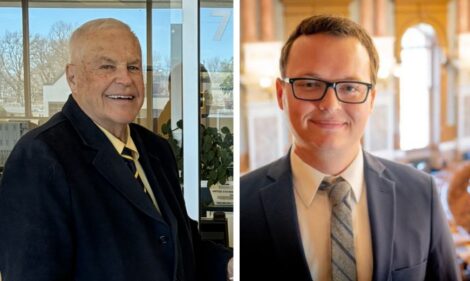
Douglas County commissioners delay the decision on a new truancy program for elementary and middle school students
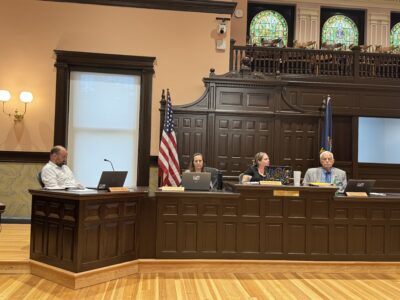
photo by: Josie Heimsoth/Journal-World
Douglas County commissioners meet on Wednesday, May 27, 2026.
Tensions were high between Douglas County commissioners on Wednesday after they couldn’t come to an agreement on whether to implement a new student truancy program.
Commissioners deferred the decision on an “EveryDay Counts” truancy program for elementary and middle school students, after a motion to approve the program failed with a 2-2 vote, with Commissioners Erica Anderson and Gene Dorsey opposed and Commissioner Karen Willey absent.
The proposed program would be administered by Douglas County Criminal Justice Services’ Youth Services division and is designed to help students improve their attendance before their cases reach the court system, as the Journal-World reported.
Schools would have a chance to implement their own interventions to improve attendance, but if those efforts don’t work and a student becomes legally truant, the case could then be referred to the EveryDay Counts program.
Kelsey Dachman, executive director of the Center for Supportive Communities, gave public comments in opposition to the program, saying the CSC was not at the table for conversations on the EveryDay Counts program. Multiple CSC staff were also in attendance on Wednesday.
The nonprofit provides behavioral health services for children and families, and it has a truancy program of its own. These services were previously allocated funding from the county until commissioners set aside $150,000 in the 2026 budget to explore alternatives to existing truancy services to save money.
For 2026, the CSC submitted multiple additional funding requests totaling $274,000 – to cover the cost of potentially lost AmeriCorps funding, a new in-home behavior analyst position and other expenses. The large costs of base funding for truancy services and the additional funding requests made commissioners reconsider options for truancy services.
“Two weeks after the budget hearings, we actually found out from AmeriCorps that we did have funding,” Dachman said. “And so commissioners knew that immediately. And so we were all kind of confused why this decision was still happening.”
Despite the majority of the County Commission deciding to allocate funding to explore a new program, Anderson and Dorsey had their own concerns about approving the program on Wednesday. Anderson was against creating a program operated by the county.
Dorsey said he wanted to delay making a decision until commissioners begin talking about the 2027 budget to give staff more time to figure out if they could handle the workload from the program.
Youth Services staff told commissioners they would be able to operate the program effectively, and County Administrator Sarah Plinsky said she didn’t want to wait until budget time because it would be a tight turn around before the next school year begins.
Commissioner Shannon Reid said county staff did what they were asked to by bringing forward the proposal for the program. Commissioner Patrick Kelly said the decision was not because the CSC was not doing an adequate job at providing services, but he thought costs were starting to get too high.
“This for me, is not because CSC is not doing a good job, that’s not what this is about,” Kelly said.
“I feel the tension that we’re having here about a partner not being funded in the future, but I want to make sure that we’re not … disrupting future budget processes that we have and how we do our budget cycle in July,” Kelly said.
When commissioners couldn’t come to an agreement, Dorsey pitched the idea of giving money to CSC – from the amount of the contingency in the 2026 budget – to provide services through 2026 and reevaluate the proposal from staff.
Anderson actually made a motion in favor of Dorsey’s proposal, but it also failed.
“It’s hard for me to make sense of that because it feels like we’ve given all this direction to staff to do something different and bring us something different, which is exactly what they did and to just rewind the tape,” Reid said.
While there was no direction given to county staff from commissioners, Reid said it would be good for commissioners to communicate their concerns with staff and see if anything can be changed in the current proposal.
In addition, Kelly suggested bringing the proposal forward at a future meeting when all five commissioners were at the table.
IN OTHER BUSINESS, COMMISSIONERS:
• Allowed county staff to proceed with a Youth Apprenticeship Challenge Grant to motivate more private donors and businesses to contribute to Peaslee Tech’s $10 million endowment campaign to provide scholarships to low-income youth and other eligible county residents. The Peaslee Promise Campaign has raised $358,300 as of May 20.
Douglas County commissioners set aside $62,500 in one-time funding for the program. But instead of giving all of that money to Peaslee Tech immediately, the county wants the organization to first raise new donations from the community toward the Peaslee Promise Campaign. Then, the county will match those donations of $5,000 or more.
• Authorized the chief judge to execute a memorandum of understanding to accept awarded funds from the Office of Judicial Administration in the amount of $159,730. The purpose of this grant is to support upgrades to courtroom technologies to enhance audiovisual capabilities. The funding will be used to reimburse the county for equipment previously purchased for courtroom technology improvements at the Judicial and Law Enforcement Center.
• Amended the Douglas County road records to include the correct route of the intersection of North 900 Road and East 675 Road, which is located approximately 1.25 miles west of Lone Star. A surveyor performing a survey in the county highlighted a discrepancy in the road records from 1874, calling for this intersection to be a 90-degree turn. The actual roadway makes a gradual turn and travels in more of a diagonal direction.
Many of the public roads in Douglas County were opened in the early 19th century, and in some cases, the physical road is not the exact location as shown in road records. These plans could have changed because, for example, it was easier to go around the base of a hill or cross a creek at a different location.
A Kansas Supreme Court case from 1886, Shaffer V. Weech, gives a ruling on how to deal with a situation where the road records and the roadway differ. The ruling was that if the actual roadway has always been in one location, then that is where the road actually is, not where the records say it should be.
“Looking back at our oldest aerial photography, this has not been a 90 degree turn, and it is more likely than not due to the small creek crossing at this location,” a memo to commissioners said. “This caused the travelway to be built in a different location than what is shown in the road records.”
• Awarded a construction contract to Kings Construction Company Inc. for a bridge replacement project with a total contract value of $1,355,431 and authorized the public works director to approve change orders totaling up to 10% of the contract amount. The bridge is located on North 1600 Road, 0.3 miles west of Stull, and construction is scheduled for 2027.
Other News
Douglas County commissioners discuss tracking results of awarded funding to community partners

Baldwin High already has won $25K and is competing for $1M through national sports program

On sister city visit, delegates from Hiratsuka, Japan, see Lawrence’s friendship firsthand
U.S. Sen. Roger Marshall faces Democratic, Libertarian challengers in general election

Incumbent Douglas County commissioner and newcomer challenger face off for District 5 seat