Douglas County commissioners to consider new truancy program for elementary and middle school students
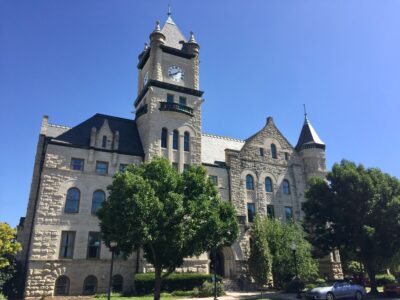
photo by: Journal-World
The west side of the Douglas County Courthouse, 1100 Massachusetts St.
Douglas County commissioners on Wednesday will consider a new truancy intervention program for elementary and middle school students who repeatedly miss school.
The proposed “EveryDay Counts” program – which would be administered by Douglas County Criminal Justice Services’ Youth Services division – is designed to help students improve their attendance before their cases reach the court system. County officials began developing the idea for the program after commissioners set aside $150,000 in the 2026 budget to explore alternatives to existing truancy services.
Schools will have an opportunity to implement their own interventions to improve attendance, but if those efforts fail and a student becomes legally truant, the case could then be referred to the EveryDay Counts program.
When the student is referred, truancy staff would contact the student’s parents or guardians, explain the program and the truancy process, and ask the family to voluntarily participate in case management services.
Truancy coordinators will work directly with students, families and schools to identify why a student is missing school and what barriers may exist. Staff could conduct home visits and school visits, connect families with community resources such as mental health services or financial assistance programs, and use “barrier reduction funds” to help with issues like transportation, rent or utilities.
Students in the program would be expected to attend school for six non-consecutive weeks without any unexcused absences. For every successful week of attendance, students could earn one day of credit toward completing the program early, along with praise and other rewards. If a student successfully completes the attendance goals, the truancy diversion case would be closed.
Families who don’t participate in the program or other local programs, if the attendance problems continue, could be referred to the District Attorney’s Office. The office would decide whether to file a Child in Need of Care case in juvenile court. A judge could then order the student to attend school, participate in truancy services or in more serious cases enter other court-supervised programs.
The program is estimated to cost $74,357 for the remainder of 2026 and $113,467 in 2027. These costs include funding for an additional truancy coordinator, incentives and emergency assistance for families. If approved, the program would launch at the start of the 2026-2027 school year.
IN OTHER BUSINESS, COMMISSIONERS WILL:
• Consider allowing county staff to proceed with a proposed Youth Apprenticeship Challenge Grant to motivate more private donors and businesses to contribute to Peaslee Tech’s $10 million endowment campaign to provide scholarships to low-income youth and other eligible county residents. The Peaslee Promise Campaign has raised $358,300 as of May 20.
Douglas County commissioners set aside $62,500 in one-time funding for the program. But instead of giving all of that money directly to Peaslee Tech immediately, the county wants the organization to first raise new donations from the community towards the Peaslee Promise Campaign. Then the county will match those donations of $5,000 or more.
As the Journal-World reported, commissioners delayed the decision on the program in Nov. 2025.
• Consider authorizing the chief judge to execute a memorandum of understanding to accept awarded funds from the Office of Judicial Administration in the amount of $159,730. The purpose of this grant is to support upgrades to courtroom technologies to enhance audiovisual capabilities. The funding will be used to reimburse the county for equipment previously purchased for courtroom technology improvements at the Judicial and Law Enforcement Center.
• Consider amending the Douglas County road records to include the correct route of the intersection of North 900 Road and East 675 Road, which is located approximately 1.25 miles west of Lone Star. A surveyor performing a survey in the county highlighted a discrepancy in the road records from 1874, calling for this intersection to be a 90-degree turn. The actual roadway makes a gradual turn and travels in more of a diagonal direction.
Many of the public roads in Douglas County were opened in the early 19th century, and in some cases, the physical road is not the exact location as shown in road records. These plans could have changed because, for example, it was easier to go around the base of a hill or cross a creek at a different location.
A Kansas Supreme Court case from 1886, Shaffer V. Weech, gives a ruling on how to deal with a situation where the road records and the roadway differ. The ruling was that if the actual roadway has always been in one location, then that is where the road actually is, not where the records say it should be.
“Looking back at our oldest aerial photography, this has not been a 90 degree turn, and it is more likely than not due to the small creek crossing at this location,” a memo to commissioners said. “This caused the travelway to be built in a different location than what is shown in the road records.”
• Consider awarding a construction contract to Kings Construction Company Inc. for a bridge replacement project with a total contract value of $1,355,431 and authorize the public works director to approve change orders totaling up to 10% of the contract amount. The bridge is located on North 1600 Road, 0.3 miles west of Stull, and construction is scheduled for 2027.
The County Commission’s business meeting will begin at 5:30 p.m. Wednesday in the Douglas County Commission meeting room at 1100 Massachusetts St. The meeting will also be available via Zoom.
Other News
Clinton State Park and other state parks will increase overnight camping, vehicle permit fees starting next month
‘No day is like the other here’: Students from Lawrence’s German sister city discover football, new foods and new friends on exchange
GCSAA celebrates 100 years with new plaza and statue honoring its founder and first president

Go, See, Do: Library book sale, candidate forum and more
Gas station at Lawrence’s new Costco will be open starting next Wednesday