Addressing homelessness will take more than increasing shelter’s capacity, commissioners told
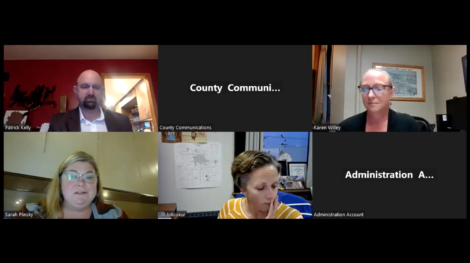
photo by: Douglas County screenshot
Assistant Douglas County Administrator Jill Jolicoeur gave the Douglas County Commission an update regarding the county's supportive housing and homelessness initiatives during the commission's Wednesday, Oct. 26, 2022 meeting.
A Douglas County leader says it’ll take more than just increasing capacity at the Lawrence Community Shelter to make a dent in homelessness in Lawrence, following recent calls from business owners and community members to boost capacity.
Last Tuesday, a group of prominent downtown business owners signed a letter to the city and county urging, in part, that the local governments take over operations at the nonprofit homeless shelter and declare a “shelter and housing emergency” in the community. Later the same day, the Lawrence City Commission discussed capacity at the shelter and learned from the shelter’s interim executive director, Melanie Valdez, that increasing capacity would take more funding and staffing.
Assistant Douglas County Administrator Jill Jolicoeur has been spearheading the county’s supportive housing and homelessness initiatives, and she gave Douglas County commissioners an idea of where things stood at the end of their meeting on Wednesday. Jolicoeur said county and city staff keep in weekly communication about issues related to homelessness, including recent conversations regarding the shelter.
Douglas County Administrator Sarah Plinsky, however, stressed that calls to expand shelter capacity should be tempered a bit and that the shelter isn’t the only answer to addressing homelessness in the community.
“The answer to solving homelessness is not a bigger shelter,” Plinsky said. “The answer is how do we move people out of emergency shelter and into more supportive and transitional and permanent housing? Simply warehousing people is not the answer to homelessness.”
That doesn’t mean the county doesn’t plan on continuing to support the shelter. Jolicoeur said the city and county continue to work together in determining the shelter’s 2023 funding agreement, which could be changed from its current arrangement. According to a memo from Jolicoeur included with Wednesday’s meeting materials, the county plans to shift its funding contribution of $296,000 per year away from a Community Partner Agreement, which since 2019 has been doled out across two payments.
Rather than that format, the county will continue to provide up to the same amount of funding it has been, $296,000, but instead on a quarterly basis through a services agreement. At this point, Jolicoeur said the county was still in the process of finalizing that agreement, at which point it will be brought back to city and county commissioners for their approval.
That type of agreement is the same one the county has with organizations like Bert Nash Community Mental Health Center, DCCCA and Artists Helping the Homeless. The services agreement will operate on a reimbursement basis, Jolicoeur said, and each round of funding support from the county will be based on whether quarterly reports from shelter leadership align with accompanying scope of work expectations. Scope of work details in a draft version of that agreement include serving up to 50 individuals on a nightly basis. Five of those spots would be dedicated transitional beds, two reserved for referrals from the Sheriff’s Reentry Division and three reserved for referrals from the City of Lawrence Homeless Initiatives.
“The number of folks that they’re indicating they can house on a nightly basis, with the county and city funding and other sources of funding they have, is 50,” Jolicoeur said of that draft requirement. “I think conversations between city and county staff were hopeful that number could be closer to 65, and we’re not getting an indication that that’s possible at this point.”
The shelter, generally, has the capacity to house 125 people and 140 during cold weather. But it reduced the number of beds it provides from 125 to 65 in August of 2019, citing budget issues initially, and has since continued to operate at the lower capacity due to staffing issues and a more recent “housing first” approach focused on quickly housing people. According to the shelter’s website, it can currently serve up to 50 individuals and two families.
Jolicoeur also spoke about the city’s temporary campsite in North Lawrence, which remains in operation under a 2020 city ordinance allowing camping on public property in the downtown commercial district when there’s no available space at the overnight homeless shelter. She said keeping a list of who’s staying at the campsite is important in order to help connect them with supportive services.
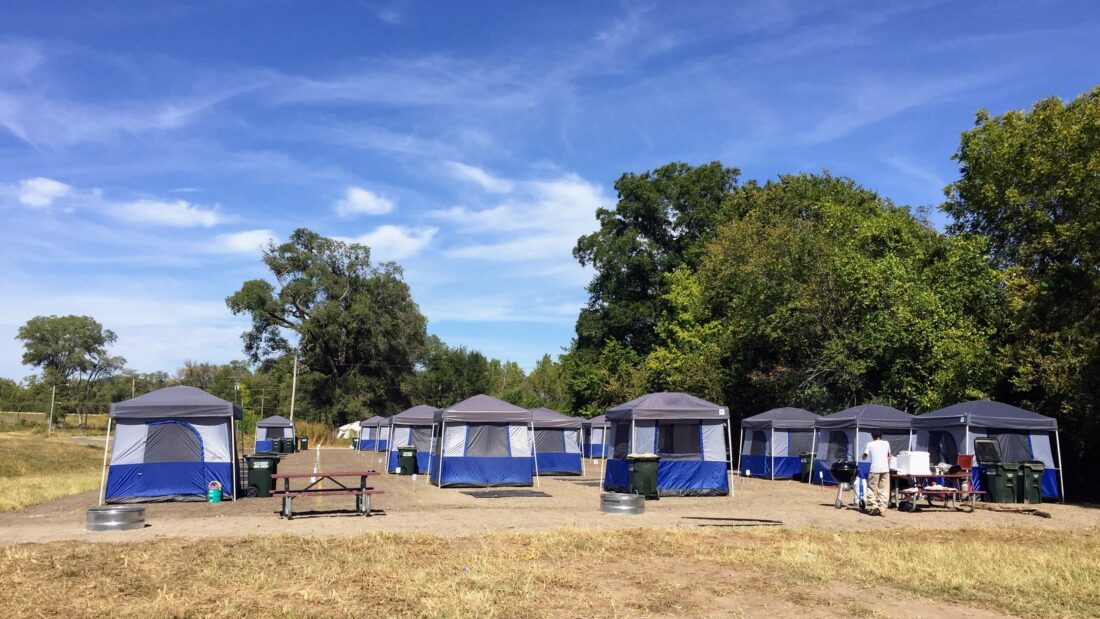
photo by: Rochelle Valverde/Journal-World
A city-run campsite for people experiencing homelessness is pictured on Sept. 30, 2022.
But Jolicoeur’s memo notes that county staff isn’t aware of any benefits or impact that would arise from declaring a shelter and housing emergency, nor is the county in a position to consult or comment on requests to rescind that ordinance.
“There’s a lot of coordination around making sure that we’re, to the best extent possible, monitoring the folks that are staying there,” Jolicoeur said. “… That coordination continues, and we provide that support.”
The county has been part of conversations regarding a permanent campsite location, but Jolicoeur said that to her knowledge a location has not been identified and there’s no proposal for how the site would be operated and supported on an ongoing basis.
Commissioner Patrick Kelly said he understood that a lot of folks were frustrated by the current homelessness situation, but he encouraged them to look at the best practices that are listed in the Built for Zero data-tracking initiative, which the county joined in 2020. That initiative’s goal is to achieve a milestone of “functional zero,” an ongoing state where homelessness is continuously rare and brief.
“… That’s a bit of a mind shift sometimes for people, and it’s why Douglas County invested so much of our (American Rescue Plan Act) funds in building supportive housing,” Kelly said. “It would be nice if we could just say ‘Poof, there’s $10 million worth of supportive housing in our community,’ but it’s going to take time to build up that inventory.”
One of the recipients of American Rescue Plan funding was the Housing Stabilization Collaborative, which helps to distribute funding for rent and utility assistance and is under the county’s administration. Jolicoeur said while a lot of the dollars the HSC has disbursed in the past couple of years were a result of coronavirus pandemic relief aid, the county also has ongoing funding support budgeted toward the collaborative.
“I feel really good about the collaborative spirit right now and the efforts to date, and I think that everybody’s doing the best they can right now, from my vantage point,” Jolicoeur said.
County Government
Douglas County commissioners to discuss proposed changes to funding agreements with community partners
County leaders express support for plan for the Wakarusa River Valley, but say this is just a starting point

As development pressures grow, Douglas County lays out drafted vision for Wakarusa River Valley
Douglas County Commissioner Gene Dorsey announces write-in campaign after losing in primary election
Douglas County commissioners support pilot idea to use ‘tiny homes’ to expand care after health crises