Leaders involved with new crisis center don’t dispute county’s claim that they missed deadline, failed to produce budget
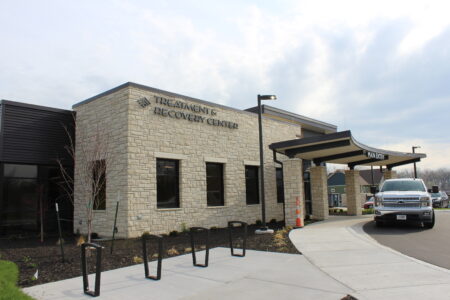
photo by: Austin Hornbostel/Journal-World
The Treatment and Recovery Center, located on the Treatment and Recovery Campus of Douglas County at 1000 W. Second St., is pictured on Friday, April 15, 2022.
The day after Douglas County’s top administrator addressed the source of tensions between the county and the nonprofit formed to oversee the yet-to-open, multimillion-dollar Treatment and Recovery Center of Douglas County, the center’s leader did not dispute any of the county’s claims — including that the nonprofit had yet to produce a budget and had failed to meet deadlines.
The nonprofit, Behavioral Health Partners, was formed by LMH Health and Bert Nash Community Mental Health Center to develop and manage the new behavioral health care center, which had a ribbon cutting in June but has yet to open. The leader of the center is Dr. George Thompson.
Near the end of Wednesday’s Douglas County Commission meeting, Douglas County Administrator Sarah Plinsky shared a number of concerns regarding Behavioral Health Partners’ oversight, including that the county still hasn’t received a budget for the center, that BHP missed a contractually committed opening date of July 1 and that the county has been concerned about the timeline for licensing the facility or exploring alternative licensing scenarios since May. Plinsky’s statement wasn’t listed as its own item on the Wednesday agenda and took place two and a half hours into the County Commission meeting.
Thompson, the center’s executive director and medical director, didn’t dispute any of those specifics in a response to the Journal-World’s request for comment, and said he is planning to share a press release soon “to introduce the community to Behavioral Health Partners.”
“Our plan is to continue to work closely with Sarah Plinsky to open the TRC as soon as possible,” Thompson said in an email response to the Journal-World Thursday afternoon. “I don’t have any further to add at this time.”
When asked for comment about Plinsky’s statement during Wednesday’s commission meeting, Bert Nash CEO Patrick Schmitz said only that “the Bert Nash Center is committed to providing excellent, quality care to our community.” A Bert Nash spokesperson said the Journal-World’s questions about the specifics of Plinsky’s comments — including whether the nonprofit failed to produce a budget and missed deadlines — needed to be directed to Thompson, not Schmitz, even though Schmitz is a member of Behavioral Health Partners’ board of directors, according to a list of members on LMH Health’s website.
Though Plinsky said there isn’t any agreement in place, the county did confirm earlier this week that there has been some discussion with Connections Health Solutions, an Arizona-based behavioral health crisis center, to operate the Lawrence center for several years. The Heritage Group, a health care-focused private equity firm, has Connections in its portfolio. Documents obtained by the Journal-World through a Kansas Open Records Act request show that leaders involved with Behavioral Health Partners were made aware of that consideration in September, following months of rising tensions.
As the Journal-World previously reported, Russ Johnson, LMH Health’s president and CEO, told LMH’s Board of Trustees that he’s not sure LMH Health would remain involved in the center if Connections, which he identifies as a “venture-capital owned company,” is running the center.
Thursday afternoon, however, Johnson said LMH Health’s “only focus” is “supporting BHP’s efforts to open the TRC as soon as possible, because that’s what’s best for our patients, their families and the community.”
Johnson declined to answer specific questions about Plinsky’s claims regarding licensing, budgets and timelines — like Schmitz, referring those questions “to BHP.”
“I know that there have been frustrations in this project — that’s not unexpected when developing an innovative model in a complex environment,” Johnson said in an email to the Journal-World.”Still, the remarkable nature of this community collaboration is what stands to make the Treatment and Recovery Center successful, and it’s why LMH Health answered the county’s call to play a role in this important initiative.”
County Government
Douglas County commissioners to discuss proposed changes to funding agreements with community partners
County leaders express support for plan for the Wakarusa River Valley, but say this is just a starting point

As development pressures grow, Douglas County lays out drafted vision for Wakarusa River Valley
Douglas County Commissioner Gene Dorsey announces write-in campaign after losing in primary election
Douglas County commissioners support pilot idea to use ‘tiny homes’ to expand care after health crises