Replacing local providers with out-of-state operator could delay behavioral health facility’s opening by months, director says
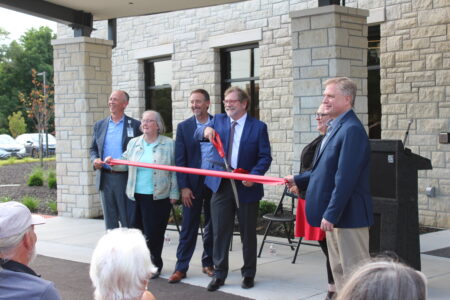
photo by: Austin Hornbostel/Journal-World
LMH Health CEO Russ Johnson; Laura Howard, the Secretary of the Kansas Department for Aging and Disability Services; Bert Nash Community Mental Health Center CEO Patrick Schmitz; Dr. George Thompson, the center’s executive director and medical director; Douglas County Commissioner Shannon Reid; and Bob Tryanski, the director of behavioral health projects for Douglas County, are pictured from left to right, as Thompson cuts the ribbon on the Treatment and Recover Center of Douglas County..
If an out-of-state company replaces local providers as the operator of Douglas County’s yet-to-open behavioral health care center, the facility’s director said it could add at least four months to the timeline for getting it open.
That’s because Connections Health Solutions, the Arizona-based behavioral health crisis center the county has been engaged in discussions with to take over operating the Treatment and Recovery Center of Douglas County, would have to get its own license, Dr. George Thompson, the Treatment and Recovery Center’s executive director and medical director, told the Journal-World during an interview on Tuesday.
Behavioral Health Partners, the nonprofit formed by LMH Health and Bert Nash Community Mental Health Center to develop and manage the center in 2020, was just granted a provisional license for the center last week. That process started in early June and was completed Oct. 11.
Connections would have to go through the same process that Behavioral Health Partners did, Thompson said, and officials at the state level have already told him it couldn’t be expedited.
”I would say (four months) is the minimum,” Thompson said. “… I don’t think it could happen any faster than that.”
Questions in the community have been mounting about when the behavioral health center will open, and county officials have asked for the public’s patience. The center hosted a ribbon cutting in June, but it never opened. On Monday, the Journal-World reported on documents that showed LMH Health leaders believed a key part of the project — an access center that could help people in mild crisis — was ready to open in mid-July. Documents from LMH Health also stated they believed the entire center could be open by Nov. 15.
On Tuesday, Thompson said he also believed the project was in a position to open soon, but he acknowledged that Douglas County leaders must be involved in that decision.
“We do have a team that’s ready to go, but readiness is a collaborative endeavor, too,” Thompson said Tuesday. “… The county holds the responsibility for assessing our readiness. We also have a very important role to play in readiness assessment, but we’re working collaboratively to establish what’s the mechanism to say ‘Yes, open the door,’ and what are the criteria, the measures to do that.”
On Monday, County Administrator Sarah Plinsky confirmed to the Journal-World that county administration believes additional resources will be necessary for the center to open and operate successfully, and that she’s considering recommending that Connections be awarded the contract to operate the center for the first several years of its existence, rather than the local group led by Bert Nash and LMH Health. Plinsky, though, said there’s no agreement currently in place for Connections to operate the Treatment and Recovery Center.
If there ever is, Bert Nash CEO Patrick Schmitz said it would have a still-to-be-determined impact on not just the center’s funding but also on Bert Nash’s funding as a whole.
Schmitz and LMH Health CEO Russ Johnson were also part of Tuesday’s conversation with the Journal-World. The center is a “designated collaborating organization” with Bert Nash via the agency’s new Certified Community Behavioral Health Clinic designation, an agreement which allows the center to provide certain services. In this case, the Treatment and Recovery Center is being granted the ability to provide crisis services, which Thompson said is actually an exception to a requirement that only Bert Nash itself could provide such services typically.
Schmitz said a designated collaborating organization relationship of this kind wouldn’t be possible with Connections; in fact, he said the relationship between Bert Nash and the Treatment and Recovery Center is the only one of its kind in Kansas, to his knowledge. As of Tuesday, Schmitz said Bert Nash hadn’t yet calculated the specific financial impact that could result from Connections taking over operations.
“We’re having to figure out, if it goes that direction, what is the impact not only for this project but for our CCBHC overall, in the short-term as well as in the long-term,” Schmitz said.
As for LMH Health, Johnson said part of this debate with Douglas County goes back to a contentious community conversation the hospital had a couple of years ago.
In 2020, the hospital was poised to replace a local physicians group that oversees the hospital’s emergency department with a large national firm — Envision Physician Services, a hedge fund-owned company. That plan was put on pause after a large number of community members began speaking out.
“I think a number of folks have pretty accurately drawn that parallel,” Johnson said. “For me, that was definitely part of my better understanding and learning what Lawrence’s culture and sensibilities and priorities and desires are. I think the message in that time was ‘We really value keeping things local,’ and that’s a message I’ve taken to heart.”
Like the company LMH had chosen to run its emergency department, Connections is heavily funded by a private equity firm. The Nashville-based Heritage Group invested $30 million into Connections in 2021, according to an announcement from both companies.
Johnson has said the fact that Connections is part of a private equity firm could play a role in where officials with Connections send patients for further care.
“It’s important to note that the introduction of a private equity firm — one with many other for-profit healthcare entities in its holdings — would likely result in patients being referred outside of our community for care,” Johnson said in an email Monday. “Competition of this nature means that our local non-profit healthcare providers will have less opportunity to fund the millions of dollars of charitable care needed in our community each year.”
County officials, though, have expressed their own concerns about how the local coalition of providers has been working to open the center. Documents obtained by the Journal-World through a Kansas Open Records Act request indicated how sharp some of the concerns had become. In one email from Johnson to Plinsky — sent Sept. 12 — Johnson notes that Plinsky during a meeting earlier that month commented that Connections “got more done in two weeks than your organizations did in two years,” a characterization that Johnson disagreed with.
Plinsky also told the Journal-World on Monday that county officials have repeatedly made BHP leadership aware of their concerns since the beginning of this year.
Johnson acknowledged some of those concerns and frustrations in a Sept. 21 email to Thompson. Johnson said the list of concerns he had heard from the county included: not meeting the county’s deliverable expectations; not understanding and addressing the depth of the county’s frustrations; not being open or transparent in ways that were meaningful to the county; having LMH Health and Bert Nash in too much of a front and center role after the Behavioral Health Partners board was formed; and not including the county in decisions which it wanted to be involved in.
County Government
Douglas County commissioners to discuss proposed changes to funding agreements with community partners
County leaders express support for plan for the Wakarusa River Valley, but say this is just a starting point

As development pressures grow, Douglas County lays out drafted vision for Wakarusa River Valley
Douglas County Commissioner Gene Dorsey announces write-in campaign after losing in primary election
Douglas County commissioners support pilot idea to use ‘tiny homes’ to expand care after health crises