Nonprofit guiding crisis center says it’s prepared to enter into operating and lease agreements immediately
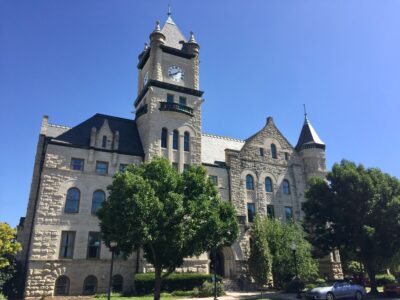
photo by: Journal-World
The west side of the Douglas County Courthouse, 1100 Massachusetts St.
The nonprofit guiding Douglas County’s yet-to-open behavioral health crisis center asserts that it’s prepared to enter into operating and lease agreements immediately.
That assertion is one of several items in a progress update that the nonprofit, Behavioral Health Partners, is set to give to the Douglas County Commission — the first update in a month.
Behavioral Health Partners’ presentation about the Treatment and Recovery Center of Douglas County at Wednesday’s commission meeting is expected to cover the status of a list of more than 20 deliverables that Douglas County Administrator Sarah Plinsky had said remained outstanding in early November.
Along with the presentation, a document included with the agenda materials addresses each deliverable and gives more context for BHP’s assertion that it’s ready to enter operating and lease agreements.
“We recommend developing a lease and operating agreement for opening as soon as possible, with stipulations that the county serve as payor only for uninsured and under-insured patients and only as a last resort,” progress information about the operating agreement reads. “We are confident in the business model of this crisis center and limiting the exposure of the county to losses.”
Other highlights from the presentation include information about its licensing and accreditation status. The TRC can use Bert Nash Community Mental Health Center’s accreditation, and BHP asserts that the facility’s temporary private psychiatric hospital license is “sufficient for opening, according to the state.” That’s a notion Douglas County leaders acknowledged as technically accurate last week, but disagreed about it being the final indicator of the center’s readiness to open.
The presentation also includes a phased opening plan for both the front-of-house “access center” intended for less severe patients and the observation and stabilization units intended to accommodate patients who need to stay from 23 to 72 hours.
The first phase would see the access center open on weekdays and the longer stay units open with a capacity of five patients per day. The second and third phases would include a fully open access center, which includes some weekend hours. The observation and stabilization units, meanwhile, would continue to open incrementally across those two phases, first increasing capacity from five to eight patients per day in phase two, and in phase three fully opening with the capacity to serve 16 patients per day.
In other business, the commission will:
• Continue discussing redistricting of the County Commission from three members to five.
The commission discussed some map options for the new commission districts hours into last week’s commission meeting, and this week will look to discuss five additional map options.
The five new maps, titled “Douglas County A” through “Douglas County E,” do have some additional wrinkles that haven’t been available for previous maps — the percentage of the population in each proposed district that lives in an incorporated city, and zoomed-in maps that show each district down to specific precincts.
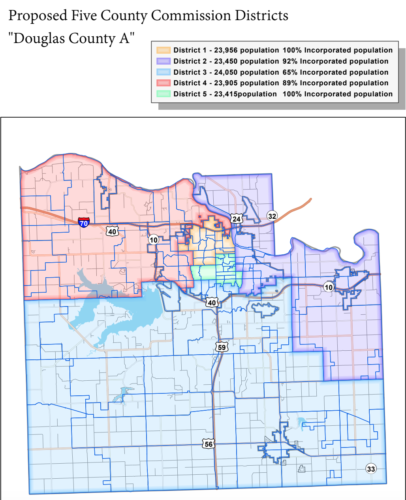
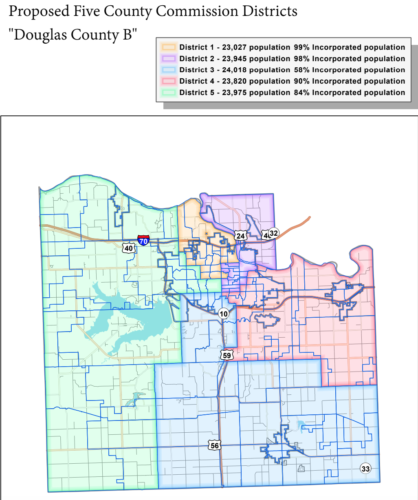
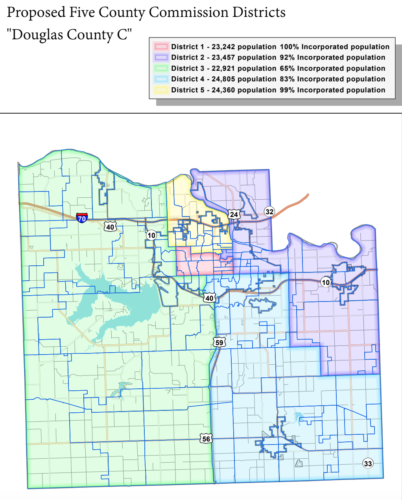
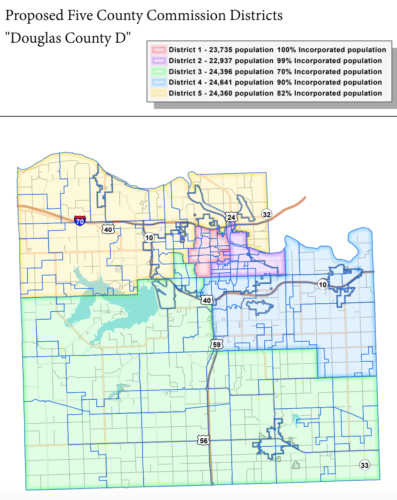
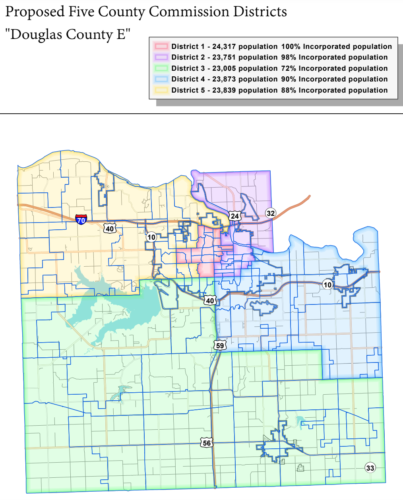
While one early map option — the “County” map — included a district located entirely outside of the City of Lawrence, all five new maps include at least a portion of Lawrence in every district.
The commission has until Jan. 1 to approve a new map of commission districts.
• Consider extending funding to Lawrence nonprofit DCCCA for a social detox project through the end of June 2023.
The county partnered with DCCCA and LMH Health to offer peer-led intervention in the LMH emergency department for patients experiencing a behavioral health crisis primarily involving substance abuse starting in 2019. The project aimed to target the limited availability of detox beds in Douglas County until the Treatment and Recovery Center was fully operational.
Outcomes from that project have been “impressive and impactful” for nearly four years, according to a county staff report, but staff is now concerned that clients in need of social detox services will no longer be served when funding expires at the end of 2022 with the delays in the TRC’s opening. The six-month extension would be funded by behavioral health sales tax dollars originally budgeted to DCCCA to provide peer support in the TRC.
• Consider adopting the amended 2022 county budget.
Commissioners are being asked to approve amendments to the 2022 budget’s ambulance fund, special alcohol fund and grants fund.
Wednesday’s business meeting will begin at 5:30 p.m. at the Douglas County Courthouse, 1100 Massachusetts St. The meeting will also be available by Zoom. For meeting information, visit the county’s website: dgcoks.org/commissionmeetings.
County Government

General Election Voter’s Guide

An incumbent Douglas County commissioner faces no opponent in general election

Incumbent Douglas County commissioner and newcomer challenger face off for District 5 seat

Primary winner faces incumbent’s write-in campaign in Douglas County Commission District 4
Douglas County commissioners to discuss proposed changes to funding agreements with community partners