Kansas 2018 races for governor, Congress drawing unusually crowded fields
Topeka ? Kansas Insurance Commissioner Ken Selzer plans to hold a barbecue event in Louisburg Sunday afternoon to officially kick off his campaign for governor in 2018.
Selzer, 64, a Republican and relative newcomer to Kansas politics, will become at least the sixth Republican to enter the race, and the 10th candidate overall, and he thinks the race will get even more crowded in the weeks and months to come.
“We are focused on running our own campaign, we’re not concerned about how many others are in the race,” Selzer said in a telephone interview Friday. “We fully expect more to join the race and we welcome everyone who wants to enter the race.”
With 11 months still to go before the 2018 primaries, the governor’s race is not the only political race Kansas drawing an unusual amount of competition.
So far, six candidates have lined up to succeed 2nd District Congresswoman Lynn Jenkins of Topeka, including four Republicans and two Democrats. And five Democrats are actively vying for the right to challenge 3rd District Congressman Kevin Yoder of Overland Park.
“I’ve been here 40 years and I’ve never seen anything quite like it, to tell you the truth,” University of Kansas political scientist Burdett Loomis said in an interview. “I think it illustrates a tremendous uncertainty in Kansas politics right now, where everybody I think sees a path to becoming governor.”
Governor’s race
This year’s governor’s race is something of an open competition. Incumbent Gov. Sam Brownback, a Republican, is term-limited. But he also is planning to leave soon because he has also been nominated for a diplomatic post in President Donald J. Trump’s administration, and if he’s confirmed, that would elevate Lt. Gov. Jeff Colyer to the governor’s office.
Colyer has already announced that he intends to seek a full four-year term of his own.
In addition to Colyer and Selzer, there is a third statewide elected official in the governor’s race, Secretary of State Kris Kobach.
Before he was elected Insurance Commissioner in 2014, Selzer spent 35 years working in the private sector, in the somewhat obscure world of insurance, accounting and reinsurance. His only other experience as an elected official was that of a Fairway city councilman.
But Selzer says he expects his business experience to set him apart from the other candidates.
“I’m a businessman that understands customer service,” he said. “I’m a CPA and I understand budgets, all of which are incredibly important to state government. My business background becomes a significant asset as I enter this governor’s race.”
Meanwhile, there are at least three other Republicans in the race for governor: Wichita businessman Willis “Wink” Hartman, who is president of an oil and gas production business; former state Sen. Jim Barnett, a Topeka physician and the party’s 2006 nominee; and former Rep. Ed O’Malley, who now heads the Wichita-based Kansas Leadership Institute.
Michael Smith, who teaches political science at Emporia State University, said that among the Republicans, Kobach clearly has the most statewide name recognition and may be considered the front-runner because GOP primaries tend to favor conservatives.
“However, he has very high negatives,” Smith said, referring to a 2016 “Kansas Speaks” poll by Fort Hays State University. “People either love him or hate him.”
One other Republican has filed paperwork naming a campaign treasurer in the race, Leawood resident Patrick Kucera. He does not maintain a campaign website and GOP officials say they have not heard from him since he filed that paperwork in February.
For the Democrats, House Minority Leader Jim Ward of Wichita officially entered the race Aug. 19. He joined former Wichita Mayor Carl Brewer, former state Rep. and former Kansas Agriculture Secretary Josh Svaty, and Olathe physician Arden Andersen in that primary.
2nd Congressional District
The 2nd District congressional race is drawing a large number of candidates because it is an open race this year, something that hasn’t happened since 1994.
Incumbent Rep. Lynn Jenkins, a Topeka Republican, announced in January that she would not run for another term. Many were anticipating that she would run for governor, but she now says she is done with politics and plans to return to private sector work.
So far, six candidates — four Republicans and two Democrats — have stepped up in hopes of filling that seat.
Of those, Democrat Paul Davis, a Lawrence attorney and former House Minority Leader, has the most experience on the big political stage. He was the 2014 nominee for governor, losing narrowly to Brownback, who won with less than 50 percent of the vote.
Davis carried the 2nd District in that gubernatorial race, but the district has leaned Republican in all recent presidential and U.S. Senate races.
The other Democrat in the race is Neosho County resident Kelly Standley, who was previously active in Colorado politics where he ran for that state’s Senate in 2012 as an unaffiliated candidate.
On the Republican side, three sitting state lawmakers and a sitting Basehor city councilman have entered the race.
The most recent of those is Sen. Caryn Tyson of Parker, a conservative who currently chairs the Senate Tax Committee. She is also the daughter-in-law of a former Senate Majority Leader, Robert Tyson, who served in the 1990s.
She joins two other conservative lawmakers in the GOP primary, Sen. Steve Fitzgerald of Leavenworth, a retired military officer, and Rep. Kevin Jones of Wellsville, also a former soldier who now works as a real estate agent.
Also running is Basehor city councilman Vernon J. Fields.
3rd Congressional District
The 3rd District congressional seat is drawing an unusual amount of attention this year, even though it is not an open seat.
However, incumbent Republican Rep. Kevin Yoder of Overland Park is increasingly seen as vulnerable. He won re-election in 2016 with only 51 percent of the vote, in a district where Democrat Hillary Clinton edged out Republican Donald Trump in the presidential race.
Smith, the ESU professor, pointed to Johnson County, a traditional Republican stronghold that makes up the bulk of the district, as an area where political leanings are shifting rapidly.
“I have a list on my computer of every county in America by vote shifts between 2012 and 2016, and in the category of counties that shifted toward the Democrats, Johnson County is in, I believe, the top 20 nationally,” Smith said. “It’s not Trump country. It might be Mitt Romney country, but it’s not Trump country.”
Competition among Democrats for the right to challenge Yoder has been stiff.
Andrea Ramsey, who has headed a charity children’s clinic in Wyandotte County the last eight years, has received a number of key endorsements, including the feminist fundraising group EMILY’S List.
On Friday, though, veteran teacher Tom Niermann released a lengthy list of his own endorsements from women leaders in the suburban Kansas City area.
Also in the Democratic race is Chris Haulmark, a disability rights advocate from Olathe; and Bonner Springs labor rights attorney Brent Welder.
And on Sept. 25, Mission Woods financial consultant Jay Sidie, who lost to Yoder in the 2016 race, will formally announce that he is running again.
The independent political rating website Cook’s Political Report recently lowered its rating of the 3rd District to “lean Republican” instead of “likely” or “solid” Republican, mainly because of Trump’s weak showing in the district and Yoder’s own narrow re-election victory.
Smith said the key to the 3rd District race may be whether Democrats can turn out their base in Wyandotte County, something they have had difficulty doing in recent years.
“I’ve heard many people mention to me over the years that the Democrats don’t really make the efforts they could on turnout,” he said. “If voters in Wyandotte County ever started showing up, it could shift that district even more.”
City Government
Abandoned housing pilot program, data center rules, funding clawback for Bert Nash project on City Commission’s agenda
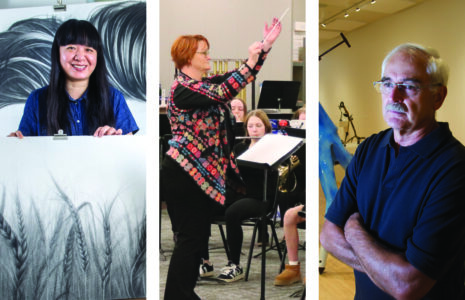
KU professors, middle school band director, radio personality among this year’s Phoenix Award honorees: ‘It’s a cool mix’
Housing Stabilization Collaborative’s request for city trust fund aid won’t be considered because it was filed late
On sister city visit, delegates from Hiratsuka, Japan, see Lawrence’s friendship firsthand
Voters Guide: Lawrence voters will decide whether to raise transit sales tax