Police patrols work around high fuel costs
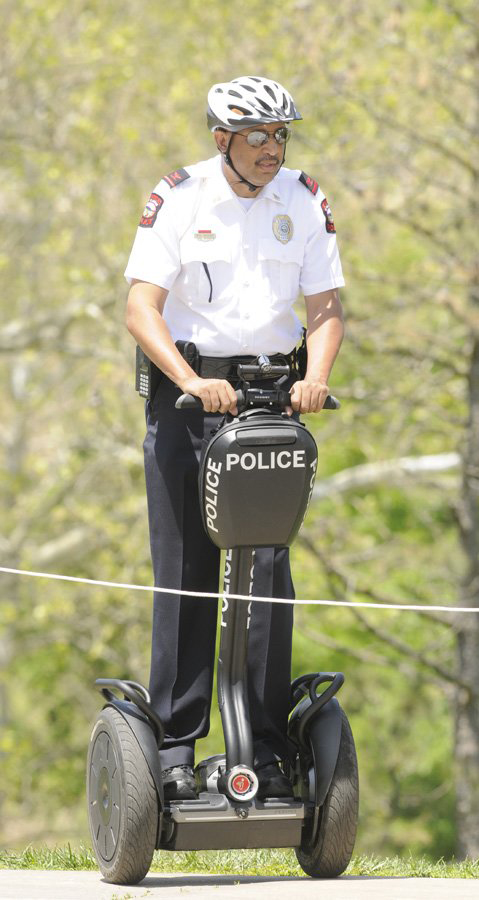
Ralph Oliver, chief of the Kansas University Public Safety Office, uses a Segway scooter on a recent patrol of campus.
Police budget
A year ago when Eudora Police Chief Greg Dahlem submitted his department’s 2008 budget to city leaders, he estimated gasoline costs at $4.25 a gallon.
He wasn’t far off.
In this area, gas prices have steadily inched toward the $4 mark, and there is still more than half the year to come.
“You just never know what is going to happen,” Dahlem said about fuel prices.
Just like the people they’re sworn to protect, local and state law enforcement agencies are keeping a wary eye on the price at the pumps.
Eudora police still have 75 percent of their fuel budget intact, but Dahlem isn’t taking any chances. Fuel conservation measures are being practiced. Officers don’t idle their patrol cars’ engines more than necessary, he said. Instead of staying in the car and using a spotlight to check businesses at night, officers should get out and walk, Dahlem said.
“That’s what I like them to do, period, when checking downtown businesses,” he said. “Just shut it off and walk up one side of the street and back down the other.”
Alternative patrolling
Foot patrols also are getting a new emphasis at the Kansas University Public Safety Office because of fuel costs. Earlier this year, the department purchased two $5,000 Segways. The two-wheeled, battery-powered, one-man transporters increase officer visibility and are useful for monitoring crowds as well as moving around campus, Maj. Chris Keary said. They also help cut gasoline costs.
“On an everyday basis, officers can use them to do their patrols instead of driving the car,” Keary said.
KU security officers, who handle much of the campus building security duties, use an electric car. The $12,000 vehicle purchased last year looks like a small truck with a bubble canopy. It has worked well, especially because security officers have more area to cover as West Campus continues to grow, said Elizabeth Phillips, who oversees that branch of the public safety office.
“We look at it as a cost-saving measure, but it still gives us mobility,” she said.
Maintaining services
Other law enforcement agencies are studying ways to hold down fuel costs but so far haven’t implemented major changes in the way they patrol. Lawrence Police Chief Ron Olin recently told the City Commission that if prices continue rising, patrol officers might have to park more often. And the chief said more foot and bike patrols might be necessary.
Lawrence police budgeted $257,234 this year for gasoline. So far it has used 38 percent of its fuel funding.
Douglas County Sheriff Ken McGovern is considering establishing an in-house committee of employees to study ways of cutting fuel costs, department spokeswoman Lt. Kari Wempe said.
“Cutting service to the community isn’t going to work very well,” she said. “We still have to patrol the roads and keep the community safe. That’s our job.”
Kansas Highway Patrol troopers last year spent 373,989 hours patrolling more than 14.1 million miles, department records show. During the fiscal year from July 1, 2006, to June 30, 2007, the KHP purchased 984,874 gallons of gasoline and spent more than $2.2 million, which averaged $2.24 per gallon. The totals do not include aviation fuel.
“We are aware we may have to make some changes, but not immediately,” Patrol spokes woman Trooper Edna Buttler said.
Agents with the Kansas Bureau of Investigation do not have patrol duties, but they travel throughout Kansas assisting local departments with investigations. Agents travel about 140,000 miles each month and use 7,000 gallons of fuel a month, KBI Director Robert Blecha said. Agents in western Kansas often drive 4,000 to 5,000 miles a month, he said.
The KBI budgeted $294,000 for fuel for the next fiscal year, which begins July 1. That’s $64,000 more than the past fiscal year.
“We will not cut back on investigations. We’ll just have to cut somewhere else,” Blecha said.
KU upgrades police car fleet
Kansas University’s Public Safety Office has some brand new rides.
The department recently purchased four new 2008 Ford Crown Victorias to replace the 2003 models the department had been driving around. The new cars have a new design, which depicts the changes in the Jayhawk logo over the years. They also have LED lightbars on the top, which use less battery power than the older models.
The older cars, however, haven’t been sent to the scrap yard. They’re experiencing a new life as cars for detectives and other nonpatrol officers.
“The cars that are being switched out have a minimum of 105,000 miles,” assistant police chief Chris Keary said. “Some have as much as 130,000 miles.”
The new cars are able to run on E85, a blended fuel of ethanol and gasoline, which the previous cars were unable to do.
City Government
Lawrence city leaders to discuss potential ballot question on whether mayor should be directly elected
‘A bright future ahead for bikeability in Lawrence’: Committee puts its final touches on new bike infrastructure plan
Lawrence city leaders set max mill levy at what budget proposal recommends; they also approve transit sales tax ballot question
Lawrence City Commission starts process of developing data center rules, imposes 24-month moratorium
Would an Algerian sister city work? Only if Lawrence does the work, those with experience say