

Senate supports Bush plan, but others express concern
President's plan to seal the border will boost migrant deaths, some say
Topeka ? President Bush’s call to use the National Guard to seal the border with Mexico is a political move that could backfire, making the crossing more dangerous for desperate Mexicans seeking work and keeping in the U.S. some illegal immigrants who might otherwise return home.
That’s according to Melinda Lewis, director of policy advocacy and research for El Centro, which is based in Kansas City, Kan.
As the U.S. Senate handed the president a victory Tuesday, voting down a measure focused mostly on enforcement, Lewis and other Kansans responded to Bush’s plan.
Lewis said beefing up border security could have unintended effects.
“The main two outcomes are that there will be an increase in deaths along the border, and people who do come here don’t go back because the border will be too dangerous to cross,” she said.
The deaths would occur as immigrants seek more remote and dangerous areas to cross, she said.
Trying to weave a political compromise on immigration, Bush on Monday said he would rotate a force level of 6,000 National Guard troops to help the Border Patrol.
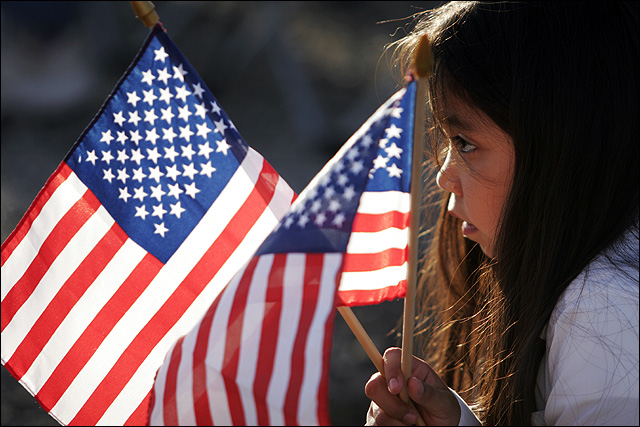
Chelsea Herrarte, 8, holds American flags at a rally last year in Emporia.
And he urged Congress to set up a guest worker program and a process so that millions of undocumented immigrants could become citizens.
Lewis said the plan to use the National Guard was meant to appease hard-line Republicans who want a strict crackdown on illegal immigration.
And it drew praise from the Republican Party of Kansas, which issued a statement claiming “most Americans felt it was a definite step in the right direction.”
But, Lewis said, it’s doubtful increased enforcement will work; it simply will drive up the stakes.
“As long as we continue to see an immigration system that is so hopelessly out of touch with both sides of the border, no amount of law enforcement that you pour into the border is going to have much of an impact,” she said.
But Lewis praised Bush for speaking sympathetically of those who come here seeking a better life.
More about immigration reform
- 6News video: Trade rep says business key to stemming illiegal immigration tide
- Trade representative sees economic solution
- Senate supports Bush plan, but others express concern
- Immigration politics proceed in, out of D.C.
- Sebelius wary of new call (05-16-06)
- Guard to join border patrol (05-16-06)
- President Bush Addresses the Nation on Immigration Reform
“His statements that the vast majority are really good people at heart : to have the president say that is not an inconsequential thing,” she said.
Double-pronged
Bush called for a comprehensive approach to the issue: increased security on the border and methods to provide citizenship.
He seemed to notch an early congressional victory as the Senate defeated a measure Tuesday aimed at securing the border before tackling other concerns such as citizenship.
Sen. Sam Brownback, R-Kan., voted against the measure while Sen. Pat Roberts, R-Kan., voted for it. Brownback has said he supports increased enforcement and a guest worker program, while Roberts has said securing the border should be the top priority.
In the House, a majority of Republicans are focused on enforcement first. In December, the House approved an immigration bill that called for a 700-mile fence along the border and made it a felony to remain in the U.S. illegally or assist anyone who was.
U.S. Rep. Jim Ryun, R-Lawrence, supported that measure. He described Bush’s new proposal “as a good first step.”
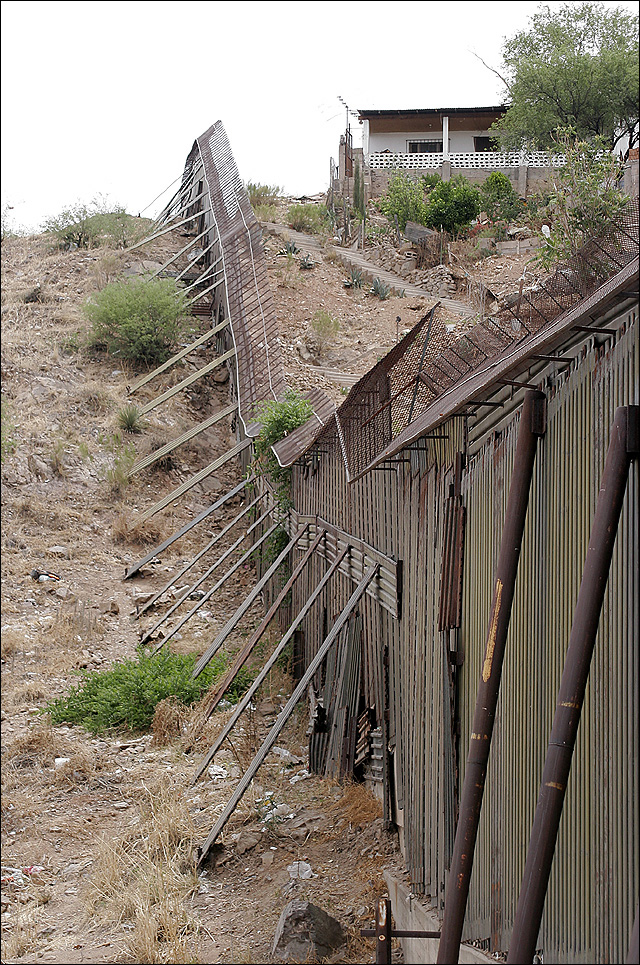
This is the border fence that separates the United States, left, from Mexico outside Nogales, Ariz.
Ryun said he was willing to consider a guest worker program “after we do border enforcement.”
Ryun also said that “at first blush” he supports the use of National Guard troops while more Border Patrol agents are trained.
Under the plan, the Guard troops would mostly serve two- to three-week stints, which could require nearly 160,000 troops to fulfill the rotation.
No word yet
Joy Moser, a spokeswoman for the Kansas National Guard, said the state hadn’t received details of Bush’s plan by Tuesday and didn’t know whether Kansans would be part of the mission.
“We haven’t had any official word yet,” Moser said. “It’s possible that they will start with border states, but I’m assuming that they will have a plan that will include other states.”
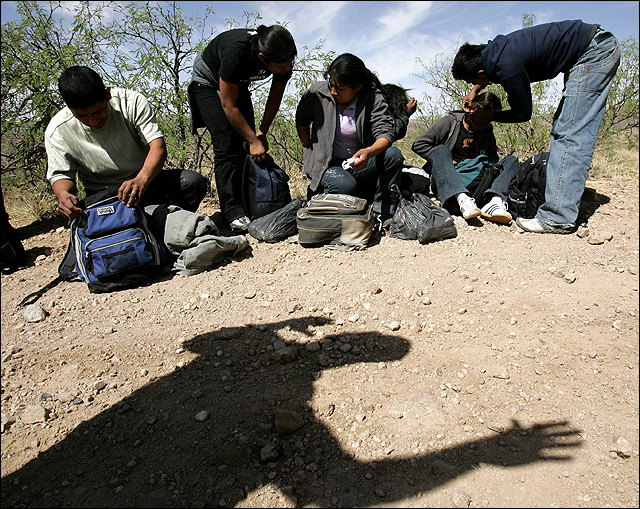
The shadow of a U.S. Border Patrol agent is cast below a group of migrants detained near Arivaca, Ariz. Reaction to President Bush's plan to use National Guard troops to beef up border enforcement received mixed reviews Tuesday.
Kansas has 7,700 Guard troops and approximately 1,000 are deployed in connection with operations in Iraq and Afghanistan.
Some border representatives opposed the use of National Guard troops.
U.S. Rep. Solomon Ortiz, a Democrat and former sheriff whose district includes much of south Texas, said the National Guard would be ineffective.
“Putting the military in the middle of what is a difficult civilian policing job is exactly the wrong way to do it,” Ortiz said.
U.S. Rep. Silvestre Reyes, a Democrat from El Paso and 26-year Border Patrol veteran, said it also would hurt American interests.
“A wave of anti-American sentiment is already sweeping across Latin America, and a deployment of military forces to the U.S.-Mexico border will only fuel these views,” Reyes said.
Ray Rojas, an El Paso native who now represents Migrant Worker Solidarity in Lawrence, agreed.
“Once you bring the military in to do police work within a civilian area, you are taking away a big separation that we have had in our country,” he said.
State Government
‘If it ain’t broke, don’t fix it’: Retired Judge Sally Pokorny tells residents why she opposes electing Supreme Court justices

KU professors would be limited in how they could present the idea of systemic racism in future classes
State legislators push back against federal energy regulators ending competitive bids
TOPEKA — Two Kansas legislators asked federal energy regulators to ensure competitive bidding occurs on ...
Senate confirms 1st of 3 Kansas nominees to U.S. District Court
Corporate income tax collections falling sharply in Kansas; Republican, Democratic leaders disagree on what it means
TOPEKA — Corporate income tax collections in Kansas have almost halved since last year, while other sources trend ...
Candidate’s campaign manager created website with documents used to attack rival
TOPEKA — Kansas U.S. Senate candidate Patrick Schmidt’s campaign manager left his digital footprint on ...