‘If it ain’t broke, don’t fix it’: Retired Judge Sally Pokorny tells residents why she opposes electing Supreme Court justices
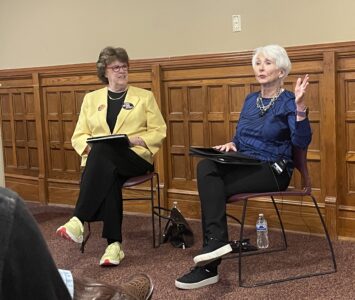
photo by: Sylas May/Journal-World
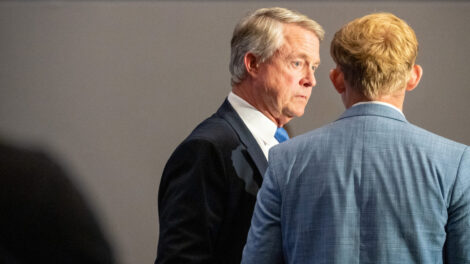
Retired Judge Sally Pokorny, right, speaks with former Kansas Supreme Court nominating commission member Kathy Webb, left, at an event at the Watkins Museum of History on Friday, June 12, 2026.
When the Kansas Bureau of Investigation began its inquiry into Sally Pokorny, she was perfectly cooperative.
The KBI agent wanted to talk to her neighbors. She gave him a few names, but the agent, thinking those ones would just say positive things about her, told her he “went and talked to all the other neighbors, too.”
She asked if he called her ex-husband. He said, “Oh, no, I pulled your divorce file, looked pretty amicable to me.”
Pokorny hadn’t done anything nefarious. The reason she was under investigation, she told a crowd of listeners at the Watkins Museum of History on Friday, was that she was a judicial nominee in Kansas’ merit-based system, and if your name makes it to the governor’s desk, “you have a KBI background check done on you.”
“They do look at that,” said Pokorny, who recently retired after 17 years as a judge in Douglas County District Court. “Nothing is off-limits.”
But the thorough vetting process could change for candidates for the state’s highest court if voters approve a proposed constitutional amendment that’s on the ballot in August. If passed, it would change the selection process for Kansas Supreme Court justices from the current merit-based system, which uses a nonpartisan nominating commission, to a system where voters would elect Supreme Court justices.
On Friday at the Watkins Museum, Pokorny and her longtime friend Kathy Webb, who’s served on the nominating commission, discussed the problems they saw with the amendment in a conversation hosted by the advocacy group Women for Kansas. Pokorny said Kansas is one of 32 states with a merit-based system, and “if this gets changed, we will be the first state to back away from a merit selection system in place.”
She said she’s seen things passed in the Kansas Legislature that have “terrible blowback” or “unintended consequences,” and that the amendment being proposed leaves many questions unanswered about how the elections would work.
“We don’t know, one, whether this is going to be a partisan election. Are you going to run as a Republican or a Democrat? That’s not clear in the amendment.” she said. “… Can you also be the chair of the Republican Party and be a Supreme Court justice? There’s no clarity on that.”
Beyond that, she said there are more fundamental reasons why politics and the judiciary shouldn’t mix.
One of her mantras, Pokorny said, is, “If it ain’t broke, don’t fix it. And nobody has convinced me that this system is broke!”
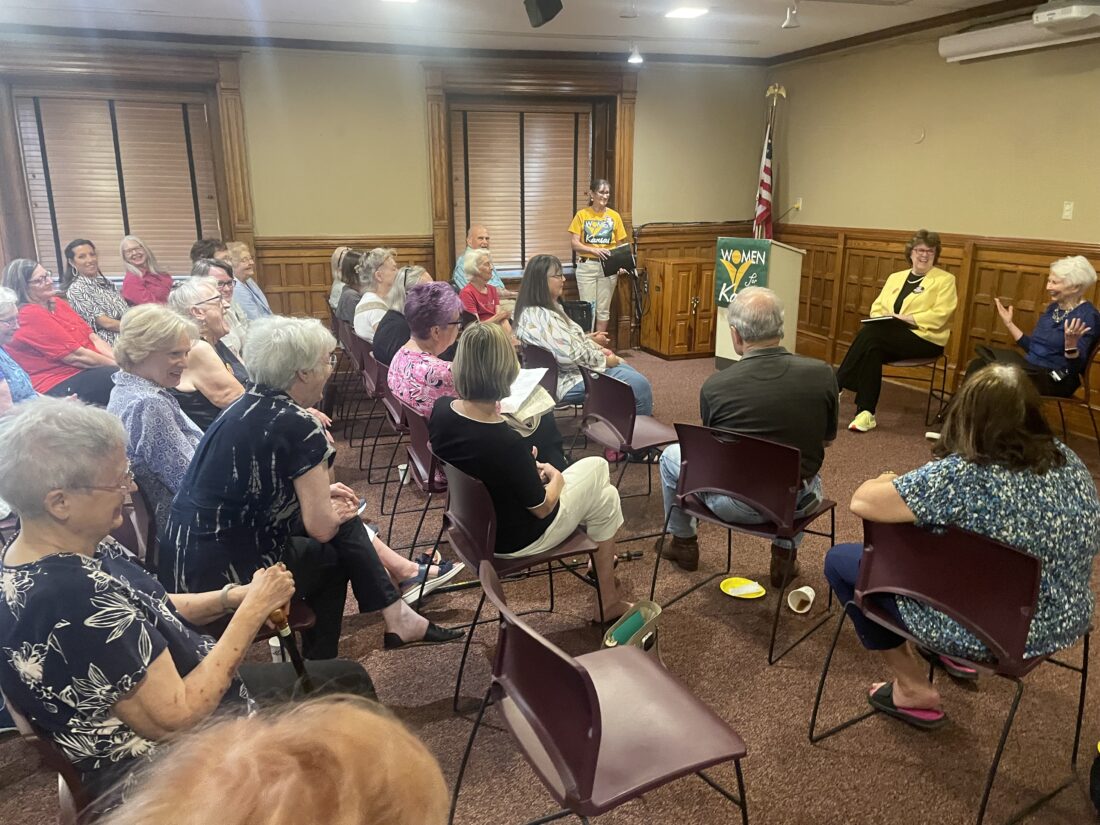
photo by: Sylas May/Journal-World
Retired Judge Sally Pokorny and former Kansas Supreme Court nominating commission member Kathy Webb take part in a discussion at the Watkins Museum of History on Friday, June 12, 2026.
The process now
Webb said Kansas implemented its merit selection process for a good reason. It was done in response to a 1950s political scandal known as the “Triple Play.”
According to an account from Humanities Kansas, the scandal went like this: Incumbent Gov. Fred Hall lost the Republican primary during his 1956 reelection campaign. Then, on Dec. 31, 1956, the chief justice of the Kansas Supreme Court, longtime Republican William Smith, resigned. Hall himself then resigned as governor, which elevated his lieutenant governor, John McCuish, to the governor’s office. McCuish then immediately appointed Hall to fill the new vacancy on the Supreme Court.
“That did not sit well with Kansans,” Webb said. “And that resulted in the merit-based selection process that we have today.”
The current process uses a nonpartisan commission to vet candidates before sending them to the governor, and Webb served on that commission for four years. She said the commission has nine members. Four of them are lawyers, one from each congressional district, and these are chosen by lawyers. Four are laypeople chosen by the governor. And a chair is elected by lawyers around the state.
Those members are responsible for diving deep into each candidate’s background, Webb said, and because the application that candidates submit is over 100 pages, “that’s a huge process.”
“They have more than a thousand pages to review,” Webb said.
This includes all sorts of information about the person. Some of it is financial data. Pokorny said that during her own vetting process, she had to turn over information on her assets and her credit report.
“And the reason for that is that you want to make sure that you’re going have a judge – or justice – who’s not subject, potentially, to bribery or bankruptcy,” she said. “Either one is not a good look for a judge.”
Candidates have to submit a writing sample that shows they know how to think through a legal problem, Pokorny said, and they have to get a recommendation from a judge: a letter that says, “Yes, this person has appeared in front of me, they have always been prepared, ethical, honest, done a good job, they’re competent, they would make a good judge.”
They also have to list references that the vetters can call, such as other attorneys who have been in court with them and can assess how they performed.
These assessments aren’t sugarcoated, either, Pokorny said.
“Maybe a year ago, I had an attorney put me down as the name to call, because he had practiced in front of me,” she said. “And I said no. No, no, no, he’s terrible.
“I think they get honest answers from most people, because people that they’re calling understand the importance of the type of person who would be appointed to that position.”
Pokorny said one talking point of the side that favors elected justices is that the merit-based system is “an inside job by the attorneys.” She said that’s not accurate, because the laypeople on the commission have just as much responsibility as the attorneys for investigating candidates. And she doesn’t think there’s been a case before where all the attorneys and all the laypeople split on a candidate.
“They do a pretty good job of coming to a consensus,” Pokorny said.
Would people run?
With elected justices, a lot of things would be different, Webb and Pokorny said, including whether people would want to run at all.
Pokorny said she was briefly the county attorney in Montgomery County in southeast Kansas, so “I can see from the point of having been a politician.”
“I did raise money for my campaign,” she said, “and so, no, I didn’t like that. I didn’t like having to ask people for money.”
Most politicians don’t like fundraising, she thinks, but she also ran into political problems from trying to do her job in a small town. There were cases involving people from the “country club” set, she said, who thought they or their kids “were not accountable if they broke the law.”
One case she remembers involved a pharmacist and doctor who were selling illicit drugs, and she got “horrible publicity” from prosecuting them. She said the pharmacist’s wife attended the same church as her, and “I had to pray for her soul for the terrible things that I was doing to her family.”
As a result, she said, when she ran for reelection, she was “resoundingly, humiliatingly defeated.”
Right now, there’s an opening on the Kansas Supreme Court because of Chief Justice Marla Luckert’s retirement. But Webb said there weren’t as many candidates as usual looking to fill it.
“This time there were seven candidates,” she said. “Last time there were 15 or 16. … And there’s some theory that a lot of candidates held back, because if this amendment passes, then they’re going to have to run for office to keep the position.”
Voting the right way
Pokorny worries that elections could make justices too focused on “issues” and on how they would vote – which she said was not appropriate for this branch of government.
“The executive and the legislative are supposed to be political,” Pokorny said. “You’re supposed to be able to go to that person and say, ‘If I elect you, how are you going to vote on that issue?'”
But a good judge, she said, wouldn’t think in that way.
“If you are an honest judge, you cannot say to somebody, ‘Yes, this is how I’m going to vote on that issue.’ Because there is no such thing as a case that is only about an issue. Every case deals with a specific fact of that case and the law that applies to the case.”
She gave Wisconsin as an example of what can happen when the court becomes political.
In that state’s 2025 election for just one Supreme Court seat, she said, $100 million in campaign contributions flowed in. About $20 million came from Elon Musk, she said, and about a million each came from George Soros and Illinois Gov. J.B. Pritzker. None of those men lives in the state.
“Why are these people who are not going to have their personal case come before the Wisconsin Supreme Court pouring all this money into this election?” Pokorny asked. The answer, she said, was a political issue: redistricting. Donors from each party wanted a candidate who they thought would draw favorable districts for them.
Pokorny said these donors don’t focus on a judge’s qualifications – just on their vote.
“It’s not that I want a fair judge. It’s not that I want an educated judge. It’s not that I want a judge with pristine character who’s only concerned about upholding the law and the Constitution,” she said. “I want a judge who’s going to vote the way I want this issue to go!”
Kansas has its own political battles that Pokorny and Webb were worried about – including the battle over abortion rights.
Webb pointed out the button she was wearing, which read “Vote No Again” – a reference to another amendment that would have eliminated a constitutional right to abortion in the state, which was rejected in 2022 with nearly 60% of the vote. She said this was probably the reason the Supreme Court amendment was on the ballot this year – to put justices on the court who would be less likely to uphold abortion rights.
“If I were to suggest that this amendment is really about abortion,” one audience member asked, would Pokorny and Webb agree?
“I’d agree,” Pokorny said.
“And what I find ironic is that one of the talking points for ‘vote yes’ is, ‘The people deserve a voice in the decisions that are made in government,'” she went on. “We voiced our opinion and decision on saying our constitution does protect bodily autonomy for women.”
“And they want to undo that voice of the people.”
State Government
State’s anti-trans law harms people while not make anything better, experts testify
Trans plaintiffs challenging state law testify in Douglas County about harms they’ve suffered
Political ad over patient being arrested for unpaid medical bills has Marshall crying foul in U.S. Senate race
Kobach orders League of Women Voters to stop paying teenagers to register to vote
TOPEKA — Attorney General Kris Kobach sent a cease-and-desist letter Friday to the League of Women Voters to stop ...
Lawmaker suggests KBI could leave Topeka if city doesn’t help with HQ
Plans for a new Kansas Bureau of Investigation headquarters in downtown Topeka are moving forward, but a new ...