KU researchers, students chosen for project that aims to answer questions about the Big Bang, mysteries of physics
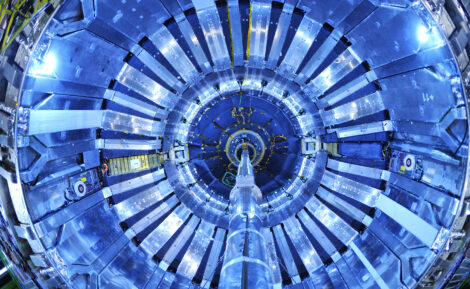
photo by: AdobeStock
Equipment associated with the Large Hadron Collider in Europe is pictured in this AdobeStock image
Never doubt the level of curiosity among University of Kansas researchers. Sometimes they are interested in finding out what happened in a time period as small as a few millionths of a second.
If they happen to be the first few millionths of a second in the creation of our universe, even better.
A KU team indeed has been chosen to work on that task and has received a $1 million federal grant to build equipment for the world’s largest particle accelerator that slams together protons in hopes of finding new insights into how the universe began, among other mysteries.
A team led by Michael Murray, a KU professor of physics and astronomy, has been awarded U.S. Department of Energy funding to build two specialized devices that will be installed at the Large Hadron Collider, a 17-mile underground loop of magnets and high-tech equipment at the border of France and Switzerland.
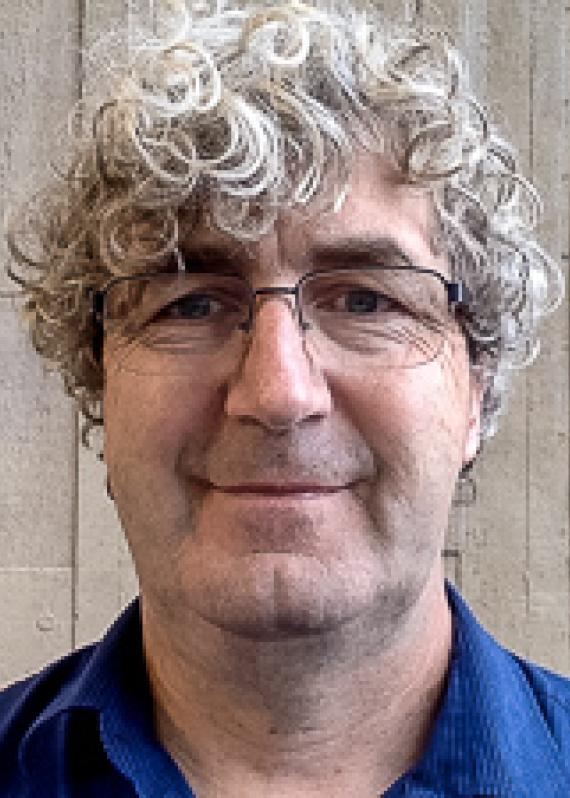
photo by: University of Kansas
Michael Murray
The collider, operated by the European Organization for Nuclear Research — or CERN as it is commonly called — is widely regarded as one of the most important pieces of infrastructure in the world for the study of fields such as quantum physics, dark matter, and what really happened during the Big Bang that is theorized to have created the universe.
A pair of devices that are actually manufactured on the KU campus are set to play a big role in trying to answer those questions.
“Kansas students will have the opportunity to contribute at every step,” Murray said in a press release.
The devices are called High-Luminosity Zero Degree Calorimeters, which is often shortened to HL-ZDCs. The HL-ZDCs detect energetic neutrons and photons that escape following an explosion. Measuring those neutrons and photons are key to helping scientists determine what type of collision took place — such as direct collision or more a glancing blow between subatomic particles.
Such information about the collision type, in turn, is critical to understanding a material known as quark-gluon plasma, which CERN describes as an “astonishingly hot, dense soup made of all kinds of particles moving at near light speed.”
Perhaps the most significant attribute about quark-gluon plasma is that scientists believe the entire universe was filled with it during the first few milliseconds of existence. Not surprisingly, physicists are eager to study the material so the Large Hadron Collider collides ions of heavy materials such as gold and lead to recreate conditions that researchers believe are similar to the Big Bang.
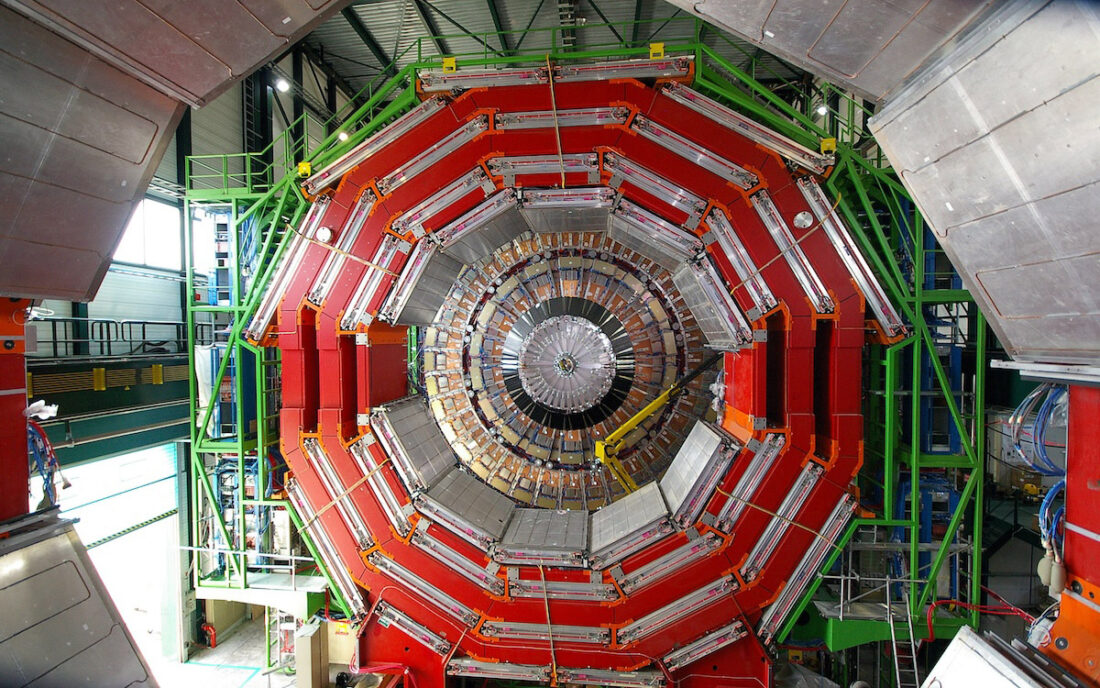
photo by: CERN
The Compact Muon Solenoid at the Large Hadron Collider is seen. Two calorimeters built at the University of Kansas will be shipped to CERN and integrated into CMS before the High-Luminosity LHC era, slated for mid-2030.
The Large Hadron Collider currently is shut down for a multi-year upgrade that is expected to last until 2030. The KU team is part of that project, and it wasn’t a surprise that the Lawrence group landed a contract for renovation.
KU teams built the ZDC devices that have been used in the Large Hadron Collider since it opened in 2008. Murray, who has been at KU since 2002, has been been designated the project leader for the ZDC portion of the upgrade at CERN. Murray has been working on the technology for more than a decade.
Murray, fellow researchers and students will build the ZDC devices at KU’s Mechanical Prototyping Lab located in the basement of Malott Hall on KU’s main campus. From there, the devices will go to the Fermi National Accelerator Laboratory just outside of Chicago for a variety of tests. While there, KU researchers and students will work with Fermilab specialists on various simulations and software development.
Once work is completed at the Chicago-area lab, the devices are off to the Franco-Swiss border for installation at the Large Hadron Collider.
“This project connects the full chain of experimental science,” Murray said. “Detectors assembled in Lawrence will be tested in a high-energy beam at Fermilab, installed at CERN and then used by an international collaboration to answer fundamental questions about matter.”
Super facts about the supercollider
Here’s a look at a few mind-numbing figures related to the Large Hadron Collider
• The machine sends particles through its tunnel at a speed that is equal to 99.9999991% the speed of light.
• When functioning at top speed, the collider sends a proton around its 17-mile tunnel 11,245 times per second.
• To keep its more than 9,000 magnets cooled, the collider operates at a temperature of negative 271 degrees Celsius. That’s colder than outer space.
• To help achieve the massively fast speeds, the pipes in the tunnel have been emptied of air. That creates a vacuum chamber that has pressures that are ten million million times lower than the outside air at sea level.
• The particles traveling through the collider are so small that CERN describes the task of getting them to collide is “akin to firing two needles 10 kilometers apart with such precision that they meet halfway.”
Source: CERN
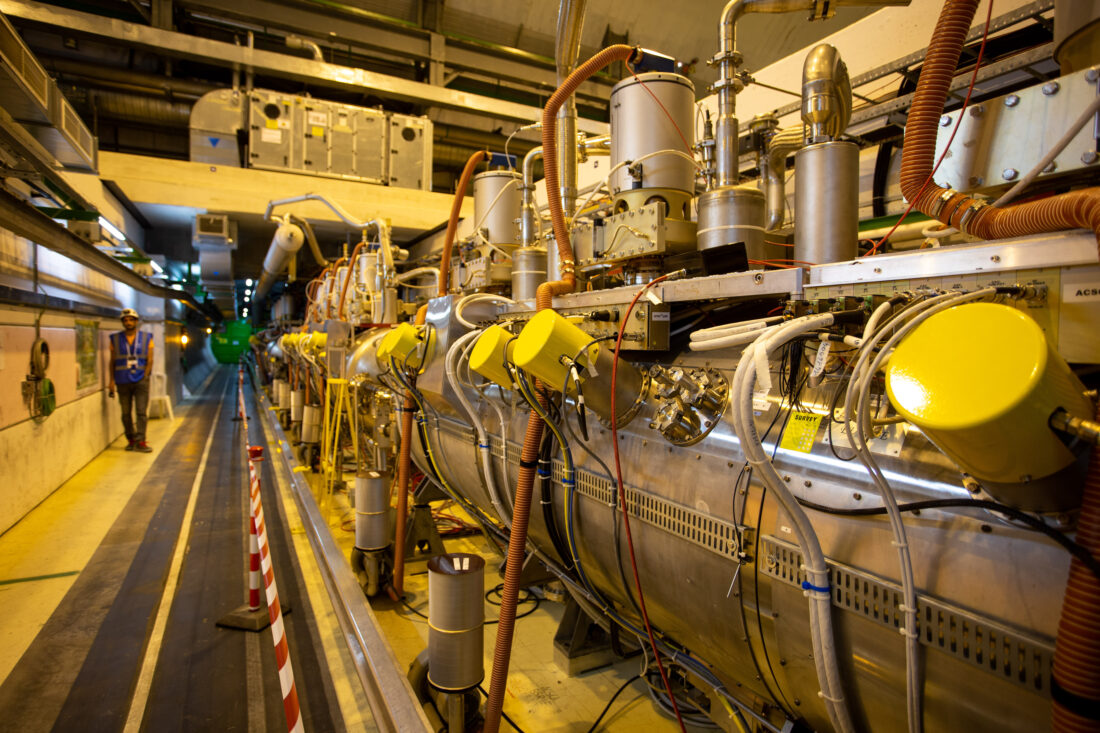
photo by: AdobeStock
A portion of the Geneva-based international research center for CERN is pictured.
State Government

Opinion: The Lawrence man seeking to break the power of Republican, Democratic parties this election
State tax receipts top estimate by $147M for quarter
TOPEKA — The state of Kansas collected $147 million more in taxes than anticipated during the first quarter of ...

Rep. Tracey Mann to skip candidate forum in Lawrence; spokesman scarce on details

Kobach, Mann debate criminal justice priorities at Tuesday event as they campaign in attorney general race

Kansas must count mail ballots that arrive three days after November election, appeals court rules