KU alum touts ‘dream’ job
Luncheon features Boeing leader
New technologies are poised to do more than help make planes lighter, stronger and more durable, the president and CEO of Boeing Commercial Airplanes said Tuesday.
The developing use of carbon-fiber composites also will help ground the effects of that most stubborn of travel maladies: jet lag.
“Because of the design of the fuselage and the wing composites, you can lower the pressure altitude now – so you can have more air around you – and you can increase the humidity,” said Alan Mulally, speaking to a luncheon crowd of about 100 at SpringHill Suites by Marriott. “And the testing that we’ve done shows that probably has the most to do with reducing jet lag than anything else we could do.
“So you’re actually going to enjoy flying, and feel better when you get there.”
From the benefits of composite construction to the value of capitalism and the strength of an education at Kansas University, Mulally touched on dozens of topics during his visit as part of the Lawrence Chamber of Commerce’s Spring Luncheon Series.
But throughout the discussion, Mulally kept his focus on the story of Boeing Co., where he started as an engineer fresh out of KU and worked his way up to his current post as corporate executive vice president and leader of more than 50,000 employees, whose cumulative work has 12,000 Boeing jets flying worldwide.
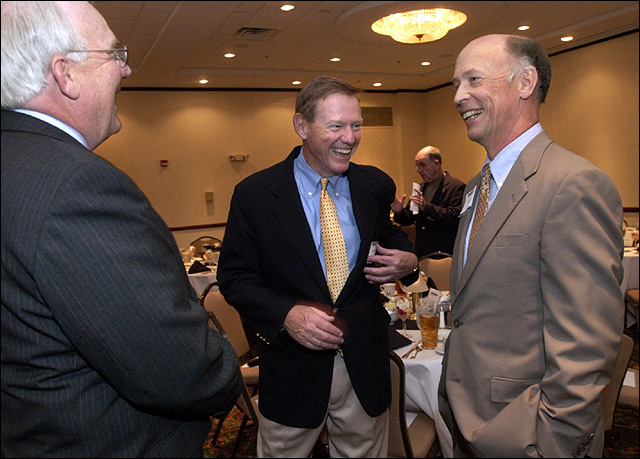
Alan Mulally, president and chief executive officer of Boeing Commercial Airplanes, center, laughs with M-Pact Inc. President Jim Martin, left, and Douglas County Bank President Ted Haggart before the start of the Lawrence Chamber of Commerce's Spring Luncheon Series. Mulally was the keynote speaker at the luncheon Tuesday at SpringHill Suites by Marriott.
“I found my dream,” Mulally said of his employer. “And it really isn’t about planes. It really is about getting people together around the world. And every time you get people together, then you find out that we have more in common than we don’t.”
Among his observations:
¢ On the extended capabilities of the new 787 Dreamliner, which is picking up orders from airlines worldwide: “Its range is longer than the 777 or the 747. Northwest has purchased a lot of 787s, and they’re going to connect almost every city where they operate in the USA to every city in India and in China – that’s direct, nonstop. That’s going to take hours off those flight times of going through hubs.”
¢ On the value of an education at KU, where Mulally received his bachelor’s and master’s degrees in aeronautical and astronautical engineering: “I think I can be objective about this (laughter). The University of Kansas rocks. It’s just that simple. : The curriculum in the engineering school … it is world class. And the graduates from the University of Kansas are world class. : And when you come from the University of Kansas, you’re two or three years ahead of students from anywhere else in the world.”
Related content
¢ On how Kansans need to focus on increasing productivity and product quality to remain a major player in Boeing operations: “We’re in every single state, and almost every country, and where we’ll keep operating is where we can economically compete.”
¢ On the value of free markets, as airlines grapple with rising fuel costs and increasing relaxation of airline market regulations: “Letting the market forces decide will get rid of the carriers that are not viable. : There are plenty of people that can make money and are making money in the airline industry around the world. …
“Can you imagine what would happen to our industry if we actually had a choice? Look at what happened to the industry when we had a choice with Southwest. Southwest Airlines, now, this year, they’ll carry more passengers inside the United States than American, Delta, United or Continental. Thirty-five years of profitable growth.
“There continues to be a shakeout. … We believe in capitalism, right? The consumer, we are the ones who allocate precious resources. We’re the ones that decide the standard of living with our purchases. Let the forces work and we’ll be OK.”
City Government
Conversations on Riverfront site’s future have already begun, but Lawrence city staff says there’s a long way to go

These officers play many roles on downtown patrol in Lawrence, and they don’t want to see it cut
Lawrence Transit’s sales tax is ‘critical,’ its director says, and an increase could be on the ballot in November
New question arises around Rock Chalk Park trails: Why are nearly 2 miles of them missing?
City of Lawrence enters negotiations with a city manager candidate; announcement could come next week