A state of higher gardening
There's more to learn about than academics at Kansas University. A walking tour reveals a campus where something's always in bloom.
We’re fortunate to live in the shadow of Mount Oread.
But amid all the hustle and bustle of academic life at Kansas University, one of the jewels of campus is its immaculate and varied landscaping.
The scenery makes it well worth slipping on your walking shoes, treading up the hill and taking time to explore the flora perched atop our fair city.
Campus landscape manager Mike Lang graciously reserved a bit of time in his hectic schedule recently to take me on a walking tour of the grounds. With 1,000 acres to manage and 30 crew members to accomplish this massive task, Lang looks at his job as one of maintenance and replenishing. And lately Mother Nature has kept his crew incredibly busy.
“I’m most proud of our response after the microburst storm,” he says. “We had everything cleaned up in a relatively short amount of time. The crews were spectacular. It is really a gardener’s dream to have such an outstanding team and a thousand acres to play with.”
Most of us have heard that 60 percent of KU’s buildings were damaged in the March 12 storm, but 129 campus trees also fell victim to the melee, one of them being a state champion pin oak near Potter Lake.
But the environs remain stunning.
As we meander past the Natural History Museum on Jayhawk Boulevard, Lang points out the two white fringe trees poised at the building’s entrance. This is one of his favorite trees. Although it grows slowly, it’s hardy and has a delicate, lacy look.
I ask about a gnarly, knotted pine rooted next to the museum. Lang’s response indicates the tree might not be around much longer.
“We will probably lose all our Scotch pines to the nematode, which is a microscopic worm-like creature that gets into the pines,” he explains. “It is comparable to heart disease in humans; they attack the vascular system of the tree.”
A grand estate
The annual beds in front of Fraser Hall have been cleared of the tulip bulbs that were recently awash in brilliant colors. They’ll be replanted with celosias or begonias for their summer show. The yearly budget for annuals is around $12,000, Lang says, noting that he and his crew planted 15,000 tulip bulbs last fall and are in the process of planting 7,000 summer beauties.
“We try to use landscape annuals,” he says. “We simply don’t have the manpower to deadhead, so we try to have plants that take care of themselves.”
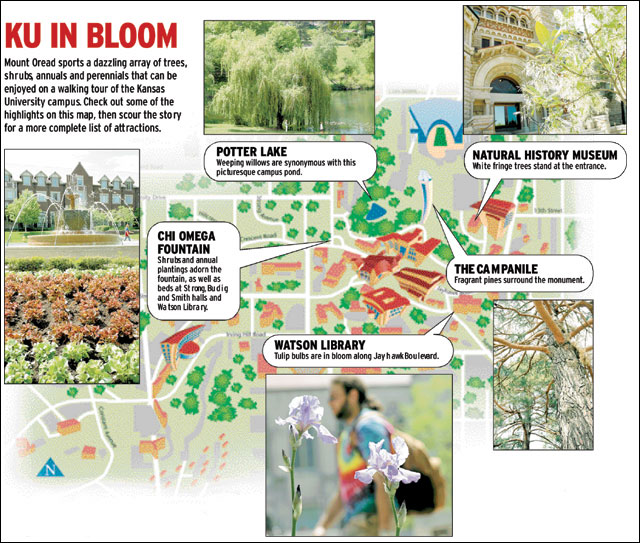
Photos by Mike Yoder ¢ Graphic by Mindie Paget
Lang points out a limber pine that was a dedicated tree.
“There are hundreds of gift trees (on campus),” he says. “Many are maples or oaks because people want long-living trees. We are planting a few memorial trees in front of Danforth Chapel soon.”
Presently in front of Danforth, and lined up along Lilac Lane, are five or six Japanese tree lilacs that soon will be in full bloom, providing a heady scent on the winding road. Just behind the chapel is a bed that is home to Pink Ruffles crape myrtle, a dwarf shrub that yields blooms in August and September, when color can be hard to find.
We arrive at the chancellor’s residence and find a feast for the eyes. Most noticeable is the state champion Japanese maple that arches over the circle drive. Its crimson leaves sparkle in the sun, and it is truly spectacular. Red Ribbons roses are planted in a substantial grouping on the front lawn. They bloom in blood red with a yellow center and will be in full glory any day. White and pink dogwoods frame the palatial home with their delicate blooms, fluttering softly in the breeze.
One of Lang’s favorite shrubs, pearl bush, hugs the back of the property, creating a natural barrier from the sororities and fraternities behind the estate. Next to the front porch, the leaves of the oakleaf hydrangeas are filling in and are sure to put on a marvelous show in a few weeks.
A personal favorite
One of the more exclusive trees on campus is centrally located, Lang says.
“Right in front of Strong Hall is a persimmon in Golden Jubilee,” he says. “This is very unique to this area. It is native to the timbers but not often found in landscaping like this one is.”
A cluster of fruiting pear trees blooms between Marvin and Lindley halls. But of all the flora available to Lang, he has a few favorites.
“I really appreciate the viburnums. They have a wonderful size and shape; they can tolerate sun or shade,” he says. “A novice gardener cannot go wrong with planting a few of these. As Michael Dirr, the foremost authority on woody plant material, writes in his book, ‘A garden without a viburnum is akin to life without music and art.'”
The fragrant Korean Spice variety clings near the west entrance of Lippincott. A newer planting of a less familiar variety, Winterthur, is located behind the stone sign on the west end of Memorial Drive.
Worth the blisters
The winding Memorial Drive is rooted mostly with native trees. At the west end, a bayberry shrub towers with its waxy leaves and aromatic fragrance. Cornelian cherry dogwoods bloom in small clusters of yellow along the serpentine path, and a full and fascinating tactile experience waits near the Campanile, with its smoke trees and various pines.
Synonymous with Potters Lake are the weeping willows that cling to the banks of the picturesque pond. Lang thinks these are nice looking trees but warns that they are labor intensive.
I want to know more about the perfectly shaped sycamore tree that provides a canopy of shade on the hillside for tailgating before football games. Lang thinks the sycamore may have been a state champion tree at one point, although he’s not sure of the distinction. Even if it has never been publicly crowned, it’s a magnificent tree.
I ask Lang what he would recommend that visitors not miss.
“I couldn’t really pick a particular spot that is my favorite, but if I were visiting I would want to walk down Jayhawk Boulevard to enjoy the landscaping and the annual plantings at Chi-O Fountain, Strong Hall, Budig Hall, Watson Library and Smith Hall,” he says. “These are just some of the annual beds in which we try to keep color from early spring until fall. A walk down Memorial Drive would also provide a visitor with landscaping and views at the Campanile, Korean War Memorial and the Vietnam War Memorial.”
In other words, loosen up those muscles and strap on some comfortable shoes. And don’t let the enormity of 1,000 acres deter you from taking a walking tour of campus.
It’s worth every blister.
– Jennifer Oldridge, a Kansas University graduate, is an avid gardener who previously operated a landscaping business.
Home and Garden
10 top performing new plants for this season
Flower gardens endure hot, dry summers better if you choose these plants

Debunking common garden hacks, quick fixes and myths

Douglas County Master Gardeners invites public to annual native plant sale
How to mulch your garden beds without harming plants