Conference focuses on reducing oil use
With prices skyrocketing, the typical Kansas household will spend $3,500 at the gasoline pump this year, according to a new report.
And a $100 rebate check to ease the pain of rising gas prices, as some U.S. senators are proposing, won’t solve the real problem of America’s dependence on foreign oil, according to organizers of a traveling national conference that will convene Saturday in Lawrence.
“This isn’t just a pump price problem,” said Tom Collina, executive director of 20/20 Vision. “It’s about runaway demand. As consumers, we’re simply demanding and consuming too much oil.”
With gas prices up 80 percent since 2004, every person in the state will pay an extra $670 at the pump this year, the report found.
20/20 Vision, a nonprofit group that encourages civic involvement to promote peace and environmentally sound policies, will host Powershift 2006 in Kansas University’s Kansas Union. Lawrence is 20/20 Vision’s fifth stop on a national tour that’s hit Kalamazoo, Mich., Richmond, Va., Portland, Ore., and Fort Wayne, Ind.
The event comes as federal and state lawmakers drum up plans to deal with election-year gripes over fuel costs. U.S. Senate Republicans on Thursday proposed a $100 rebate check for taxpayers.
Democrats, meanwhile, were assembling their own package of measures, including a proposal offered by Sen. Bob Menendez, D-N.J., for a 60-day suspension of the 18.4-cent federal gasoline tax and the 24-cent a gallon diesel tax.
In Kansas, Gov. Kathleen Sebelius’ office released a list of ways to battle high gas prices. The list called for Kansans to, among other things, car pool, drive at or below the speed limit and use cruise control.
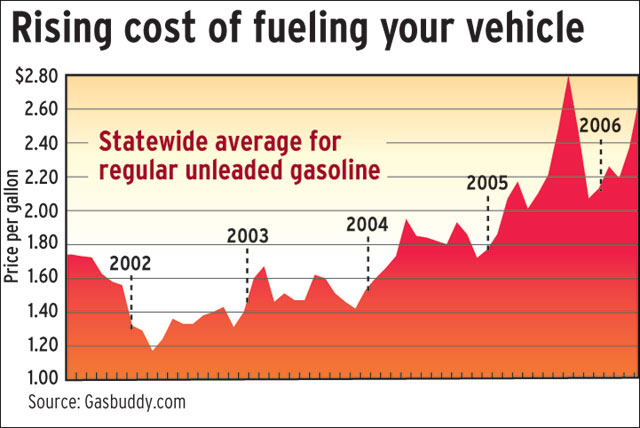
Kansas drivers will burn 1.3 billion gallons of gas this year for a total cost of $3.7 billion at $2.75 per gallon, according to a report released by the Union of Concerned Scientists, a nonprofit based in Cambridge, Mass.
“It’s not just a question of the evil oil companies or the evil Saudis,” Collina said. “It’s a question of what we do every day with the oil we buy abroad.”
The bad news, Collina said, is there is no silver bullet to ease the current crisis.
“We need to regain control of our energy in the future,” he said.
Don MacKenzie, a vehicles engineer with the Union of Concerned Scientists, said the fastest and most effective solution is to demand better fuel efficiency.
Americans saw great strides in fuel economy in the late 1970s and early 1980s. But following a drop in fuel economy – from 22.1 miles per gallon in 1988 to 21 miles per gallon in 1994 – fuel economy has been relatively flat, according to the Environmental Protection Agency.
“The standards have gone nowhere and overall fuel economy has gone backwards compared to 20 years ago,” MacKenzie said.
Related Content
- The search is on for alternative fuel sources
- House Bill No. 2883: Concerning the theft of motor fuel
- Gasoline drive-off stats
- Big wheels, high prices put strain on wallets (04-26-06)
- Patrol seeks fuel deals
- Conference focuses on reducing oil use
- Congress struggles to respond to anger over high gas prices
- Exxon Mobile reports record profit as outcry rises
The technology to improve fuel efficiency with efficient engines, better transmissions, lighter-weight materials and improved aerodynamics is out there, but isn’t being used, he said.
“There are a lot of technologies that the auto makers have sitting on their shelves,” he said. “For the most part they’re not being used to their maximum potential.”
The conference will address how the nation’s foreign oil addiction affects not only drivers’ wallets, but also the environment and national security.
“Oil is running out,” said Ethan Nuss, a KU senior and regional director for 20/20 Vision. “It’s a finite resource. The disastrous part is just how integrated it is into our entire economy.”
Rep. Dennis Moore, D-Kan., is expected to speak at the conference. More than 400 people had registered as of Thursday, organizers said.
City Government

Lawrence’s housing study calls for hundreds of new units a year, repairing existing affordable homes

Lawrence has made an offer to a city manager candidate, but negotiations are still in progress, mayor says
When to hire for Fire Station 6? How big a raise for staff? Exploring the variables in Lawrence’s budget ‘math problem’
City Commission OKs purchasing former Journal-World printing plant; it could become a City Hall annex

In bike plan draft, Lawrence cyclists are asking for more physically protected bike lanes, not just paint