Steel artistry
Sculptors, metal fabricators create ornate works
Is this what Old World artisans’ workshops looked like? Steel is heated in a forge to a blistering 2,800 degrees, hammered on an anvil, and bent in elaborate curves to create majestic gates that weigh more than a ton and stand 14 feet high.
The modern-day artisans at work here, in jeans and steel-toed work boots, combine delicate design sense with heavy physical labor to fabricate the entrance gates for a new golf course community in Pasco County, Fla.
Krogmann Iron & Sculptures in Pinellas Park, Fla., does architectural metalwork: balconies, staircases, gates, a chandelier for Stetson Law School that will stand 15 feet high and 8 feet wide.
“This is what we love doing,” said Terry Krogmann, 48, a graduate of the Parsons School of Art & Design in New York who spent 20 years as a metal sculptor. “It takes old-fashioned hard work to get it done.”
He and his team of eight — sculptors, fabricators and finishers — use some modern machines to speed their work: cutters to chop metal bars to the right length, a roll bender or power hammer to create the curves, or fishtails. It’s art, but it’s a business, “and our biggest fear,” Krogmann says, “is that we’ll outprice ourselves and the market will dry up. It’s in our interest to get as much of a body of work out there as possible so we can keep doing it.”
Ninety percent of the company’s output goes to Miami, Krogmann says, where architects and builders have long called for elaborate metal detailing that may add $100,000 to $150,000 to a home’s price.
“It’s amazing,” Krogmann says. “It’s almost like they’re trying to see who can outdo each other. They’re really loading the houses down. It’s a good time for artists, so we’re trying to get as much business as we can while the gates are open. That’s the unfortunate part of the art world: You’re either making good money or you’re not making anything.”
Gates galore
The gates under construction, which cost $40,000 to $50,000 per pair, will stand at the entrances to the clubhouse and seven residential villages at the Champions’ Club, a new residential project that overlooks the 18-hole Fox Hollow Golf Club. The 368 homes will range in price from $400,000 to more than $2 million, including homesite.
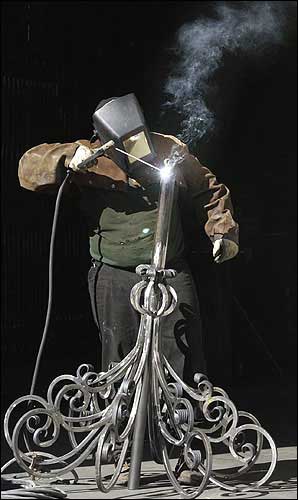
Fabricator Dominick Marini, of Krogmann Iron & Sculptures in Pinellas Park, Fla., welds a massive chandelier.
Reflecting the community’s Mediterranean theme, each of the nine large gates is executed in a different style, Krogmann said: Spanish, Italian, French. The large gates stand 14 feet tall and 30 feet wide and weigh about 2,500 pounds.
Krogmann got involved in the project when landscape architect Phil Graham, who is working on the Champions’ Club, saw the gates Krogmann created for a home and for a newly refurbished arcade, both in St. Petersburg, Fla. It took 60 days to finish four sets of gates.
He “baroqued” and “re-created” and “fine-tuned” and “basically redesigned” the plans the developer brought him, “and they gave me the green light to go for it,” he said.
Krogmann was living the feast-or-famine life of an artist when he was approached in Miami by “a guy who wanted a really crazy gate,” he recalled. He discovered that architectural metalwork played to his talents as a sculptor, designer and artist. “We can create the appropriate design for the appropriate structure,” he said, and then execute the work in their studios.
Corporate clients
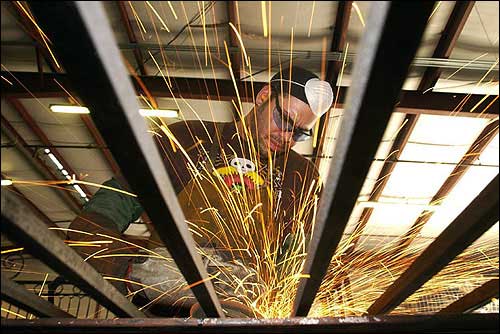
Alex Agosto smooths out the edges of a large gate inside the Krogmann Iron studios in Pinellas Park, Fla.
The company works in other media as well: marble, clay, bronze, wood, resin. On a recent day, artist Gelso Luz, 41, stood carving a frieze out of foam showing the trial of Galileo, one of a series of friezes showing scenes from the history of the law, also for Stetson Law School. Workers will make a rubber mold from his foam carving, then pour concrete to create the finished panel. The foam and the polyester gel coat with which they coat the mold are “contemporary materials we use in a project that’s Old World driven,” Krogmann said.
Much of their work is for corporate clients: banks, financial companies, Procter & Gamble, Bristol-Myers Squibb. They work in metal, marble and stone to create such items as sculpture that stands in front of corporate offices or pieces of art to decorate interiors. Some corporate clients want the abstract and severe, in the style of Henry Moore; others prefer realistic, neoclassical Italian and French style.
The artisans who work with Krogmann almost always have had “some kind of art background, either formal art or some kind of apprenticeship,” he said. “All I do is orchestrate their talents and my talents. One guy’s very good at carving wood. Another’s good at carving marble. It’s a collection of talents, and we put them together to make it happen.”
Home and Garden

10 top performing new plants for this season

Flower gardens endure hot, dry summers better if you choose these plants

Debunking common garden hacks, quick fixes and myths

Douglas County Master Gardeners invites public to annual native plant sale
How to mulch your garden beds without harming plants