Rare tureens from 17th, 18th century are costly
The trading ships of the 17th and 18th centuries went to the Far East from Europe and the United States to buy tea, silk, Indian textiles, Japanese lacquerware and porcelains.
The Americans traded Hawaiian sandalwood, ginseng, furs and sea slugs, which were used for soup. Sea captains liked a cargo that had enough porcelains to fill spaces on the ship that were below water. If the porcelains were soaked in a storm, they were not damaged; other goods could have been ruined. Dishes were made in aAsia to European tastes and were often copies of English and French patterns.
Sometimes full sets of dishes with special initials, coats of arms or very fanciful designs were ordered on one trip and delivered on the next. Dishes were decorated with designs familiar to the particular customer. Special shapes included chamber pots, bidets, clock cases, cane handles, bulb pots and strainers. Europeans were depicted in European clothing but had Asian facial features. Chinese scenes were adapted to be more familiar to Europeans.
Animal shapes were used for boxes, tureens and figurines. Soup or vegetables were served at the table in a tureen that was used by three or four guests. The large soup tureen that held enough for all the guests was not used until the 19th century. One very rare tureen was shaped like a large three-dimensional crab attached to a plate. It sold at Christie’s New York for $276,300.
My small, round, Victorian oak table has four twisted legs, metal ball-and-claw feet and a shelf stretcher with a circular indentation that’s large enough for a vase or bowl. The 30-inch-high table was found in the attic of a building once owned by a doctor. I use the table to display an antique toilet set, with the bowl and pitcher on the tabletop and the chamber pot on the lower shelf. A metal plate on the lower shelf is incised “Eureka Nebulizer, Chicago, Ill., Patd. Nov. 6, 1900.” Why?
Your table is a typical Victorian parlor table. These small tables were made in large numbers during the last two decades of the 19th century. Most parlor tables have a lower shelf, but no indentation. A nebulizer is a medical instrument that converts a liquid into a fine spray. By the end of the 19th century, nebulizers were being used to treat lung diseases, including asthma. It is likely that the Eureka Nebulizer Co., which sponsored an exhibit at the 1904 St. Louis World’s Fair, bought tables like yours from furniture manufacturers — then sold the tables, fitted with Eureka nebulizers and tags, to doctors and hospitals. Victorian parlor tables sell for $200 to $400.
I collect Bunnykins. They are the Royal Doulton dishes and figurines that picture rabbits dressed and acting like humans. When were the first ones made?
The Bunnykins were created by Barbara Vernon Bailey. She chose the name Sister Mary Barbara when she became a nun in 1928. When her father, Cuthbert Bailey, became the managing director of the Royal Doulton Burslem factory in the 1930s, he thought about his daughter’s watercolors of bunnies who acted out parts of her life. The father rabbit, with a pipe and glasses, was modeled after Bailey himself. Sister Mary Barbara created 66 different Bunnykins drawings by the 1940s. But her religious duties took too much of her time, so Walter Hayward began drawing Bunnykins scenes. The designs by Bailey’s daughter are not being used on new pieces, but they can be found on old dishes in antiques shops. Sister Mary Barbara died in 2003 at the age of 92. She had found it hard to believe that her Bunnykins were so important to collectors. A rare piece, like the Airmail Delivery plate, sells for about $300.
My small, antique clear-glass creamer has wide ribs around the body. The mark on the bottom is “Chippendale Krys-Tol.” Age and value?
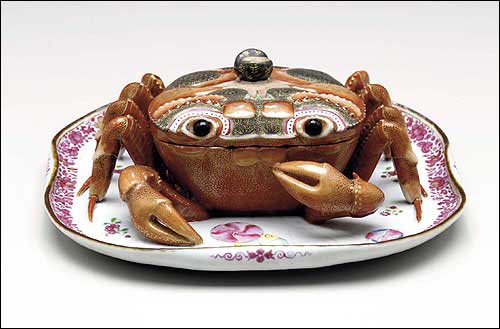
This crab-shaped tureen was made in China for export in the 18th century. It recently sold for 76,300 at an auction.
Marks are not often found on glass. The mark on your creamer was used by the Jefferson Glass Co. of Follansbee, W.Va., between about 1907 and 1918. A matching sugar bowl was also made. Your creamer — a piece of standard American household glass — would sell today for $30 to $50.
After my father died, we found a Pollak’s Rocket Radio kit with its original box and instructions. The radio, made in Japan, is black and red, and is shaped like a rocket ship. The original $2.98 price tag is still on the box. Does the set have any value?
Transistor-radio kits with radios shaped like rockets were sold under several brand names during the late 1950s. They all look pretty much the same, although they were made in various colors. To change the radio station, pull or push on the nose of the rocket. If your set and its box are in original condition, it would sell for about $75.
Tip
When moving, wrap dishes in bubble wrap and pack on edge. If you have no bubble wrap, put each dish in a plastic bag to keep it clean, then wrap in newspaper and pack on edge. Put about 3 inches of paper on the bottom of the carton.
– The Kovels answer as many questions as possible through the column. By sending a letter with a question, you give full permission for its use in the column or any other Kovel forum. Names and addresses will not be published. We cannot guarantee the return of any photograph, but if a stamped envelope is included, we will try. The volume of mail makes personal answers or appraisals impossible. Write to Kovels, (name of your newspaper), King Features Syndicate, 888 Seventh Ave., New York, N.Y. 10019.
Home and Garden
10 top performing new plants for this season

Flower gardens endure hot, dry summers better if you choose these plants
Debunking common garden hacks, quick fixes and myths

Douglas County Master Gardeners invites public to annual native plant sale
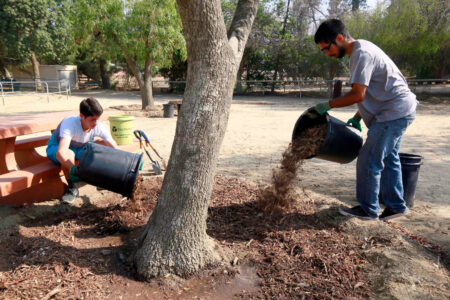
How to mulch your garden beds without harming plants