A look at the questions facing city leaders as they consider a $1B plan that seeks to capture Costco sales taxes
New store expected to generate millions in annual sales taxes, but where should they go?
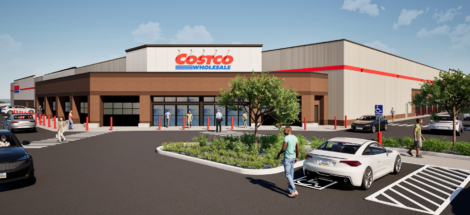
photo by: City of Lawrence/MG2
The entrance of a proposed Lawrence Costco store is shown in this rendering.
Lawrence’s newest $1 billion-plus development proposal includes plans for a life-sized board game and a nature trail that encourages you to walk in your bare feet.
But, no, neither one of those elements is the most unique component of a recent development plan filed by a group led by Phil Bundy, a Wichita developer who now also operates in the Kansas City area.
Instead, the most unique element is that Bundy’s group wants to use the tax revenue generated by a private business that his group played no role in developing or bringing to Lawrence. That business is the giant Costco wholesale club currently under construction near Rock Chalk Park in northwest Lawrence.
Bundy’s planned developments aren’t particularly close to Costco’s northwest Lawrence site. Instead, the first phase of his development would be on the far south end of town at the intersection of U.S. Highway 59 and the South Lawrence Trafficway. The second phase of the development would be a little closer to Costco, but still a few miles away at the intersection of Bob Billings Parkway and the SLT.
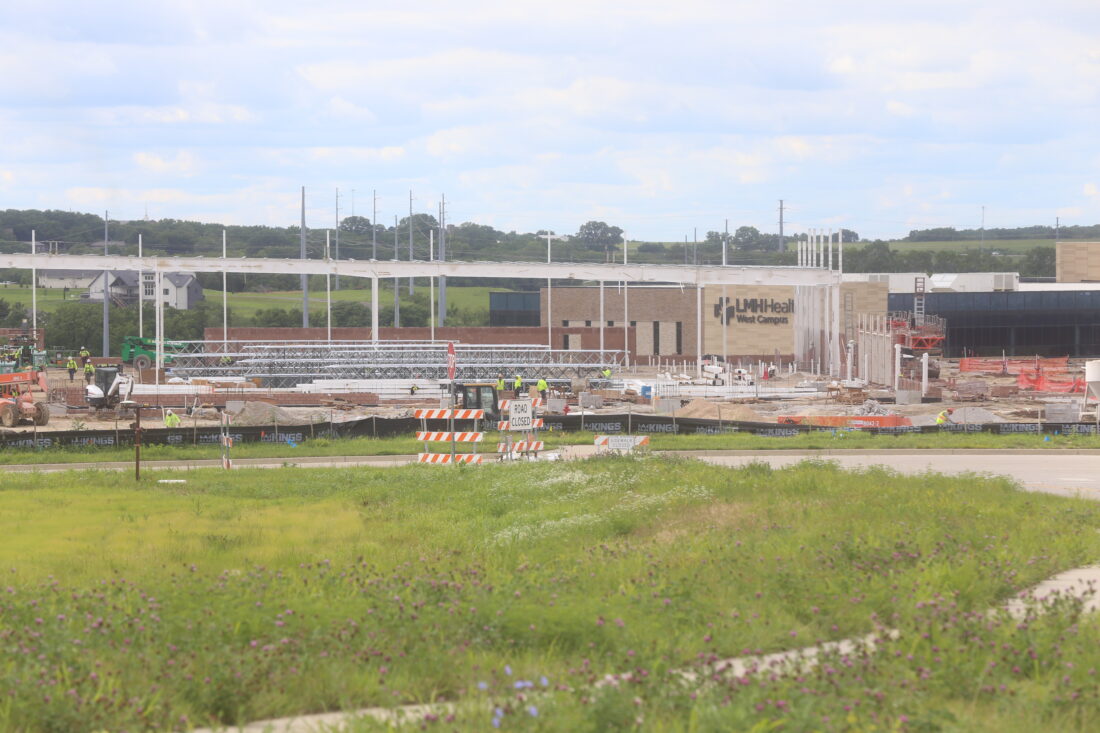
photo by: Chad Lawhorn/Journal-World
Steel frames are being constructed at the new Costco location in northwest Lawrence, pictured on June 22, 2026.
The geographical elements of the deal are unique, but even more so is the idea of using the tax revenues from a business that the developer isn’t associated with. Normally, an incentive plan for a new development goes something like this: The developer promises to build several new attractions that will bring lots of new consumers into Lawrence. Those new consumers will generate lots of new sales tax revenues through their purchases. The developer seeks to keep a portion — or in the case of STAR bonds, essentially all — of the new taxes generated by the new development.
Bundy’s group is seeking all of that. The two phases of the project call for multiple attractions that, if successful, would bring new consumers and create new tax dollars. As we’ve reported, those include in the southern district: an indoor/outdoor multi-sport venue that would focus on soccer but have lacrosse and many other sports fields/courts; an attraction based on popular board games from the company Hasbro, which would allow people to play interactive, life-sized board games; and a nature trail attraction that encourages visitors to experience the facility in their bare feet to better connect with nature. The Bob Billings and SLT phase of the project would include an indoor arena for up to 5,000 people that could host everything from concerts to indoor bicycle races.
Both phases also would have plenty of room for big box retailers, hotels, restaurants and other such attractions that would create sales tax dollars.
Bundy’s group is proposing to use the state’s STAR bond authority to capture all of those new sales tax revenues to pay for everything from the cost of buying land for these projects to infrastructure related to the development. As a reminder, the difference between a STAR bond incentive and the more common Tax Increment Finance incentive is that with a STAR incentive, the developer gets the sales tax revenues generated from both local and state sales taxes. With the TIF, the developer only gets the local taxes.
If Bundy’s group had stopped right there, this would be a pretty standard — although still large — incentive application. But Bundy’s group hasn’t stopped there. Instead it is asking that it also be allowed to collect all the sales taxes generated by the new Costco store that is already under construction north and west of Sixth Street and George Williams Way.
That creates an interesting question for the city to consider. It essentially is: Does the city want to pocket its winnings or bet again?
I phrase it in that way because, arguably, the forthcoming Costco is the result of a previous $25 million bet made by the city. That is approximately how much public funds the city invested to facilitate the development of Rock Chalk Park, which includes a city recreation center and multiple KU sports facilities. The city could have spent far less to build just a recreation center, but it chose to spend tens of million more to help facilitate the joint complex.
City officials were told one of the payoffs of that bet would be that a major new commercial district would develop next to Rock Chalk Park. While it has taken many years longer than expected, that commercial district appears to be arriving with Costco as its anchor, and likely a dozen more complementary businesses — which largely haven’t been announced — to follow.
Thus, the pocket-your-winnings versus bet-again question. Sometimes pocketing your winnings is the smart move, and other times betting again turns out fabulously. Today’s article isn’t an effort to determine the best answer. Rather, it is a great opportunity to look at some big numbers that should create big discussion at Lawrence City Hall.
Those numbers are expected Costco sales. You have to have an understanding of how much Costco is expected to produce in Lawrence sales in order to have an idea of how much money the city would either be putting in its pocket or putting back in play.
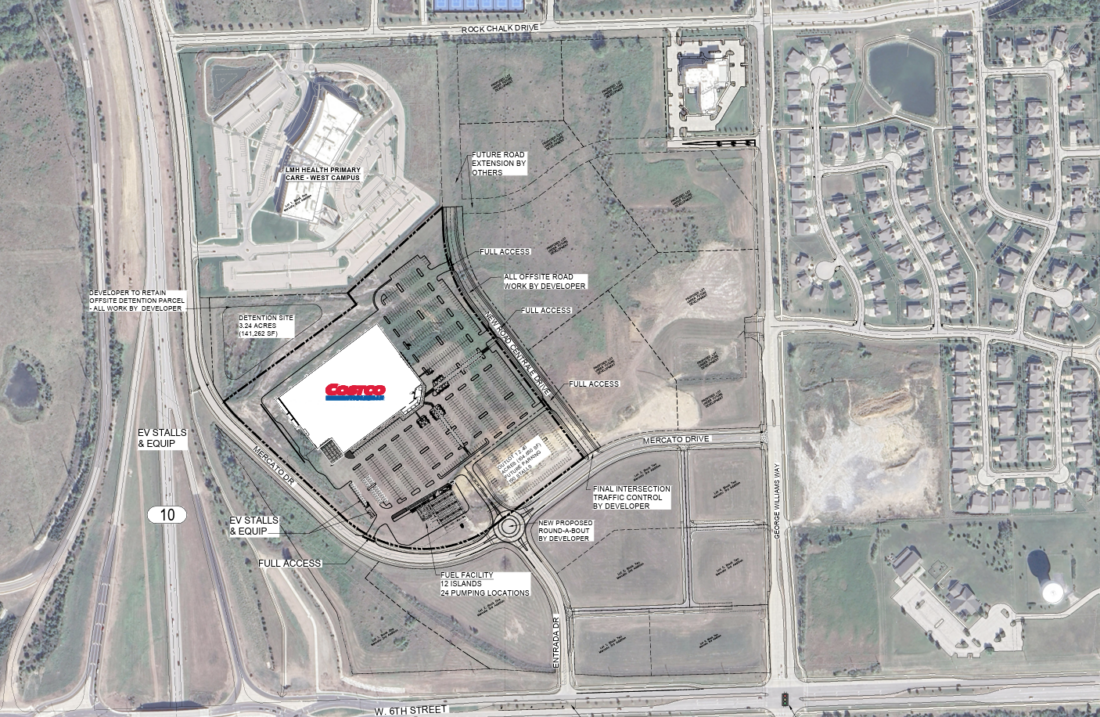
A site plan document shows the proposed location of a Costco store in northwest Lawrence.
I’ll start this exercise with a caveat: If slices of Costco cake could be redeemed for shares in Costco, I likely would have enough to sit on Costco’s board of directors and have direct insight into the specific sales numbers of a Costco store. But, that’s not the case, and I don’t have access to those figures. There are lots of consulting businesses that produce those types of estimates, though, and they have some good data to work with, given that Costco is a publicly traded company that does have to reveal its broad financial statements.
So, I am using that type of information, and I have used some AI chat bots to help gather it. City officials are likely going to find themselves in a similar position in a few months, so we might as well get used to having less than perfect data as the community sorts through this.
Here’s a look at some questions and the best available answers currently:
— How much does a Costco store produce in sales? The nationwide average is about $275 million a year in sales. But several sites note that newer stores may be closer to $100 million to $150 million a year, as they build up their membership bases. Whether Kansas stores hit the national average is a little uncertain.
— How much would the city get in sales tax revenues based on those numbers? The city charges a sales tax of 1.6%, with 1% of it available to use for any city purpose, while the rest goes to specific uses, such as transit, infrastructure and affordable housing. Looking very broadly, a 1.6% tax on $275 million in sales would produce $4.4 million a year in city sales taxes. At $150 million it would be $2.4 million. If you are looking for a midpoint, $200 million in sales would produce $3.2 million. The county — a sometimes forgotten entity in these deals — would collect between $1.8 million and $3.4 million in addition to what the city collects. To be a bit more realistic, I would likely take 5% to 7% off of all of those numbers above. That’s because some of Costco’s sales are related to the sale of gasoline, which doesn’t have a local sales tax on it. Also, about 2% of Costco’s revenues come from the sale of memberships, which also aren’t taxed in Kansas. So, I think a fair estimate for the city’s sales tax collections would be more than $2 million a year, but probably not much more than $4 million per year. The city and county combined could probably collect between $3.5 million and $7 million a year from the store.
— What about the state sales tax? That’s a big one, sort of. The state charges a 6.5% sales tax, but it is important to remember that the state does not charge the tax on grocery items. Several sites estimate that about 55% of Costco’s sales would be related to groceries, as defined by Kansas law. The city and county charge sales tax on those grocery items, but the state doesn’t. Still, even with those sales taken off the table, the amount of state sales tax generated by the store is large. At $150 million in sales, the state would collect $4.3 million, at $200 million it would be $5.8 million, and at $275 million it would be about $8 million.
If you add up the local sales taxes and the state sales taxes, you get a range of about $8 million to $15 million a year that Bundy’s group would be getting in STAR bond revenues to pay for its new developments. The STAR bond incentive would last for 20 years, so the development would get somewhere between $160 million and about $300 million in tax revenues from Costco alone during the life of the incentive. The amount could be less than that, if the city and county decided to negotiate the deal that way. For instance, the city might want to exempt its sales tax related to affordable housing, and the county might want to exempt its sales tax devoted to behavorial health care from the STAR bond incentive.
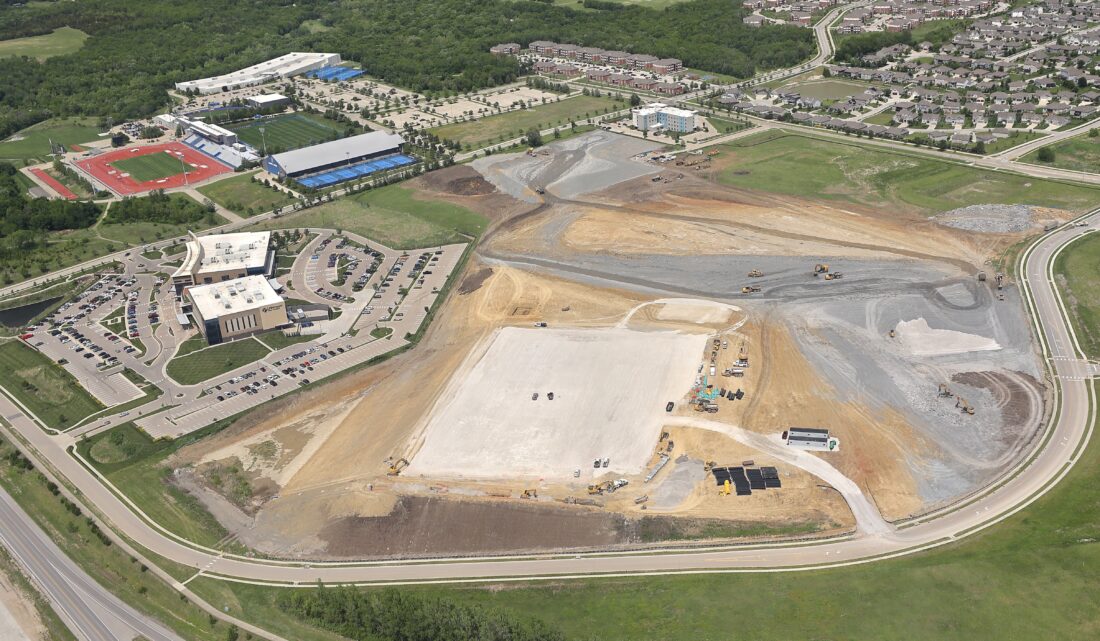
photo by: John English/Special to the Journal-World
Excavation work for a new Costco store in northwest Lawrence is pictured on May 12, 2026.
At this point, the interesting questions become a little less numbers-based and more philosophical, so I’ll just pose them rather than try to answer them.
In a sense, the city and the county have two big questions in front of them. The first is: Are they comfortable giving up $3.5 million to $7 million a year in sales tax revenues to be used for a project that would build the sort of things proposed by Bundy’s group? If the governments were being asked to give up $3.5 million to $7 million a year in sales tax money that already was part of their budgets, that likely would result in a hard no. But, given that the city and county haven’t yet started receiving the money from Costco — the store doesn’t open until later this year — the governments haven’t yet grown dependent on the money.
The second question is whether the city and county would be comfortable giving up the $3.5 million to $7 million if they were assured that approximately $4 million to $8 million of tax revenues that normally would go to the state of Kansas instead would be kept in the local community.
In some ways, that is the most interesting question because the $4 million to $8 million in state sales tax revenue generated by Costco isn’t speculative. We don’t know whether this board-game-based attraction or this new arena will actually develop and be successful. But, we do know that Costco is being built, it will open and it will produce millions in new sales tax revenue.
That level of certainty is different than most STAR bond projects. There is $4 million to $8 million of state money per year — $80 million to $160 million over the course of the incentive — for the taking, assuming that state officials sign off on the STAR bond project, which is required but not assured. However, the city and county would have to get comfortable with the idea that while the money is remaining in the community, city and county officials really wouldn’t have full control over how it is spent.
For example, $50 million of the STAR bond money would go to building the multi-sport complex. Would that be the city’s first choice for spending the money, given that it already has spent $25 million building a multi-sport complex of its own at Rock Chalk Park? Another $50 million of STAR bond money would go toward building the new west Lawrence arena. Would that be the city’s first choice for spending $50 million?
Building more housing to ease the city’s tight supply and high prices might be a higher priority, based on recent election results. STAR bond proceeds, though, can’t be used to build housing developments. The STAR bond program is geared toward attracting tourists and out-of-state visitors.
Regardless, as we’ve reported, Bundy’s project involves new housing. A close reading of the STAR bond applications gives us some details about what he’s proposing. For the property west of Bob Billings and the SLT, the group is proposing $400 million of traditional single-family homes, $50 million of “garden apartments,” $40 million of single-family homes for rentals, and $10 million for senior living.
STAR bond money couldn’t be used to construct any of those projects. But the application also shows how the STAR bond money might indirectly benefit the housing development. The application calls for STAR bond money to pay for an $18 million water tower, an $8 million sewer line, $5.7 million of road extensions west of the SLT and $7 million of other miscellaneous infrastructure.
Since that water tower, since that sewer, since those roads will be serving the STAR bond-eligible arena, the STAR bonds can be used to pay for that infrastructure. But that water tower, that sewer, those roads won’t only be serving the arena. They’ll also be serving the new homes.
Of course, the city and the county could choose to devote their new sales tax revenues from the Costco development for housing infrastructure — with this developer or someone else — and forget the entire STAR bond concept. The Costco project is so large that sales taxes from the project can fund millions of dollars of new infrastructure to support housing on its own.
They also could forget both the STAR bond idea and the housing, and simply use the new local Costco sales taxes to reduce property taxes. That also would be popular with a segment of the population, and conceivably, would help make housing more affordable.
But, without the STAR bond idea, you aren’t keeping any of the state’s sales tax collections from the store in Lawrence. How interested is the community in keeping those Costco state sales tax dollars from going to Topeka?
The last consideration I will mention is whether city commissioners will hear an argument about whether this STAR bond proposal is competitively fair. As currently structured, the deal would take money generated by Costco — which the Bundy group made no investment in — to build hundreds of thousands of square feet of new commercial space that technically will compete with Costco and the dozen or so businesses that are expected to locate around Costco.
Two longtime Lawrence families — the Schwadas and the Fritzels — spent millions to develop the infrastructure to support Costco and the businesses that will locate next to it. That would make them — and perhaps Costco itself — the most likely to object. But, I don’t know if they will.
Add it to the list of many questions facing city officials.
Town Talk column
National Weather Service move to Lawrence ramping up; developer Phil Bundy still pursuing a STAR bond project and more news and notes
A former lieutenant governor and his granddaughter fell in love with this Lawrence bar, and now they’re helping preserve it
Lawrence City Commission to weigh whether Costco should be included in STAR bond district
Thanks to a nonprofit that pairs artists and landlords, the Lawrence Potters’ Guild gets a temporary space of its own

After a brief bump during the World Cup, Lawrence is back to collecting less in sales taxes than it did a year ago