
A look at how partisan elections at the Douglas County Commission are limiting the voice of some voters
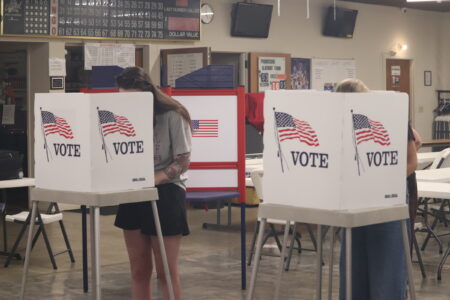
photo by: Josie Heimsoth/Journal-World
Douglas County voters fill out ballots for the primary election on Tuesday, Aug. 4, 2026.
Come January, three Douglas County commissioners will be sworn in for new terms. Two of the three will take their seats without having won a contested general election.
It is a scene that is playing out in places all across America as more political districts become dominated by one party or the other, Chris Koliba, founder and director of KU’s Center for Democratic Governance, told me recently. He also said it is becoming a significant problem for democracy.
“It is totally limiting the ability of voters to weigh in, and it will only promote further gridlock,” Koliba said.
While it is a big problem, it is not a complex problem to understand. In Douglas County, it occurred this year for two reasons: a limited number of candidates who filed for election to the County Commission, and the fact that County Commission races are partisan.
In District No. 1 and District No. 4, two candidates filed for each seat. All the candidates who filed were Democrats, which meant that registered Democrats — and only registered Democrats — went to the polls on Tuesday to choose one winner between Patrick Kelly and Milton Scott in District 1 and one winner between Gene Dorsey and Ethan Spurling in District 4.
Kelly and Spurling won the Democratic primaries on Tuesday, and indeed will have to win the general election in November before they can serve as commissioners in January. However, since no Republican or third party candidates filed for either seat, Kelly and Spurling will be the only names on the ballot in their races.
Conceivably, there are a couple of ways to tackle the problem: Do something to make running for office more attractive, or change how you conduct elections.
First, though, you’ll likely need to determine whether there is an actual problem to solve here. After all, Democrats were allowed to vote in the primary election, and Douglas County is heavily Democratic. That’s true. Douglas County is one of the most heavily-Democratic counties in the state. Yet, even so, Democrats don’t comprise the majority of voters in Douglas County.
The latest numbers from the Douglas County Clerk’s office show that approximately 55% of all registered voters are something other than a Democrat. Yes, Democrats are the most numerous of registered voters in the county with 35,987 registered Democrats. But, when you add together the 23,009 unaffiliated voters, the 20,083 Republicans, and the 1,030 third-party candidates, they easily outnumber Democrats.
Those approximately 44,000 voters are never eligible to vote in a Democratic primary, even if that primary for all practical purposes determines who will hold office. State law does allow an unaffiliated voter to change their party affiliation right before a primary election, but a Republican, for example, must make any party change by June 1, which would be about two months before the primary election is conducted.
So, it is accurate to say it is possible for nearly any registered voter to figure out how to vote in a Democratic primary in Douglas County, but it may take some planning ahead and/or making an affiliation you would rather not make.
However, there is a different way to run County Commission elections in Kansas that avoids such a scenario. In neighboring Johnson County, county commission seats are nonpartisan. That changes how primaries work. Anytime there are more than two candidates seeking the same seat on the Johnson County Commission, there is an August primary. Since the races are nonpartisan, it doesn’t matter how many Democrats or Republicans are in the group of three or more candidates. Their party affiliation, if they have one, doesn’t show up on the ballot.
Rather, the primary election is simply deciding which two candidates will move onto the General Election in November.
If you take the Johnson County model and apply it to the most recent Douglas County election, there simply would not have been a primary election for either District No. 1 and District No. 4. Instead Dorsey and Spurling would have squared off in a November general election race, as would Kelly and Scott.
The big difference is that every registered voter in their districts would have been eligible to vote in that election, unlike the Democratic primaries that just concluded. Potentially, 55% of all voters in those races could have been something other than a Democrat. Who knows whether that would have changed any outcomes, but it would have given more people a chance to vote in an election that was actually deciding an outcome.
Changing to such an election system would not be a simple process. Under any scenario, it would require a countywide vote with a majority of voters agreeing to change the system. However, before it got to that step, the Kansas Legislature likely would have to approve a provision making such a change possible in Douglas County. Legislators approved a law making such a change possible in Johnson County, but it appears that Johnson County law would require some modification for it to also apply to Douglas County.
I did reach out to all five county commissioners on Friday to see if they thought there was any appetite for such a change. Three commissioners got back to me quickly, and all expressed various levels of interest in the idea.
“I’m open to the discussion,” Kelly said via email. “Before deciding whether a change makes sense, I think the community should wrestle with questions like what problem or problems we’re trying to solve, the tradeoffs involved, what we can learn from other communities, and whether a different system would better serve Douglas County.”
Dorsey, who continues to serve on the commission until January, said he thinks nonpartisan races would be a better fit for the county. He said he just doesn’t see how a partisan system is adding much value to county government.
“The current partisan system does not add value, because local issues aren’t partisan – land development zoning decisions, road repairs, capital improvement requiring significant debt and other checkbook issues don’t fall into right or left buckets–and neither does efficient use of tax dollars,” Dorsey said via email.
Commissioner Karen Willey noted that Douglas County residents have experience with nonpartisan races. All the city and school board races in the county are nonpartisan. Willey said she’s not sure a majority of residents would agree that County Commission races should be nonpartisan.
“More often, I hear people express a desire to move nonpartisan city and school races to be partisan,” Willey said via email.
That said, Willey said she personally sees some benefits to nonpartisan races.
“I personally think that healthy local government should be nonpartisan,” Willey said. “I would rather see voters engage with candidates over ideas and values than partisan labels. I also don’t think that is the majority view.”
Town Talk column
National Weather Service move to Lawrence ramping up; developer Phil Bundy still pursuing a STAR bond project and more news and notes
A former lieutenant governor and his granddaughter fell in love with this Lawrence bar, and now they’re helping preserve it
Lawrence City Commission to weigh whether Costco should be included in STAR bond district
Thanks to a nonprofit that pairs artists and landlords, the Lawrence Potters’ Guild gets a temporary space of its own

After a brief bump during the World Cup, Lawrence is back to collecting less in sales taxes than it did a year ago