


For Lawrence to truly grow to the west, it will take at least $85M in new infrastructure; the coming Costco store might help pay the bill
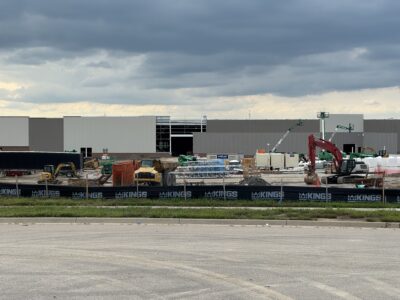
photo by: Chad Lawhorn/Journal-World
The Costco store under construction in northwest Lawrence is pictured on July 31, 2026.
The oft-quoted, old saying from more than 150 years ago is: “Go West, young man.”
I suspect there is a less-quoted, second part to that saying: “Bring your wallet.”
Both phrases have meaning in modern day Lawrence, as there has been much talk at Lawrence City Hall about expanding the city limits west of the South Lawrence Trafficway in an effort to open up hundreds of new acres for housing that hopefully will help ease the community’s housing crunch.
So, “Go West” indeed is a mantra you can hear around town today.
You can hear the part about the wallet, too, but you have to be listening a lot more closely.
Regardless, opening up the Lawrence city limits west of the area where the Bob Billings Parkway and SLT interchange sits today will require many millions in infrastructure investments to make the land — which is largely farm fields or hay pastures today — ready to accommodate houses and businesses.
Given that city commissioners in August may well be asked to officially annex several hundred acres of land west of the SLT, now might be the time to start talking about the wallet issue a little louder. With that in mind, I spent some time going through the city’s latest five-year capital improvement plan to tally every project that specifically had a notation about being needed to accommodate west of SLT growth.
What I found is that the city needs to complete at least $85 million worth of infrastructure projects to really get the area west of the SLT primed for development.
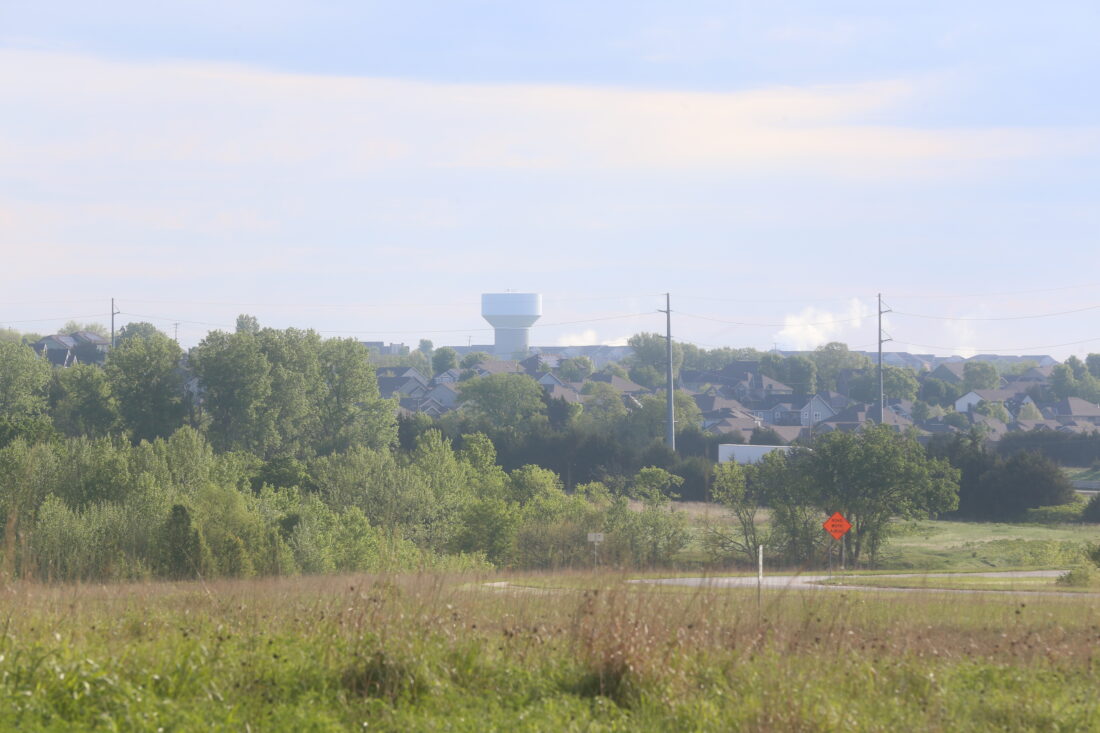
photo by: Chad Lawhorn/Journal-World
A piece of property west of the South Lawrence Trafficway and Bob Billings Parkway interchange is shown with Lawrence homes in the background on April 30, 2026.
The projects on the city’s CIP include items like an $18.75 million water tower to provide service to new homes. It also includes more than $20 million for items like sewage pump station improvements. Those projects do the unglamorous but very necessary tasks of pumping sewage up a hill so that it can make its way to one of the city’s two sewage treatment plants.
It also is important to note that many of these projects aren’t located in the area west of the SLT, and residents east of the SLT could pay a heavy price if these projects aren’t completed and development is allowed to proceed. For example, some of the projects are to expand the size of existing sewer transmission lines that are east of the SLT. If those lines aren’t expanded and new homes west of the SLT are allowed to be built, the end result could be that the lines get overloaded and existing residents have sewage backing up into their homes.
The $85 million worth of projects also do not include every cost that the city is likely to incur as the city goes west. For example, my tally didn’t include the cost of building or staffing a new fire station that will be used to serve that area.
Lastly, the $85 million amount shouldn’t be mistaken for the total amount of infrastructure needed for the area. It basically represents the type of infrastructure city government is responsible for providing — major streets, major sewer lines, big water towers, etc. The $85 million total doesn’t include the many residential streets or sidewalks or the smaller water and sewer lines that actually run to individual homes. Developers are required to pay for those pieces of infrastructure.
As annexation requests start to make their way to the City Commission, now is the time to understand the $85 million price tag. Once a property is annexed, there is some legal responsibility for the city to be prepared to provide services to it.
Now also is the time to think about how the city might pay for that $85 million. That question has become particularly interesting and unique. There are two reasons why: One is called a STAR bond, and the other is called Costco.
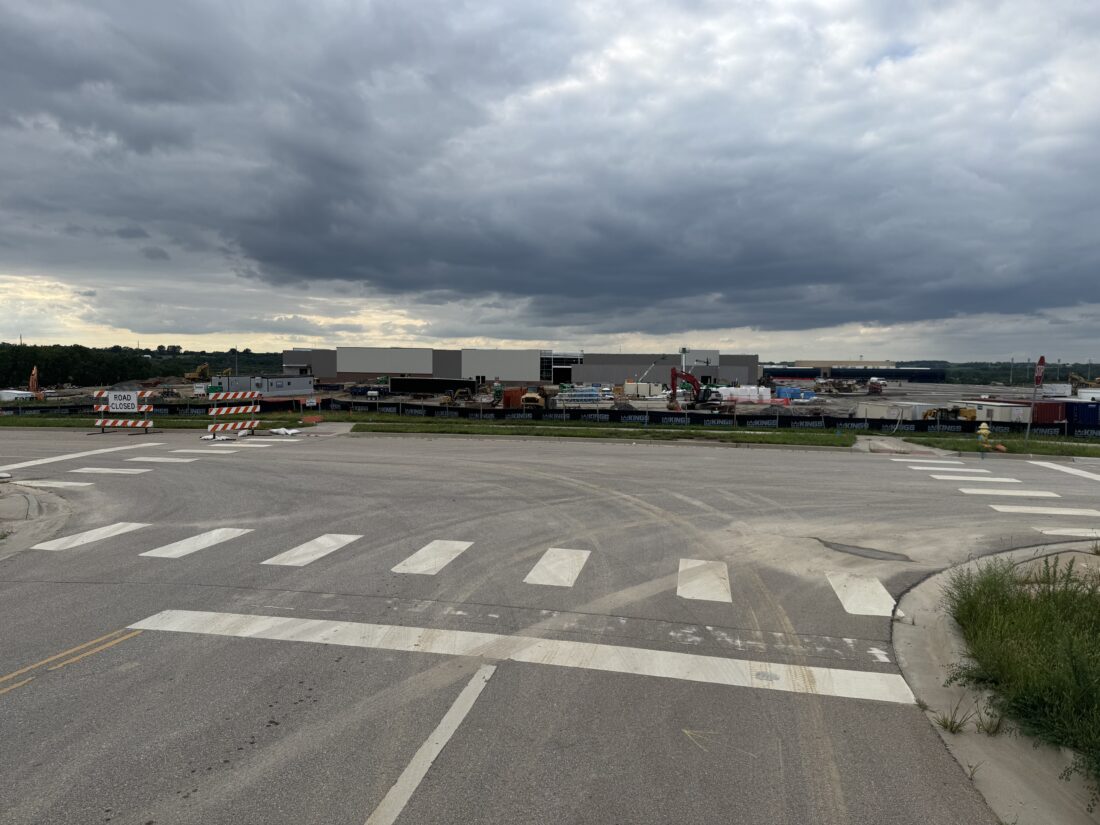
photo by: Chad Lawhorn/Journal-World
The Costco store under construction in northwest Lawrence is pictured on July 31, 2026.
As we’ve reported, businessman Phil Bundy — who has done a lot of development work in Wichita — is seeking to annex 288 acres west of the SLT to build everything from apartments, single family housing, big box retailers, and an entertainment arena that could host events ranging from concerts to professional cycling races.
That arena component makes the project eligible to apply for state STAR Bond designation, which is an incentive aimed at attracting tourism drivers to the state. STAR Bonds are powerful incentives — they were key in bringing the Kansas City Chiefs to the Kansas side of the state line — because they allow a developer to essentially capture all the local sales taxes generated by the new development and all the state sales taxes generated by the new development. The state charges sales tax at a rate roughly three times higher than local governments, so getting the state to give up those funds is a big deal to a developer.
The use of STAR Bonds would make the project pretty unique in Lawrence. The only other project to qualify is the Gateway project currently underway at the KU football stadium. But, as we’ve reported, Bundy’s plan has a twist beyond that. He wants to not only capture the sales tax revenues generated by the new development in his project, but he also wants to capture the sales tax revenue generated by the soon-to-open Costco store near the intersection of Sixth Street and the SLT. That store — which will be open well before Thanksgiving — is not part of Bundy’s development at all. A different group of developers brought that store to town. But the STAR Bond law theoretically would allow Bundy’s group to capture that revenue, if the local governments agree to the idea.
STAR Bond projects can be used to pay for public infrastructure projects. Given that, I wondered how many STAR Bond dollars are contemplated to be used for the $85 million of needed public infrastructure west of the SLT. The answer: About $32 million.
That number comes from what I would call a preliminary STAR Bond application Bundy has provided to City Hall. That application is wide ranging in that includes an application for Phase 1, which is a project that would occur in south Lawrence near the SLT and Iowa Street interchange. It centers around a private indoor/outdoor sports complex operated by the youth soccer organization Sporting Kaw Valley and a host of retail development around it.
The application also includes a Phase II, which is the arena, housing and retail development for the property west of the SLT. For this article, I’m focusing only the Phase II part of the application. That part of the application says it plans to spend $122.7 million in STAR Bond money over the life of the project. Of that amount, $91 million would be for private elements, with $50 million going towards the arena, $5 million to an RV park, and $27 million to acquire the land for all of this.
The amount of STAR bond money to be spent on public infrastructure totals $31.7 million, according to the application. In other words, about 37% of the total STAR Bond funds would be spent on public pieces of infrastructure while 63% would be spent on private elements.
I recently asked Bundy why he thought that breakdown was the right amount. He noted there are only certain things the state allows STAR Bonds to fund. There has to be a tourism element to the project, for instance, thus some money needs to be used to ensure the arena becomes a reality.
But it was what else Bundy said that should really catch the attention of City Hall leaders: He’s willing to negotiate. When I asked him whether he envisioned that 37% number perhaps increasing, his response was sure and quick.
“Absolutely,” Bundy said. “Those are things we are all going to talk about. What is it we can pay for and what is it that we can’t? There are limitations in the STAR Bond stuff. We can’t pay for everything, but there is a lot we can pay for.”
With Costco included in the mix, there is also a lot of nearly-guaranteed money to be captured. The inclusion of Costco is what would make this STAR Bond proposal much different than a traditional STAR Bond plan. Traditional STAR Bond plans are based on so much speculation. Take KU’s Gateway project for example. Will KU sell out the stadium for years to come? Will the projects conference center attract hundreds of events per year? Will the retail around the site be successful?
Bundy’s project has some of those same type of questions. Will this west Lawrence arena really draw a crowd? Do we need an RV park in west Lawrence? But the Costco development has fewer questions. Costco is a proven retail destination. You have to look really hard in America to find a Costco store that has an empty parking lot. Given that the Lawrence store is being designed to serve not only Lawrence but also will be the closest Costco store to communities such as Topeka and Manhattan, expectations are high that the store will produce a lot of sales and, thus, sales tax revenues.
Seemingly, one of the questions city and county commissioners may be asking as they contemplate a potential STAR Bond deal is whether the relatively sure dollars of Costco should primarily be used for public infrastructure or private elements?
If you treat it fairly, that is probably a complex question. For today, though, it probably is enough to note that the expected amount of sales tax revenue generated by the Costco store alone possibly could pay for all of the $85 million in private infrastructure needed to open up the west of SLT land for development.
You may recall in June that I used a back of a napkin and some AI-aided research to create some estimates for how much a Lawrence Costco may generate in annual sales tax revenues. When you include city, county and state sales tax dollars, the estimates ranged from $8 million to $15 million a year, depending on how successful Costco is in attracting shoppers.
Again breaking out the napkins and the AI-aided research, I calculated how much debt a project could undertake if it had annual revenue streams of $8 million a year or $15 million a year for 20 consecutive years. At $8 million, it was estimated a project could take out debt to build about $65 million worth of projects. In other words, the Costco sales tax revenues alone could pay for about 75% of the needed public improvements for west of K-10. At $15 million a year, it could pay for all of the public improvements and still have about $45 million left over.
A key point to understand about those numbers — in addition to them being very rough estimates — is that they are dependent upon using STAR Bonds. That is the only way that you can capture the state’s share of the sales tax dollars. Without capturing those state sales tax dollars, the numbers become much smaller.
Expect Bundy to hammer home that point in the weeks and months ahead.
“You might as well,” Bundy said, “use the state’s money to pay for those improvements. . . It is a great investment for the City of Lawrence.”
In all fairness, that is still to be determined, but it is becoming clearer that it may determine whether Lawrence indeed “goes West.”
Town Talk column
Affordable apartment project in East Lawrence that escaped funding clawback shows new sign of progress
KC-area dealer Cable Dahmer buys Lawrence’s longtime Dale Willey Chevrolet and GMC dealership
Introducing a new writer for the Journal-World’s Town Talk feature
Bad television was a big part of the creation of Town Talk. While some of these posts made about as much sense as ...