


Voters turn out big when there’s a question on the ballot, so why don’t the feds or state allow more of them?
Kansas amendment lost big overall, but actually won the majority of counties in the state
photo by: AdobeStock
Here’s a thought exercise for you: Imagine there was a national election where voters would decide whether there should be a national sales tax of X% to fund a single payer healthcare system for all Americans.
Do you think a lot of people would show up to vote in that election?
“It sure seems like people would come out and vote on that,” Chris Koliba, founder and director of KU’s Center for Democratic Governance, told me recently.
Douglas County this week gave us some evidence that voter interest would be high in such an election. Voter turnout in the primary election held in the first week of August — also known as vacation season in a college town — topped 40% and was thought to be the second-highest primary turnout in the county’s history.
The high turnout was largely credited to the fact the ballot contained a question on whether the Kansas Constitution should be amended to require the state’s Supreme Court justices to be elected rather than appointed.
It is perhaps not coincidence that the county’s highest turnout for a primary came in 2022 when there was also a constitutional question on the ballot. That one was about abortion rights, and polls were busy throughout that election.
It seems like it is easier to get people interested in voting when they have an interesting yes/no question to answer rather than when they are just choosing between one politician or another.
But don’t expect to see the national sales tax/healthcare question — or any other — on a national ballot anytime soon. There is no mechanism in place that allows for a national referendum on any question.
That’s true even in today’s moment, which political scientists largely agree is defined by populism. President Donald Trump has sold himself as a populist president, and the idea is not confined to Republicans. In this week’s election, Cindy Holscher pulled off a mild upset to win the Democratic nomination for governor by running a more populist campaign than her challenger, Ethan Corson.
The idea of using national referendums to decide some of the biggest questions of the day hasn’t really got much debate. Despite that, Koliba called it an interesting idea, especially since the idea of populism and returning the power to the people seems to be having a national moment.
He thinks one result of such a national referendum system would be predictable enough.
“I think it certainly would enliven democratic participation,” Koliba said. “I think people are very interested in weighing in on matters of the day.”
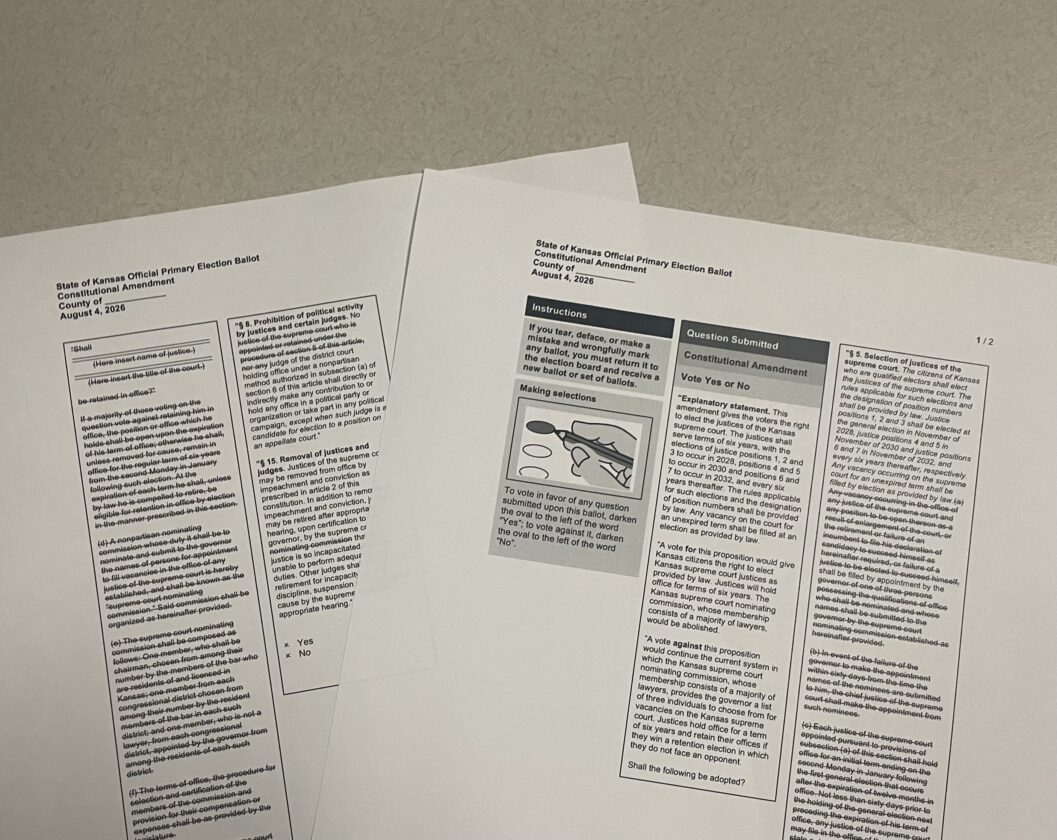
photo by: Sylas May/Journal-World
Language of a ballot question about whether Kansas Supreme Court justices should be elected is shown on July 16, 2026.
Perhaps one reason the idea of a national referendum doesn’t come up much is that it would require amending the U.S. Constitution, something that hasn’t been done since 1992. (The last amendment involved how Congress can change its pay, if you are trying to win a trivia contest.)
It also is worth noting that you won’t be seeing any such referendum questions in Kansas. Only constitutional amendment questions show up on a statewide ballot. You would not see, for example, a question deciding whether the state should expand Medicaid.
Before such a question could show up on a statewide ballot, the Kansas Constitution would have to be amended, Koliba said. About half the states in the U.S. do allow for statewide referendums, Koliba said.
Our neighbor Missouri is one of them, and it has created some national conversation about the idea of referendums. Populists around the country watched the result of a Missouri referendum question that sought to limit the power of referendums in Missouri. The proposed law would have required future referendums to win by something greater than a simple majority vote.
A vast majority of our next door neighbors hated that idea. The Missouri referendum to limit referendums lost by about an 80% to 20% margin. The fact the Republican-controlled Missouri legislature proposed the referendum in the first place is a sign of “tension” that is beginning to grow around the idea of populism in action, Koliba said.
“At certain levels they are becoming controversial, particularly when legislatures are seeing ballot measures overturn some of their edicts,” Koliba said.
Whether any of that means it would be a good idea for the U.S. or Kansas constitutions to be amended to allow for referendums is another matter.
The Founding Fathers did envision problems with too many issues being decided directly by the people, Koliba said.
“There was a concern that to give citizens direct authority over policy could be problematic when you get wild swings in public opinion,” Koliba said.
The Electoral College, it is worth noting, is not a model of populism. Plus, the Constitution originally didn’t even call for the public to elect U.S. Senators. State legislators elected U.S. Senators until the 17th Amendment in 1913.
Clearly, Koliba said, there would be a point where too many referendums on too many issues would become unworkable.
“Obviously, you can’t govern everything this way, or else it would be chaos,” Koliba said.
That was one of the fears of the Founders. Koliba said a key belief of the Founders was that “for democracy to function, decisions have to be made.” That fueled the belief in representative democracy instead of direct democracy.
But today, the hallmark of our political era arguably is inaction in Congress. A sharply divided House and Senate are producing fewer bills that become law.
Does that inaction argue for action on the referendum front?
That almost certainly would take more debate to come up with an informed answer, but it seems reasonable enough to ask the question of why the question isn’t being asked more. Koliba said we are seemingly in the right type of era for the question.
“I think this is a moment of self reflection for American democracy,” Koliba said.
In other election news and notes:
• Opponents of the constitutional amendment to require state Supreme Court justices to be elected are probably glad populism was in place Tuesday. (That’s a sentence for political science nerds to dissect later.)
Why? While the majority of Kansas voters clearly opposed the amendment — it lost by a margin of 61% to 39% — the majority of counties in the state clearly did not oppose the amendment. If constitutional amendments were decided by some version of the Electoral College, the amendment may well have passed.
According to the unofficial vote totals posted by the Kansas Secretary of State, 62 of the state’s 105 counties voted to approve the amendment.
However, none of the state’s urban counties voted in a favor of the amendment. For whatever reason, there was a pretty strong urban/rural split on this issue.
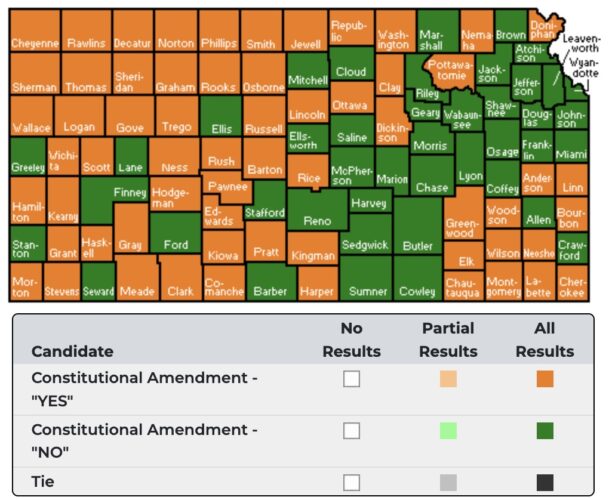
The map from the Secretary of State’s office shows a pretty strong east/west split in the vote too. Of the 51 counties west of Saline County, only 12 counties voted against the amendment. More interesting, though, is that most of those 12 counties that voted against the amendment include the largest cities in western/central Kansas. There was Reno, which is home to Hutchinson; Ellis, home to Hays; Ford, home to Dodge City; Finney, home to Garden City; and Seward, home to Liberal.
For whatever reason, the amendment was most heavily supported in the smallest of the state’s counties.
• In addition to rejecting a constitutional amendment that would have limited referendums, Missouri voters also rejected an amendment that would have replaced the state’s income tax with a higher sales tax.
That should have been an issue Kansas residents were keeping an eye on. It could have made Kansas City a very interesting place. Would much higher sales taxes in Missouri have caused a surge in retail business on the Kansas side of the line? Would the elimination of an income tax given Missouri-based businesses an advantage in recruiting employees and residents?
Both of those are likely multi-billion dollar questions, but they won’t be answered anytime soon. Missouri voters were unimpressed with the trade off of higher sales taxes in exchange for lower income taxes. About 83% of voters rejected the amendment, according to unofficial results.
Town Talk column
Thanks to a nonprofit that pairs artists and landlords, the Lawrence Potters’ Guild gets a temporary space of its own

After a brief bump during the World Cup, Lawrence is back to collecting less in sales taxes than it did a year ago

To make home construction easier and faster, Lawrence plans to experiment with a menu of pre-approved designs

Affordable apartment project in East Lawrence that escaped funding clawback shows new sign of progress

KC-area dealer Cable Dahmer buys Lawrence’s longtime Dale Willey Chevrolet and GMC dealership
Introducing a new writer for the Journal-World’s Town Talk feature
Bad television was a big part of the creation of Town Talk. While some of these posts made about as much sense as ...