
Should Lawrence ban data centers? There are some big numbers to consider
A single data center would pay millions in local taxes and fees each year
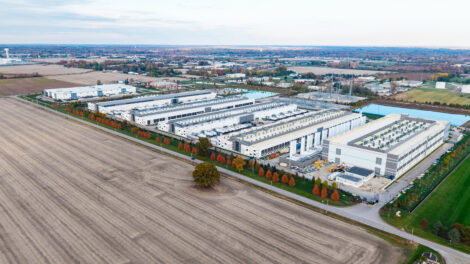
photo by: AdobeStock
Data centers to power artificial intelligence have been built on agricultural land near Dublin, Ohio, pictured in this undated photo.
I’m tempted to say that I don’t know what the big deal is about artificial intelligence. After all, people have long said all my intelligence is artificial.
But clearly AI is a big deal. Nationally, Gallup produced a poll last month that showed 71% of Americans oppose AI data center construction in their communities. Locally, the AI frenzy has produced plenty of data center news to watch. There are a multitude of “No Data Center” signs between Eudora and Tonganoxie, where developers are in the early stages of a proposal to build a large data center north of the Kansas Turnpike between those two communities.
Then, there is De Soto. It is in the process of becoming the data center capital of Kansas. It might have a shot to become the data center capital of middle America. There are approximately five proposals for data centers to be built around the $4 billion Panasonic battery production plant, which by the way, may convert some its electric vehicle battery production to production of batteries that store energy for data centers.
But the most local of news on data centers is now coming from Lawrence City Hall. Commissioners heard from dozens of residents calling for a moratorium on data center development in Lawrence. That call for a moratorium came after the Journal-World published a series that revealed — among other things — that Lawrence’s new development code allows data centers to be developed on any industrially-zoned property in the city without any special approvals from the City Commission.
City commissioners expressed interest in a data center moratorium, but stopped short of ordering one at their meeting this week. Instead, it asked staff to bring back more information. It will be interesting to see how much debate this moratorium proposal creates. Politically, this should be an open-and-shut case. Anytime you have 71% of a very divided America agreeing on an issue, you are taking a large political risk to go against public sentiment.
That said, good politics doesn’t always equal good economics or good long-term strategy. With that in mind, it seems prudent that any moratorium debate would at least examine a few topics. Here are three to consider.
— Water. The amount of water data centers use has been a major reason for opposition. They can use a lot of a precious natural resource to make their cooling systems work. One of the more interesting data center pieces I’ve read recently, though, highlighted an alternative view of that issue. It was written by the Kansas News Service, and we republished it this week in the Journal-World. It examined the debate around a massive data center and solar farm project that is proposed for southwest Kansas.
The project would be spread over 6,000 acres and would consume 600 million gallons of water per year for cooling. In parched western Kansas you want to use 600 million gallons of water per year? That surely is a reason to oppose the project.
Except, developers of the proposed project pointed out that 600 million gallons of water usage actually would be quite a water savings for the area. The 6,000 acres of farmland uses about 3.2 billion gallons of water per year because it is irrigated farmland.
That is the thing about water usage: It can be difficult to keep it in perspective. That’s true not just in the country, but also in cities. In a city like Lawrence, a conservative estimate of how much water is used to irrigate lawns would be about 500 million gallons a year. More likely, the number would be closer to 1 billion gallons a year.
If the city is basically fine with people using almost 1 billion gallons of water a year to make grass greener, why would it have a problem with a data center using 600 million gallons a year to power an emerging technology?
One answer, of course, would be because we don’t have the 600 million gallons to spare. However, that is not the case in Lawrence. I recently wrote a three-part series on Lawrence’s water and sewer utilities. One of the findings from that investigation was that Lawrence’s water treatment plant produces about 10.5 million gallons of water per day. The plants, however, have the capacity — and the raw water supply — to produce 41 million gallons of water per day. A finding of the investigative series was that the city has spent millions of dollars to upgrade its water plants in anticipation of large amounts of residential growth that did not materialize. That has been one reason water rates have risen at rates far greater than inflation.
Arguably, serving a large water-using data center might make Lawrence’s water utility more efficient.
If Lawrence had to serve a data center customer that needed 600 million gallons of water per year, it basically would need to produce just less than 2 million extra gallons of water per day. All else equal, Lawrence would be producing 12.5 million gallons of water per day instead of the 10.5 million gallons it normally produces. In other words, it would be using about 31% of its daily capacity of water production instead of its current average of 25%.
Lawrence’s water situation might actually give it a competitive advantage in attracting data centers. While some other communities may need to increase their treatment capacity to serve a data center, Lawrence seemingly would not.
But is it a competitive advantage worth pursuing?
— Revenue. A look at revenue potential for the community might be helpful in answering that question. Looking at how much money the city would collect in water payments and property tax payments probably is prudent.
On the water payment front, I’m going to keep the calculations very back-of-the-napkin in nature. The city’s 2024 audited financial statements show the water volume and charges for the city’s largest water customers. If the city charged the 600 million gallon data center the same rate it charges Baldwin City — the city’s second largest water customer at about 214 million gallons a year — the city would collect about $2.8 million in water fees from the center. If the city charged it the rate it charges KU — its largest water customer at about 244 million gallons — it would collect about $5.1 million per year in water revenues.
On the property tax front, such calculations are highly dependent upon the specific data center and its value. But let’s assume that the data center would have a value of $250 million. That’s the value amount that generally triggers a project’s eligibility for a lot of state tax breaks.
With a fair market value of $250 million, a data center would have an annual city property tax bill of about $2 million and about $2.5 million to the county. It also would pay millions in school district property taxes, but that gets complicated due to the state’s school finance formula, so let’s not even consider that.
Of course, the data centers could ask for tax abatements, and De Soto, for example, is certainly giving some of those. But Lawrence would be under no obligation to give a property tax break to a center. It could take the approach of, if you want to pay full price, come. If you don’t, then don’t.
— Energy. Last is the issue of electricity. Just like water, these data centers use a lot of it. The high energy usage has been an argument against many centers. Specifically, there has been great concern among consumer advocates that data centers won’t pay their fair share for electricity costs. In other words, electric utility companies spend billions of dollars upgrading infrastructure to serve these data centers, and instead of the data centers paying for all of those infrastructure costs, the costs get spread amongst all of the utility company’s customers. That would mean your bills will go up because of a data center.
Utility companies in Kansas say there are regulations in place to prevent that scenario, but there is skepticism that such regulations actually will work. Let’s not try to solve that debate here. Rather, let’s recognize that Lawrence will have next to no impact on how that plays out.
That’s because when Lawrence’s electricity provider, Evergy, sets its rates and has them approved by the Kansas Corporation Commission, there is not some Lawrence-specific utility rate. Instead, Evergy’s rates are set by broad territories. The territory that includes Lawrence includes most of eastern Kansas, including De Soto (but not other parts of the KC metro.) Thus, if the regulations don’t work to ensure that data centers pay their fair share, it won’t matter that the data center isn’t located in Lawrence. If it is located anywhere in the same territory as Lawrence, it will impact Lawrence’s rates.
Is all of this a moot point? Is Lawrence even a place data center companies are interested in being? I don’t know. I will note that a Lawrence-based development company — Alcove Development — has gotten into the data center business, but it notably did not choose Lawrence for its first project. It is seeking to develop a center in Osawatomie instead. I hope to talk with Alcove officials in the future to learn more about their venture and thought process.
So, maybe Lawrence’s water situation, and the fact that it has an industrial park that already is immediately next door to a power plant, and soon may be basically next door to a solar plant, makes Lawrence potentially attractive to a data center developer. Or it may not.
Regardless, Lawrence city commissioners likely will have a data center moratorium question to consider. Commissioners seemingly will have the choice of looking at lot of numbers about the data center equation or, perhaps, just one — 71% of Americans don’t like them.
Town Talk column

A former lieutenant governor and his granddaughter fell in love with this Lawrence bar, and now they’re helping preserve it
Lawrence City Commission to weigh whether Costco should be included in STAR bond district

Thanks to a nonprofit that pairs artists and landlords, the Lawrence Potters’ Guild gets a temporary space of its own

After a brief bump during the World Cup, Lawrence is back to collecting less in sales taxes than it did a year ago

To make home construction easier and faster, Lawrence plans to experiment with a menu of pre-approved designs