

KU professors would be limited in how they could present the idea of systemic racism in future classes
Kansas Board of Regents to look at DEI policy again next week
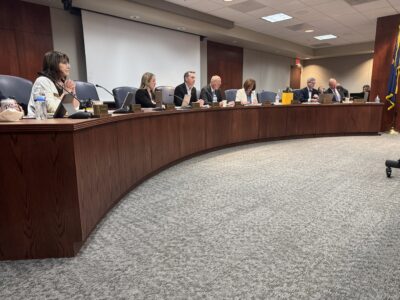
Members of the Kansas Board of Regents are pictured on May 20, 2026.
The idea of systemic racism could still be taught in required KU courses, but professors could not urge students to accept the idea as fact, according to a proposed policy under consideration.
The Kansas Board of Regents next week will consider a new diversity, equity and inclusion policy for the University of Kansas and the state’s other public universities. Regents discussed — but did not agree on a policy — at last month’s meeting.
At their upcoming Wednesday afternoon meeting, Regents will consider a new version of the policy that provides a different set of definitions for faculty members to adhere to when teaching classes.
The biggest change is proposed for the definition of what constitutes class content that is deemed to be related to the idea of Critical Race Theory. The definition says CRT content is any content that “presents racism as systemic within laws, policies or institutions.” That part of the definition is unchanged from the proposed policy a month ago.
However, the new policy adds more specificity to the other elements that would trigger class material being labeled as “CRT-related content.” In addition to addressing the idea of systemic racism, the content also would have to “promote acceptance of that viewpoint rather than presenting it as a subject of scholarly, historical or legal study.”
The revised definition also includes a statement that: “Discussion of race, racism or the history of the civil rights movement do not constitute DEI-CRT related content for the purposes of this policy.” That statement was not in the previous version of the proposed policy.
The policy is a requirement of the Republican-controlled Kansas Legislature, which during its last session attached a provision to the state budget that says the state’s universities must have a DEI-CRT policy in place in order to receive their full amount of state funding for the next school year.
The creation of a policy is a first step in ensuring that the state’s universities are not requiring any student to take classes with DEI-CRT-related content. Universities could continue to offer classes with DEI-CRT-related content, but those classes could not be a requirement to receive a degree, except in very limited instances.
The budget proviso approved by legislators requires the Kansas Board of Regents to adopt a policy and set of definitions in advance of the 2026-2027 school year. It then requires universities to certify that their degree programs don’t require any DEI-CRT-related classes ahead of the 2027-2028 school years.
Regents at their meeting last month expressed concern about the definition section of the previously proposed policy.
“The concern I’ve had is the ability of professional historians or professional political scientists to study these things from the lens of history or the realms of political science without running afoul under the law based on a definition that is overly broad,” Regent Peter Johnston said last month.
Regents, however, also were told by staff that whatever policy is adopted realistically will need to be supported by key legislators, or else the universities may be facing a new set of requirements approved by lawmakers in the future.
Whether the new proposal will pass that test is unclear. A staff memo provided to the Regents ahead of Wednesday’s meeting simply said the new proposal had been created after discussion with “the heads of the public postsecondary institutions, academic officers and others . . .”
The Kansas Legislature, along with many other Republican-controlled legislatures across the country, created the DEI requirements after a majority of lawmakers became concerned that DEI topics were becoming too heavily emphasized at the state’s universities.
State Government
‘If it ain’t broke, don’t fix it’: Retired Judge Sally Pokorny tells residents why she opposes electing Supreme Court justices
KU professors would be limited in how they could present the idea of systemic racism in future classes
State legislators push back against federal energy regulators ending competitive bids
TOPEKA — Two Kansas legislators asked federal energy regulators to ensure competitive bidding occurs on ...
Senate confirms 1st of 3 Kansas nominees to U.S. District Court
Corporate income tax collections falling sharply in Kansas; Republican, Democratic leaders disagree on what it means
TOPEKA — Corporate income tax collections in Kansas have almost halved since last year, while other sources trend ...
Candidate’s campaign manager created website with documents used to attack rival
TOPEKA — Kansas U.S. Senate candidate Patrick Schmidt’s campaign manager left his digital footprint on ...