Free State junior wins prestigious national prize for advancing racial equity; ‘I didn’t really believe it for the first five minutes’
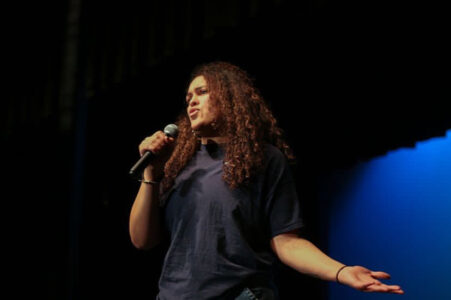
photo by: Lady Ortega-Perez
Free State High School junior Soledad Edison performs at the school's "Encore" variety show recently.
A Lawrence student has been named a recipient of the prestigious Princeton Prize in Race Relations — the culmination of what she describes as years of fostering important conversations with her peers about equity.
The honor “overjoyed” Soledad Edison to the point that she was “literally physically jumping up and down” when she heard about it, she said.
Edison, a junior at Free State High School, won the prize for the greater Kansas City, Missouri, region for 2022. It’s sponsored by Princeton University and Princeton alumni and recognizes high school students who, according to Princeton’s website, have “worked to advance racial equity in their communities.” Edison is among a select group, as only 29 students were recipients of last year’s prize nationwide.
Edison is acting president of Free State’s Equity Council, which was founded last August. She told the Journal-World that the council originated from an antiracism reading group composed of students who met over the summer.
Council members now engage in ongoing conversations with their peers about the changes they’d like to see in their school community — for example, developing ways to be more accommodating to a wider range of gender identities.
The group has also become involved with a revamp of the history curriculum in public schools, pushing for more emphasis on inclusivity starting with the Lawrence school district’s younger students. It has also developed a partnership with the University of Kansas’ Department of African and African American Studies, and has connected with faculty to present to the group about topics related to race and culture.
The group also hopes to eventually host a multicultural week with speakers and student town halls.
“Obviously, I only have the rest of this year and the next year, but the hope is that in five years, 10 years, this council will still be around and they’ll still be working on building better policy, making classrooms a little bit more inclusive, letting everybody’s voice be heard,” Edison said.
That last point plays into the group’s biggest goal, she said: to encourage peers to listen, learn, understand and educate.
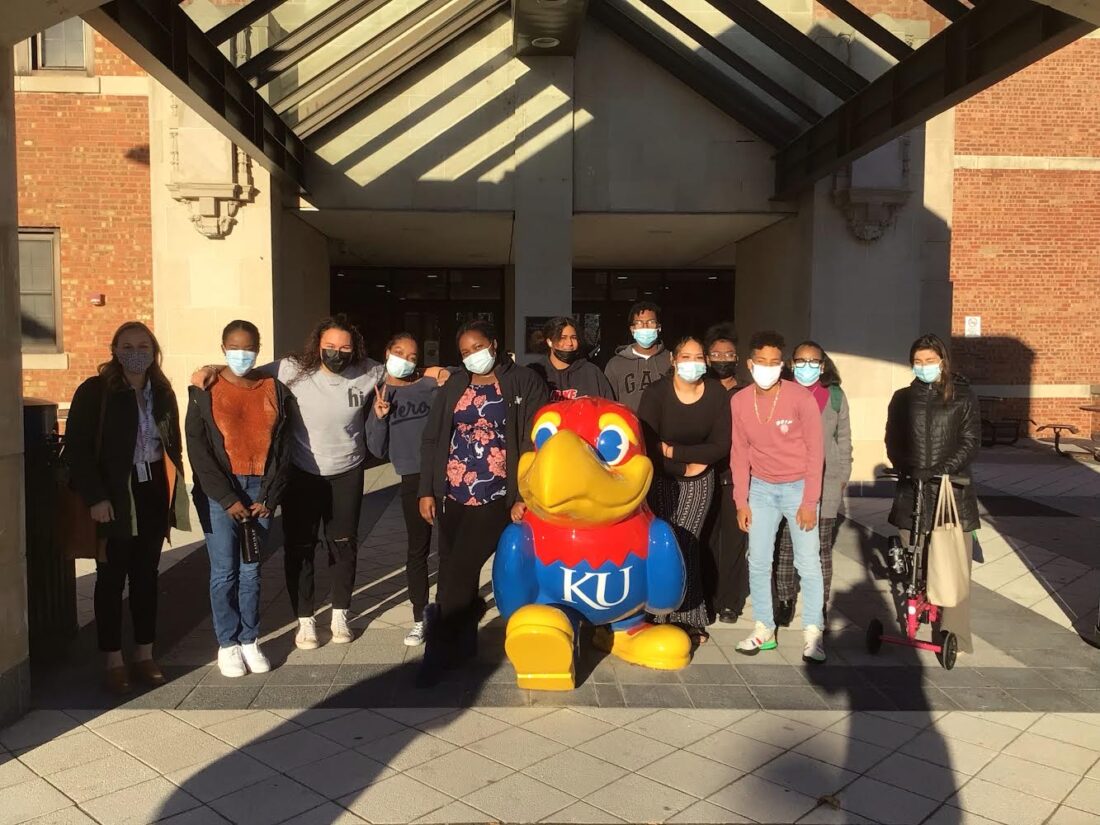
photo by: Courtesy of Soledad Edison
Free State junior Soledad Edison, pictured here third from the left in a light gray shirt, with some students at a Black leadership conference at the University of Kansas.
Edison said she didn’t expect to be selected for the Princeton prize. Candidates have to complete an application process explaining the scope and impact of their work to advance racial equity in their school or community. She was more than a little surprised when she saw the email telling her the good news.
“I was just expecting rejection. I don’t know; I’m kind of a pessimist like that,” Edison joked. “And when I clicked it, it was like ‘Congratulations,’ and my jaw dropped. I thought I was having a stroke a little bit, I didn’t really believe it for the first five minutes and I was reading it over and over again.”
Even more than a week later, she’s still feeling a bit awestruck.
Each prize recipient receives $1,000 and is invited to participate in the Princeton Prize Symposium on Race with other recipients from across the country in April. That event will take place virtually this year, but Edison is excited for the opportunity to engage in more discussion about equity and to connect with like-minded young people from across the country.
Edison said she had been thinking hard about equity issues since she was in middle school in Baldwin City. She’s Black and identifies as queer, and recalls initiating discussions with her teachers and the principal at the time about how they could make the predominantly white school more equitable for students like her.
Those are conversations Edison said she’s been around her whole life, thanks in part to some of her family members. One of her older sisters has been involved in Lawrence’s Black Lives Matter chapter, and her mother has stayed involved in community activism even as a single parent of four children. She said she felt like it was her job to pour that influence back out into the community.
“My whole family, we like to see progress and we like to see change,” Edison said. “We like to see things improve for people. We are ‘people people,’ right? We love helping people. One thing that’s really pushed me is my family.”
This focus has encouraged Edison to take a more active role in understanding topics like the Lawrence school district’s recent exploration of budget reductions for next year. When school closure scenarios were still on the table to make up for a multimillion-dollar budget shortfall, she attended a meeting discussing an equity impact analysis of some of those scenarios. Edison said that “opened her eyes” to what’s going on in the community at an even broader scale beyond the walls of her high school.
Outside of her equity work, Edison said she stays as involved as she can at school. She just performed in the Free State choral program’s annual variety show, “Encore,” last week, and spoke to the Journal-World after arriving home from track practice; she throws shot put and discus. She also is part of a student tutoring group that helps peers workshop essays.
As for the future, Edison’s goal is to attend the University of California-San Diego. She told the Journal-World she’d like to pursue a degree in cognitive science, which she’d use to become an educational neuroscientist and study how bias in the educational system affects the psychological standing of Black and Brown communities.
Other News
RJ Mitte, ‘Breaking Bad’ actor and disability rights champion, dies at 34

Clinton State Park and other state parks will increase overnight camping, vehicle permit fees starting next month
‘No day is like the other here’: Students from Lawrence’s German sister city discover football, new foods and new friends on exchange
GCSAA celebrates 100 years with new plaza and statue honoring its founder and first president
Go, See, Do: Library book sale, candidate forum and more