Police department paid $1.7 million to county last year in jail costs; chief says that’s too much
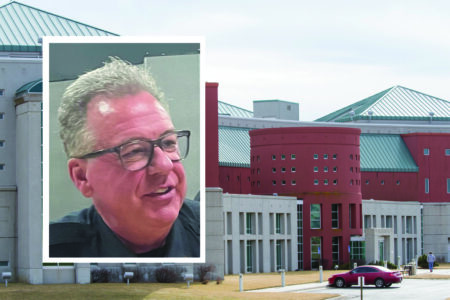
photo by: Journal-World File Photos
Lawrence Police Chief Rich Lockhart and the Douglas County Jail are pictured.
Every time someone is arrested on a municipal offense and stays in the Douglas County Jail for more than four hours, the Lawrence Police Department is billed $287 a day. In 2027 that bill will be $301 a day.
“The impact on our budget has been significant,” Lawrence Police Chief Rich Lockhart told the Journal-World.
That cost, which has increased dramatically over the past several years, has perplexed Lockhart for multiple reasons, not the least of which is the somewhat mysterious math behind the pricing.
In 2022 the police department was billed $119 per day for “prisoner care” at the jail, he said. In the span of four years, the bill had increased by 141%, to today’s price of $287 per day. Next year it will be $301 per day.
The price is quite a bit higher than that charged by other counties, Lockhart noted. Wyandotte County currently charges $85, for example, and Jefferson County charges $51. Johnson County is proposing to charge $230 next year.
It’s not clear what math has been used to arrive at the $301 figure. Lockhart has never been invited to or involved in any type of negotiation concerning a reasonable price. As a rule, he is simply told what the price will be and has no choice but to pay it. In June, for instance, he got an email from Sheriff Jay Armbrister — obtained by the Journal-World — regretfully informing him of the $301 per-day cost for 2027. In the email, Armbrister noted that he had attempted to keep the price unchanged but was unsuccessful.
“I have asked if we could not raise it and leave it as is and was told the city and county have an agreement as to the calculation and the city has not asked that the agreement be re-negotiated or anything, so they will be moving ahead,” Armbrister wrote, adding that he wanted Lockhart to hear it from him “before the bill starts showing up.”
Six years ago, the price per day had been under $100, Lockhart said, adding that $100 seems to be an average price that is charged among various counties.
“For years we were budgeting less than $600,000 a year for prisoner care,” Lockhart said. “And last year we paid $1.7 million, so that’s about a $900,000 increase.”
That money has to come from elsewhere in the already-strained budget, he said. “For us, that means we’re having to cut police officer positions. We’re having to cut back on training, equipment and all those kinds of things.”
Lockhart said he had been raising the topic of per-day costs for years. The issue has been frustrating because it’s not one that the department has any control over. Police officers can give notices to appear to municipal offenders instead of arresting them and taking them to jail, but that course of action isn’t always appropriate due to public safety concerns.
According to department records, the number of annual custodial arrests has varied little over the past several years, hovering around 2,000, but the number of notices to appear has increased from 116 in 2021 to 639 in 2025.
Aside from arrests, if someone is convicted and sentenced to jail time for a municipal offense, every day that person spends in jail is billed to the Lawrence Police Department.
The county typically does not bill if someone spends less than four hours in jail, but Lockhart said that arrangement was basically “a gentleman’s agreement” that was subject to change.
In the last quarter of 2025, the majority of billing was for single-day stays in the jail. But 10 long-stay inmates — anywhere from 32 to 85 days — accounted for $143,352 of that quarter’s bill.
Chronic arrests for municipal offenses present a special challenge. Lockhart mentioned one individual who is arrested so often that it’s like the jail is his home — a home that the taxpayers are footing the bill for. It’s a case where mental health treatment hasn’t been a viable option. And giving the man a notice to appear instead of arresting him is just delaying the inevitable; after so many failures to appear a warrant will be issued, and he’ll be back in the jail. If he’s there 300 days out of the year, that bill comes to $90,000.
Lockhart is well aware that the jail provides services beyond a cell and a bed, but paying $300 a day whether an inmate is there five hours or 24 hours doesn’t make a lot of sense to him.
“We would like to see and have a discussion about what goes into the (cost) formula and how the formula impacts these different areas of our operation so that we all have a mutually agreed-upon fee that’s reasonable for the county and recovers what these inmates actually cost,” he said.
One letter from April 2022 between County Administrator Sarah Plinsky and then-City Manager Craig Owens attempts to describe the cost formula, but Lockhart says he has hasn’t seen anything like that in writing since. That letter describes a methodology that uses direct expenses such as employee benefits for jail workers, utilities, medical costs, out-of-county housing, facility liability insurance, maintenance staff and expenses, transportation costs and “transfers to equipment reserve. That total is divided by the jail’s capacity of 167 beds, multiplied by the number of days in a year. Then a 10% administrative fee is added to cover “indirect expenditures.”
Still, Lockhart wants to see the math, and he wants an explanation of why certain costs that remain the same in running a large facility whether you have 50 inmates staying there or 100 are apparently not taken into account.
Most of all, he wants to see a billing structure based on a transparent, negotiated agreement between the city and the county.
“Our community has no idea that we spent $1.7 million taking care of prisoners last year, and they need to know that,” he said.
The City Commission was scheduled on Tuesday to receive and discuss the acting city manager’s total proposed budget for 2027.
City Government
Evacuation drill planned Tuesday at Lawrence City Hall

Bond issue for water and sewer projects, bike plan, Wakarusa Drive update on Lawrence City Commission’s agenda
Opinion: Environmentally conscious Lawrence is not focused on the biggest problem with electric vehicles

Locust Street apartments, Holcom housing development among this year’s applicants for $700K in Affordable Housing Trust Fund money
Business owners hurting from Wakarusa Drive closure say they’re getting no answers, no signs, no accountability