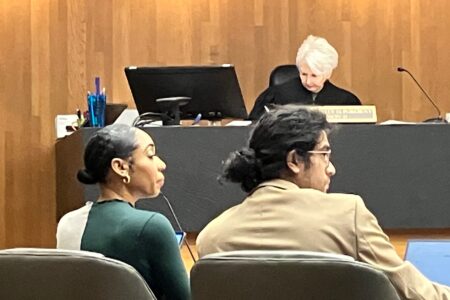
2015 date rape case on cusp of being heard by jury in Lawrence

photo by: Douglas County Sheriff's Office
Updated story
• March 4, 2019 — Jury finds man not guilty of raping KU student
On a Saturday night in November 2015, a University of Kansas student texted a Lenexa man she’d met a couple of weeks earlier in Lawrence.
The two agreed to meet up. A few hours later, the man drove to town, picked her up at her sorority house and headed for Clinton Lake. They looked at the stars, sipped from a bottle of vodka and got into the backseat.
There, she claims he raped her as she slipped in and out of consciousness. He contends he didn’t, and that when the woman seemed to experience a sudden medical emergency he stopped sexual contact and tried to rouse her.
The case is scheduled to go to trial starting Monday in Douglas County District Court.
Andrew J. Flood, 24, stands charged with rape, aggravated criminal sodomy and attempted aggravated criminal sodomy while the victim was unconscious or physically powerless. The charges are felonies.
The woman went to the hospital for a sexual assault exam and reported the incident to law enforcement the morning after it occurred. Following an investigation by the Douglas County Sheriff’s Office and lab results from the Kansas Bureau of Investigation, the Douglas County District Attorney’s Office charged Flood in June 2016.
Flood has been free on $30,000 bond since shortly after being charged.
While the criminal case has been pending, Flood filed a civil lawsuit against the woman in Johnson County District Court in February 2018, claiming that her “intentional, reckless, and false” accusations caused him emotional and mental distress.
He said “the stigma of committing an act he did not do” will “haunt him” for years to come and merited financial damages from the woman, according to filings in the Johnson County case.
The woman filed a countersuit, also asking for damages, claiming that Flood sued her to intimidate, harass and “chill” her from cooperating with authorities in the criminal case.
Court documents indicate that both sides agreed to dismiss the civil lawsuit in late December. Publicly available documents don’t indicate whether a financial settlement was part of that agreement.
•••
Flood currently works as a firefighter in Oregon, with a crew that fights wildfires as well as for a rural fire district, according to his LinkedIn and Facebook pages. He previously attended Kansas City Kansas Community College and worked for two towing companies in Johnson County, his job at the time of the incident.
According to an affidavit prepared by law enforcement prior to Flood’s arrest:
The woman told detectives that she’d consumed some vodka before Flood picked her up but that she didn’t feel effects from it. She said she drank some of the vodka from the bottle in Flood’s car.
She said he started kissing her in the backseat, which “shocked” her because she had a boyfriend and wasn’t looking for anything romantic.
At that point, she said she thought she had become intoxicated because she was beginning to lose consciousness and “black out.” She said that she intermittently awoke to find Flood raping and otherwise sexually assaulting her. What woke her up, she said, was Flood using his knuckles to rub her sternum, which was painful.
Detectives wrote in the affidavit that the woman said “she was physically unable to stop Flood and unable to tell him to stop because of her level of intoxication.”
Flood then drove her home, where he helped her inside and got her some water. She said once she was able to walk on her own, she went upstairs and he left.
Flood agreed to talk to detectives the next day, and he told them that the woman was the one who initiated the kissing and other sexual activity.
He said she removed some of her own clothes and was actively participating until, at one point, her “breathing changed and she sort of fell to one side.” Flood said she had a “blank stare” and that he momentarily worried she wasn’t breathing, but couldn’t call 911 because neither of their phones had service in the area where they were.
He said the woman passed out several more times as he got dressed and helped her get dressed, and that he did “sternum rubs” on her chest each time to wake her back up.
•••
Over the past 2 1/2 years since charges were filed, disputes about lab results and what caused the woman to pass out have been the subject of much legal debate between prosecutors and Flood’s lawyers, Tom Bath and Tricia Bath.
According to court filings from both sides:
Flood’s lawyers have emphasized that the sexual assault exam showed no physical injuries or other evidence that the woman was raped.
Prosecutors responded: “A lack of injury does not indicate there was no sexual activity. Further, KBI Lab tests showed the defendant’s DNA was present in the victim’s vaginal swab.”
Arguments over the woman’s lucidity have included a test showing her blood-alcohol concentration several hours after the incident was .01 — far below .08, the level considered too drunk to legally drive.
She reported that she had taken an antihistamine and an antidepressant earlier that day, both of which contain warnings against mixing with alcohol. The woman had fainting spells before, when having blood drawn and viewing a medical procedure, but said she’d never been diagnosed with an explanation for them.
Lab testing of a vodka bottle seized from Flood’s car and testing of the woman’s urine revealed no presence of any “date-rape” drug.
Acknowledging that the defense may use those arguments to attack the woman’s credibility, prosecutors said that legally they need only prove the woman was unconscious or physically powerless when the sexual assaults occurred — but not why.
“The state does not need to prove the reason that the victim was unconscious or physically powerless. It is undisputed that the victim continuously and repeatedly, genuinely passed out and was unconscious,” prosecutors wrote.
Flood’s lawyers disagree that the reasons don’t matter.
Leaning on opinions of a doctor they hired to review the case, they said that without sufficient evidence to determine the cause of the woman’s symptoms, “there is no way to determine whether she accurately perceived or recounted the events of the evening in question.”
They added that sorority sisters who saw the woman after Flood brought her home described her as “panicky” but “not a drunk panic — it was different.” The friends also described the woman as “twitching” and said she appeared to be hyperventilating.
“What happened to (the woman) during her, for lack of a better word, episodes, is not just AN issue in this case but THE issue in this case. Whether Andrew Flood touched her in the ways that she claims is THE issue in this case. There was no other witness to the alleged touching,” defense attorneys wrote. “… the jury will have questions about how these symptoms relate to (the woman’s) ability to perceive and recall events.”
Editor’s note: This story has been updated to clarify the woman’s description of the assault as well as the length of time pre-trial legal disputes went on.
Contact Journal-World public safety reporter Sara Shepherd
Public Safety

24-year-old ordered to stand trial in connection with Lawrence mother’s drug death
Former LHS teacher admitted having sex with a sophomore 26 years ago, but a lot turns on whether she was 15 or 16 at the time
23-year-old man charged with second-degree murder in downtown Lawrence homicide
Lawrence Police Department receives KDOT’s top traffic safety award for second straight year

Police arrest 23-year-old on suspicion of first-degree murder in downtown Lawrence homicide