

‘Highly discriminatory’: Current and former trans lawmakers speak out ahead of Douglas County judge’s ruling on bathroom, driver’s license law
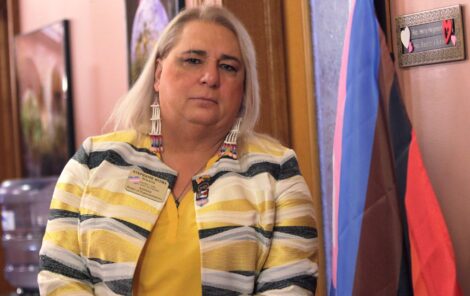
photo by: John Hanna /AP
Kansas state Rep. Stephanie Byers, D-Wichita, stands besides a transgender pride flag outside her office in the Statehouse, in Topeka, on April 26, 2022. Byers was Kansas’ first elected transgender lawmaker.
Stephanie Byers doesn’t pee standing up.
Not that it’s anyone’s business, but if that is alleged about her in a court of law — as a witness alleged last week in Douglas County — she’s going to correct the record.
And while she’s at it, Byers — Kansas’ first openly transgender lawmaker — is going to say this: She is not a threat to any woman in any public restroom anywhere.
“That is defaming my character, and it paints the picture of me as a trans person as someone who would be dangerous in a bathroom,” she told the Journal-World after the witness, testifying under a pseudonym for Attorney General Kris Kobach, made the remarks about her and fellow transgender Kansas lawmaker Abi Boatman.
The testimony came as Kobach was defending the state’s SB 244 law in a lawsuit brought by transgender plaintiffs. SB 244, enacted in February over Gov. Laura Kelly’s veto, restricts which restrooms transgender people can use in public buildings and requires the surrender of their driver’s licenses if the gender markers on them don’t match their biological sex at birth.
Byers, a Democrat who left office in 2023 and now lives in Mexico, said she was appalled, though not necessarily surprised, when she read what the 24-year-old witness had said about her and Boatman to Judge James McCabria last Friday under the cloak of anonymity.
“I’m an easy, easy target,” said Byers, who was publicly bullied by some of her colleagues while in the Legislature, perhaps most viciously by GOP Rep. Cheryl Helmer, who falsely claimed that “supposed transgenders” were committing violent sex crimes in women’s restrooms.
The witness, who identified herself as a registered Republican from Wichita, testified that when she was 19 and working as an intern for a state representative she went into a restroom at the Capitol and, peering underneath her stall, spotted the feet of someone in the adjacent stall “standing to pee,” which she said meant it was “quite clearly a man” – and, hence, reason for her to feel “quite uncomfortable.”
When the person emerged from the stall, the young woman said she recognized Byers, whom she knew to be transgender, though she consistently labeled her a “man” during her testimony.
In another incident, a few years later, the woman said she saw Rep. Boatman entering a women’s bathroom at the Capitol as she was leaving. They were never in the restroom together, but the mere sight of Boatman going in made her feel “uncomfortable,” she said, adding that she expected everyone in a women’s restroom to have “the same genitalia” — without specifying how she could ever be certain of anyone’s genitalia.
Byers, who underwent a vaginoplasty as part of her medical transition years ago, said the woman was either lying about seeing her in the restroom or misremembering what she saw.
“I did not have the physical equipment to stand to pee when I served in the Kansas Legislature,” Byers said.
But the “equipment,” while it might say something about the witness’ truthfulness, is not really the point. We all have equipment of one type or another, and “no one’s doing genital inspections before we go into the restroom,” Byers said.
The point, she said, is the demonization of a very small group of people that SB 244 targets, distracting Kansans from “real issues” that need to be addressed, like property tax relief and the plight of farmers; the point is that the State of Kansas, without any evidence that she can see, is trying to convince people that trans women pose a risk to other women in public restrooms.
The goal isn’t simply to “define” trans people out of where they can use the bathroom, an essential life function, but to further marginalize and “other” them in the public sphere, she said.
“They’re trying to push trans people back into a closet so deep that no one thinks that we even exist anymore,” she said.
None of the four civilian witnesses who testified for Kobach last week testified that they had ever experienced any actual harm from a trans person in a bathroom. Rather, the theme of their testimony was that they felt “uncomfortable” or vaguely “unsafe.”
To that, Byers said, maybe they should consider seeking out single-user bathrooms in public buildings to guard against ever feeling “uncomfortable” in the presence of another person.
The four witnesses all testified that they did not “dislike” transgender people; they just didn’t want them in the same restroom.
That’s a sentiment that Byers, a retired teacher, has heard plenty: private declarations of “nothing against you personally” coupled with public denunciations and disenfranchisement.
That sentiment reminded Byers of how people used to speak of racial segregation — the notion of separate but equal, where “equal” was never remotely a reality.
It reminded her too of a painful incident in her childhood more than 50 years ago when she and her father were denied use of a gas station restroom because they were Native American.
“Y’all might be mighty fine people,” she recalled the manager saying, “but I just make it my policy that I don’t let Injuns use my bathroom.”
Byers’ white mother, however, was told she’d be welcome to use the facilities.
“I’m 63 years old, and I still carry that,” Byers said of the crushing humiliation she felt as a kid.
Under SB 244, if Byers were to use a restroom at the Kansas Statehouse, or any government building, she would have to seek out a relatively rare single-use gender neutral restroom or go into the men’s restroom since “M” is the marker on her Oklahoma birth certificate.
The latter is something she would never do.
“I am vulnerable in a men’s restroom,” she said, noting that the vast majority of sex offenses and crimes of violence are committed by men and that transgender people are victimized at a higher rate than others.
Four plaintiffs in the SB 244 lawsuit, all bearded transgender men, are now required to seek out single-user restrooms or use women’s restrooms in government buildings — a situation that they said seems designed to create confusion and panic and “self-outing,” as in “Don’t be alarmed, Ma’am, my driver’s license says “F.'”
“That’s one of the fallacies of SB 244,” Byers said. “If they’re trying to protect women’s spaces, they’ve now opened the door so that anybody who has a beard and a bald head can walk in and simply say ‘I’m a trans man.’ … So what stops somebody now who actually is a sexual predator?”
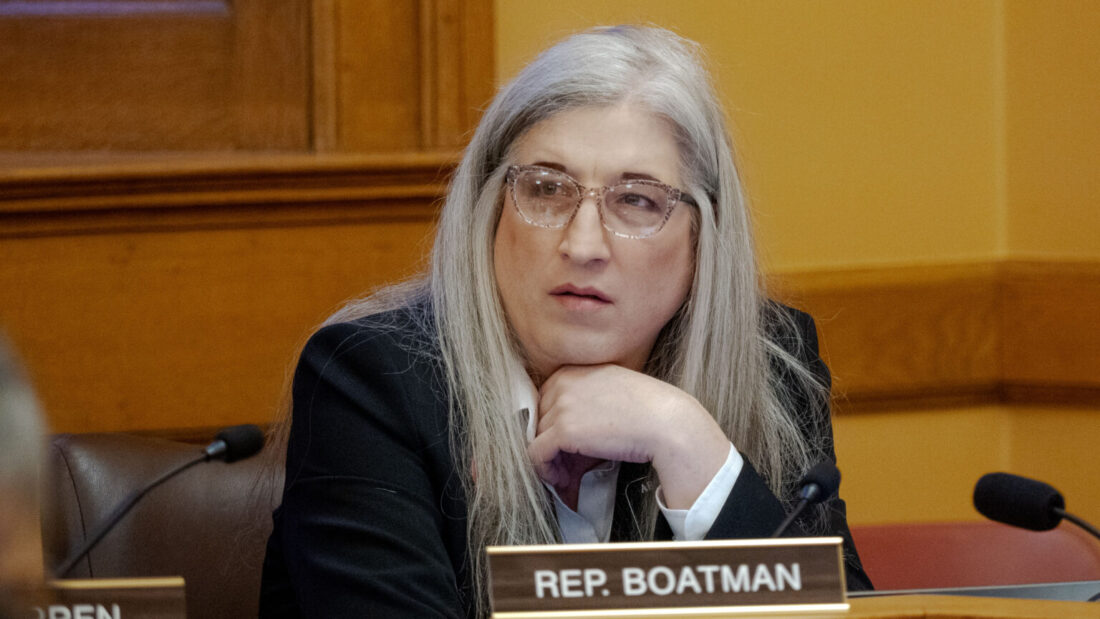
photo by: Sherman Smith/Kansas Reflector
Kansas Rep. Abi Boatman is pictured in a committee meeting on March 16, 2026, in Topeka.
Unlike Byers, Rep. Boatman, a 46-year-old Wichita Democrat, is still in office and still forced to think about which bathroom she is permitted to use when she’s working in the Statehouse.
The majority of the time, she said, she uses the one family restroom in the entire building, which she likes to call “my separate but equal bathroom.”
That restroom doubles as a lactation room, so if a breast-feeding mother is using the room, Boatman’s only other option, under SB 244, would be the men’s room.
“I think it’s highly discriminatory, and I think they’re setting an impossible standard for trans people,” she told the Journal-World. “By saying that you’re ‘uncomfortable’ just thinking about a trans person being in the bathroom … I don’t understand how this passes muster.”
Even though she was called out by name in the Douglas County lawsuit over SB 244, Boatman said she had no personal connection to the litigation other than high hopes for how it turns out.
“I hope the judge can see through these obvious scare tactics and make a decision that is beneficial for everyone and treats everyone with respect and dignity,” she said.
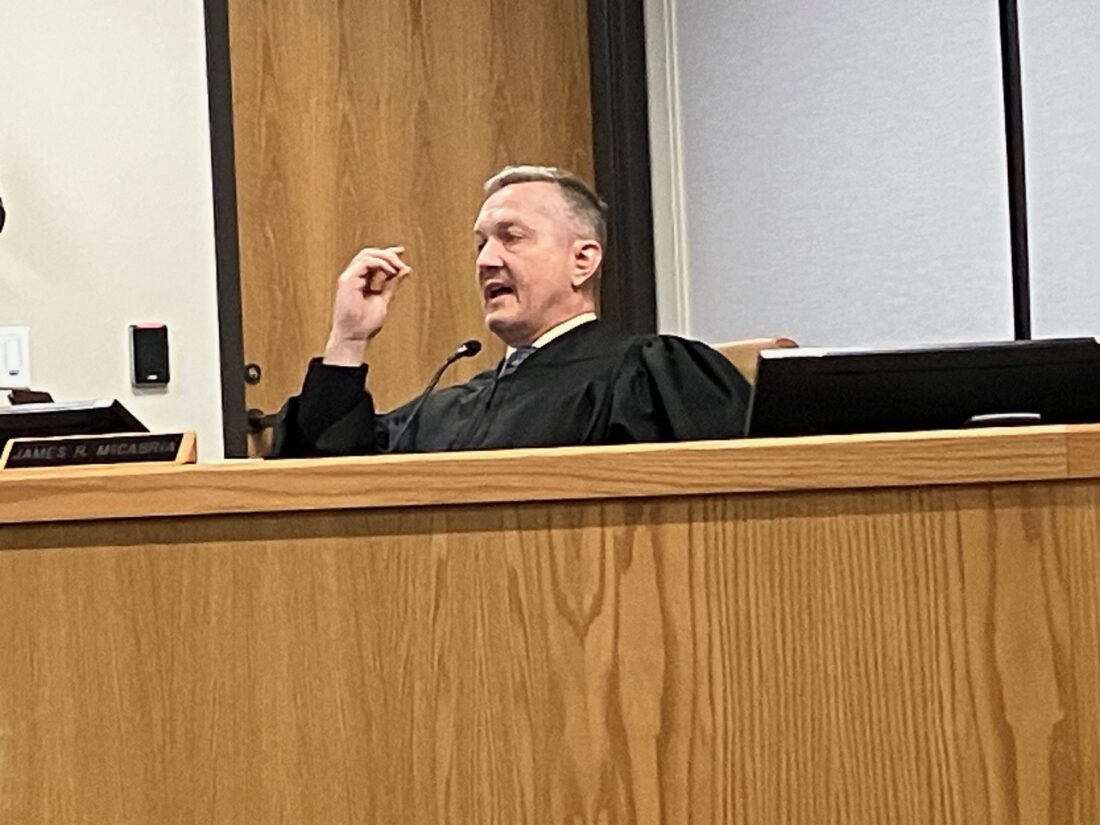
photo by: Kim Callahan/Journal-World
Judge James McCabria is pictured on Thursday, Oct. 30, 2025.
Judge McCabria is set to hear closing arguments in the case Wednesday after having heard four days of testimony last week. He is also expected to hear the state’s motion to dismiss the case. He will make a decision in coming weeks on whether to grant the plaintiffs’ request for an injunction to temporarily halt enforcement of SB 244 pending a decision on the disputed constitutionality of the law.
In May, as the Journal-World reported, Douglas County Judge Carl Folsom III issued a temporary order blocking the State of Kansas from enforcing parts of a law, known as SB 63, that would prevent minors from receiving gender-affirming care, saying that the plaintiffs had shown a reasonable probability that they would suffer irreparable harm if the law stood during the pendency of the lawsuit.
Folsom also ruled that the plaintiffs were substantially likely to prevail on their claim that SB 63 violates the Bill of Rights in the Kansas Constitution, which he said protects the fundamental right of personal autonomy, including the right of parents to make medical decisions for their children.
See previous coverage of the SB 244 lawsuit in Douglas County below:
Trans plaintiffs challenging state law testify in Douglas County about harms they’ve suffered
State’s anti-trans law harms people while not making anything better, experts testify
Kobach’s team puts on parents, cops, other witnesses to support Kansas’ anti-trans law SB 244
State Government

GOP’s highest profile figures are on rescue mission in once-reliable Kansas

In debate, Marshall says the Ukraine war, not the Iran war, has caused high diesel prices
Candidates lean on their prominent supporters in District 2 race
TOPEKA — Democrat Don Coover and Republican Derek Schmidt stood with partisan allies as their congressional race ...
Funding for new Chiefs stadium moves forward, setting sales tax revenue district
TOPEKA — State officials answered a key question this week underpinning the complex financing of the Kansas City ...
Voters Guide: A look at the candidates seeking to become Kansas Insurance Commissioner
The Kansas Department of Insurance regulates insurance companies that sell policies in Kansas. Voters will decide ...
Voters Guide: A look at the candidates seeking the job of Kansas State Treasurer
In the Nov. 3 election, Republican Kansas Treasurer Steven Johnson faces two challengers for his job as the chief ...