State’s anti-trans law harms people while not making anything better, experts testify
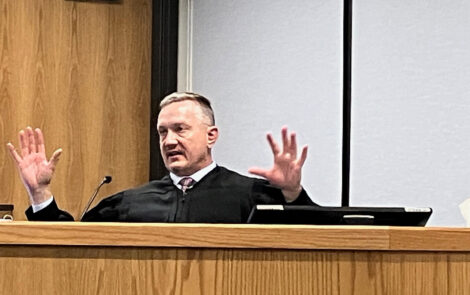
photo by: Kim Callahan/Journal-World
Douglas County District Court Judge James McCabria is pictured in October 2025 at a bench trial.
Sex crimes in public bathrooms are not a thing, and neither is a man donning female clothing in order to assault a woman in a public bathroom. That was the upshot of a forensic psychologist’s testimony Wednesday in Douglas County District Court.
Dr. Cynthia Calkins, a professor at John Jay College of Criminal Justice in New York who specializes in sex-crime prevention, testified on behalf of transgender and intersex plaintiffs who are suing the State of Kansas over the new law known as SB 244, which restricts where they can go the bathroom and what gender marker can appear on their driver’s licenses.
Attorney General Kris Kobach and his team of lawyers, in defending the lawsuit, have cited the protection of women in restrooms as an important government interest, but Calkins maintained that SB 244 was not evidence-based and did not further that interest at all.
“I do not believe [SB 244] increases the safety of women and girls in public restrooms,” she told Judge James McCabria, who is overseeing a four-day hearing on the plaintiffs’ motion for a temporary injunction of SB 244.
SB 244 became law in Kansas in February, when the Legislature overrode Gov. Laura Kelly’s veto. The part of the law that this week’s hearing concerns is (1) the provision that requires people to use the public restrooms on government property that align with their sex at birth and (2) the provision that invalidated driver’s licenses that contained updated gender markers to align with a person’s gender identity.
Calkins, who has authored four books and conducted multiple studies on sex offenses, said such offenses are unlikely in any public setting, let alone in a public bathroom.
Most sex crimes — 82%, according to one of her studies — are committed in a residential setting. Only 7% were committed in a public setting like a parking lot, wooded lot or bar. The remainder occurred in a semi-public setting such as a vehicle, she said.
Another of her studies indicated that only 4% of crimes occurred in public places.
Calkins also testified that no data supported the idea that transgender people were more likely to commit a sex offense than cisgender people. In fact, she said, transgender people report being sex-crime victims at a higher rate than cisgender people do.
When asked by plaintiffs’ counsel why she thought a perception existed that sex crimes commonly occurred in public bathrooms, she blamed media reports about rare incidents for fueling that notion. She also cited the common “stranger-danger narrative,” which runs counter to the reality that the vast majority of sex crimes are committed in private residences by perpetrators who are known to the victims.
On cross-examination, an attorney for the state questioned whether Calkins had specifically researched crime in Kansas. She said that she had not but that she believed she could generalize the findings of her studies to other states. When asked if she had researched the “privacy” interest of women in restrooms, she said that she had not and added that such research would be outside her expertise as a forensic psychologist.
Calkins was the last of the plaintiffs’ witnesses to testify. On Tuesday, as the Journal-World reported, the several plaintiffs in the lawsuit — most using pseudonyms — told Judge McCabria how SB 244 had negatively affected their lives, characterizing the law as “devastating,” “terrible,” “isolating” and “scary,” among other descriptions.
Before Calkins took the stand, two other professionals testified about the negative effects of SB 244. They were Dr. Angela Turpin, a just-retired pediatric endocrinologist from Children’s Mercy Hospital in Kansas City, and Dr. Ayden Scheim, an epidemiologist with the Williams Institute at UCLA.
Turpin, who has treated hundreds of young people as medical director of the Gender Pathways Clinic, testified that gender dysphoria is a real medical condition with specific, well-recognized criteria. She described it as feelings of distress when one’s body is not congruent with one’s internal sense of self as either male or female.
The “vast majority” of people that she has seen for gender dysphoria have responded positively to treatment and have more fulfilling lives afterward, she said.
Being able to use a bathroom that aligns with their gender identity and having a driver’s license that aligns with it are important aspects of gender affirmation, she said. Taking those things away “others” them and “makes their world smaller,” she testified, and doesn’t allow them to live fully, which in turn can lead predictably to depression, anxiety, isolation and other problems.
Turpin said that she didn’t see the value of putting any gender marker at all on a driver’s license. When it was still legal in Kansas to change one’s gender marker, she never wrote letters in support of that for people who identified as nonbinary or gender fluid, she said, but only for patients who had some kind of medical intervention and who had transitioned to a point that they were presenting entirely as male or female. Flip-flopping back to the previous gender was not something that she had seen in her practice, she said.
Scheim, the epidemiologist, cited studies showing that bathroom avoidance by transgender people was “a common phenomenon” because trans people frequently feared that using a public restroom that did not align with their physical appearance would lead to being called out or mistreated in some way.
He cited a study that found that 5% of trans men using a men’s restroom had reported being denied access, while twice that number — or 10% — of trans men using a women’s restroom had reported being denied access. Under SB 244, trans men are not allowed to use the men’s restroom in government buildings but must enter the women’s bathroom (presenting as a male) or find a single-user restroom.
Scheim also testified about anticipated discrimination, which is distinct from actual discrimination, but which negatively preoccupies and hinders many trans people because they have either experienced discrimination themselves or knew someone who did. He said he believed that SB 244 would increase both types of discrimination.
Scheim testified that restroom avoidance was associated with “poorer mental health,” as was being required to carry a form of identification that people felt misidentified them and put them in danger of being outed. He cited statistics indicating that people who had identification documents that were consistent with their gender identity saw a 25% reduction in suicidal ideation and a 47% reduction in psychological stress.
When asked how certain he was that policies such as those enshrined in SB 244 had a negative impact on health, he said, “I’m quite certain.”
Attorneys for the state sought to discredit both Turpin and Scheim as biased “advocates” for LGBTQ causes. Turpin, who had not treated any of the plaintiffs, said she was only an advocate for her patients’ well-being. Scheim said he differentiated his work as a researcher from that of advocate; he testified that his role in producing amicus briefs for parties in court cases — such as his support for the plaintiffs in U.S. v. Skrmetti, which found that Tennessee’s ban on gender-affirming care for minors did not violate the Constitution — was simply a matter of summarizing the available research.
Plaintiffs rested their case on Wednesday, and the state will begin presenting its case on Thursday morning.
State Government

In debate, Marshall says the Ukraine war, not the Iran war, has caused high diesel prices
Candidates lean on their prominent supporters in District 2 race
TOPEKA — Democrat Don Coover and Republican Derek Schmidt stood with partisan allies as their congressional race ...
Funding for new Chiefs stadium moves forward, setting sales tax revenue district
TOPEKA — State officials answered a key question this week underpinning the complex financing of the Kansas City ...
Voters Guide: A look at the candidates seeking to become Kansas Insurance Commissioner
The Kansas Department of Insurance regulates insurance companies that sell policies in Kansas. Voters will decide ...
Voters Guide: A look at the candidates seeking the job of Kansas State Treasurer
In the Nov. 3 election, Republican Kansas Treasurer Steven Johnson faces two challengers for his job as the chief ...