Trans plaintiffs challenging state law testify in Douglas County about harms they’ve suffered
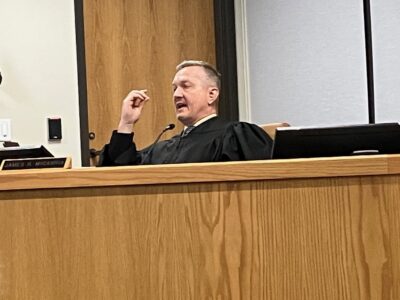
photo by: Kim Callahan/Journal-World
Judge James McCabria is pictured on Thursday, Oct. 30, 2025.
Four transgender men and one intersex woman on Tuesday told a Douglas County judge how Kansas’ anti-trans law known as SB 244 has negatively impacted their lives – forcing them to surrender their driver’s licenses, to problematically use certain bathrooms, to live in fear of being outed and to generally feel like second-class citizens.
The plaintiffs, who are suing the State of Kansas, variously described the effects of SB 244 as “devastating,” “terrible,” “isolating” and “scary,” among other descriptions.
“Why am I not considered one of the people of Kansas?” one trans plaintiff asked after telling Judge James McCabria about an incident where he was “forced to pee outside like a dog” because he couldn’t make it to a state-approved bathroom in time.
The State of Kansas, meanwhile, led by Attorney General Kris Kobach, tried to convey that the impacts on these people’s lives weren’t really that bad. Kobach, in his opening statement, dismissed their concerns as mere “inconvenience” and “discomfort” and not something that rose to the level of the constitutional claims they are asserting.
His coterie of attorneys sought to demonstrate on cross-examination that the trans men had mental health issues before SB 244 became law – and hence weren’t harmed by it – and that their claims of being “outed” were undermined by their own posting about their trans status on social media.
In turn, the plaintiffs said that any mental health issues they had, such as anxiety or depression, were greatly exacerbated by the law. They also indicated that their social media posts were old and/or limited to a select group of friends. Most also had at least one story of how showing their driver’s license with a gender marker that didn’t match their physical presentation resulted in a degrading, embarrassing or even scary experience.
One man, a nurse, testified that a bartender, seeing an “F” on his driver’s license, made a menacing comment about Brandon Teena, a transgender man who was murdered in 1993 in Nebraska. The same man testified that he feared any situation where he was asked for his driver’s license in front of his three young children because it would “out” him before he felt his children were old enough to have the conversation he intended to have with them.
Others recounted how people’s demeanors had sometimes dramatically changed after spotting the gender marker on their licenses. One cop, a plaintiff said, went from casual and friendly over an expired tag to sarcastic and disrespectful after learning of his “F” marker. The officer began cruelly referring to the plaintiff as “Ma’am.”
The parties were before McCabria for an evidentiary hearing on the plaintiffs’ motion for a temporary injunction of SB 244. The hearing, expected to last all week, is meant as a supplement to the already extensive written record in the case, and it’s something of a continuation of a hearing earlier this year after McCabria ruled that he did not then have enough information from either side to rule on the merits of the motion. As a result, he had declined to block enforcement of the law.
In his March ruling, McCabria cited a “paucity of actual examples that either side has put forward in any of the arguments.”
This week, each party is seeking to fill that paucity with evidence that will persuade the court to its side. In order to obtain a temporary injunction, the plaintiffs have to show a likelihood of ultimately winning; show that enforcement of SB 244 would cause immediate and irreparable harm; show that a temporary injunction serves the public interest and that no other remedy is available.
SB 244 became law in Kansas in February, when the Legislature overrode Gov. Laura Kelly’s veto. The part of the law that this week’s hearing concerns is (1) the provision that requires people to use the public restrooms on government property that aligns with their sex at birth and (2) the provision that invalidated driver’s licenses that contained updated gender markers to align with a person’s gender identity.
Harper Seldin, the ACLU attorney representing the plaintiffs, argued that the law singles out trans individuals “for degradation and humiliation” and is irrational because it perpetuates the very harm that it means to prevent. For one, it would put trans men in women’s bathrooms.
The trans plaintiffs, all of them bearded and apparently indistinguishable from cisgender men, testified that prior to SB 244 they had used men’s restrooms without incident. Now, they must seek out single-user restrooms, which can be few and far between, or use the women’s restroom, which can elicit anger from women in the facility and extreme discomfort and embarrassment for themselves.
Two of the men work in government buildings and, under SB 244, are not allowed to use male restrooms. One of them told of having to leave the Topeka building where he works and walk 7 minutes one way to another government building that has a single-user bathroom. One time he didn’t make it, wet himself and was forced to leave work early. He compared the experience to having “to pee outside like a dog.”
Kobach said SB 244 was not about “heaping abuse” on trans individuals. Rather, he described the plaintiffs’ case as an impermissible attempt to create “new rights” and told McCabria that the state had an important interest in protecting privacy for women and in having an “unchanging sex marker” on government-issued identification.
One of the state’s witnesses later this week, Kobach said, would be KBI Director Robert Jacobs, who will testify that it’s critical to have unchanging sex markers on driver’s licenses for law enforcement purposes.
Seldin’s team is expected to put on a trio of medical experts Wednesday who will testify about the harm that SB 244 has done to trans individuals.
Last month, McCabria granted a Lawrence transgender woman, who was also suing over SB 244, the temporary restoration of her driver’s license after the State of Kansas invalidated it. She is part of the present case, but her attorney and the state’s attorneys agreed that she will have the use of her license with a female gender marker until this case is decided on the merits.
In May, as the Journal-World reported, Douglas County Judge Carl Folsom III issued a temporary order blocking the State of Kansas from enforcing parts of a law, known as SB 63, that would prevent minors from receiving gender-affirming care, saying that the plaintiffs had shown a reasonable probability that they would suffer irreparable harm if the law stood during the pendency of the lawsuit.
State Government
In debate, Marshall says the Ukraine war, not the Iran war, has caused high diesel prices
Candidates lean on their prominent supporters in District 2 race
TOPEKA — Democrat Don Coover and Republican Derek Schmidt stood with partisan allies as their congressional race ...
Funding for new Chiefs stadium moves forward, setting sales tax revenue district
TOPEKA — State officials answered a key question this week underpinning the complex financing of the Kansas City ...
Voters Guide: A look at the candidates seeking to become Kansas Insurance Commissioner
The Kansas Department of Insurance regulates insurance companies that sell policies in Kansas. Voters will decide ...
Voters Guide: A look at the candidates seeking the job of Kansas State Treasurer
In the Nov. 3 election, Republican Kansas Treasurer Steven Johnson faces two challengers for his job as the chief ...