Kobach’s team puts on parents, cops, other witnesses to support Kansas’ anti-trans law SB 244

photo by: Kim Callahan/Journal-World
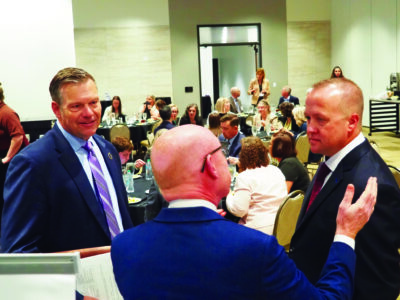
Kansas Attorney General Kris Kobach is pictured on Nov. 20, 2025, at the Douglas County Judicial and Law Enforcement Center.
A Kansas father on Thursday testified that he now sends his daughter to a private school after the girl told him that she saw a transgender female entering a restroom at her middle school in Andover.
The daughter was not in the restroom herself but just observed the trans student, whom the dad referred to as a biological male, go in. The sight made his daughter “quite emotional and sad,” the father said, and hearing about it made him angry that a “common societal rule” was being broken.
He didn’t complain to the school at the time because there was “no legal framework” for doing so, he said, but now there’s SB 244, a new Kansas law that requires people to use restrooms in government buildings, like public schools, that match their designated sex at birth.
At the time, though, he felt he had no voice and needed to take his daughter out of that school to protect her.
“I felt I could no longer keep my daughter safe in this school,” he said, adding that SB 244 will keep children “safe.”
The man, testifying under the pseudonym Tim Tanner, was one of eight witnesses that Attorney General Kris Kobach and his team of lawyers put on the stand Thursday in Douglas County District Court to defend SB 244’s bathroom requirement along with the requirement that driver’s license gender markers match a person’s sex at birth.
Prior to SB 244, a person could change the gender marker if they met certain requirements and had doctor’s letters. After SB 244, those licenses with changed markers were invalidated.
Kobach and the State of Kansas are being sued by a group of transgender Kansans who say that SB 244 violates their constitutional rights. The plaintiffs are in Douglas County this week with their ACLU attorneys to request an injunction that would temporarily stop enforcement of the law, which was passed in February over Gov. Laura Kelly’s veto. The plaintiffs and their expert witnesses testified about the negative impacts of the law earlier this week, as the Journal-World reported.
Another parent, a Kansas mom who has previously appeared in litigation alongside Kobach, told Judge James McCabria about her fears that males would show up in her daughters’ school restrooms.
Once in Colorado, she said, her 11-year-old daughter went to the bathroom in a restaurant and saw a “man in a dress” in there, became “genuinely very upset” and couldn’t use the restroom. She didn’t say that the man had done anything, only that she saw him.
The mother, also testifying under a pseudonym, said the daughter is now 16 “and she is still not allowed to use a public restroom by herself” for fear a man will enter.
A transgender student attended her older daughter’s school, and the mother became generally concerned about the bathroom issue and said the school did little to reassure her. She did not recite any particular incident that had occurred.
The woman recounted her own experience where she unwittingly went into a gender-neutral bathroom at an airport and saw a man come out of a stall.
“It was unnerving to me to see the man in what I thought was a woman’s restroom,” she said, adding that she now pays more attention to signs.
Because women do “very private things” in bathrooms, she said it was important for the state to have a law like SB 244.
“I feel safer knowing that is a law here in Kansas,” she said. “…If they were born men, I don’t want them in my bathroom.”
Judge McCabria also heard testimony from a Wichita-area teen who said she was “really scared” to have a transgender girl in her school locker room during a yoga class. She did not recount anything untoward by the other student or having to change clothes in front of the student, but said “it was definitely unsafe” to have the student in there because “you don’t know exactly what he’s thinking or seeing.”
Asked by a plaintiff’s attorney if she would feel uncomfortable with a female-to-male transgender student in the same situation, she said, “It would be unsettling, but it’s still a girl.”
Earlier this week, the transgender male plaintiffs had testified that going into a women’s restroom — the facility they are supposed to use under SB 244 — with a full beard and presenting as a man was problematic both for them and for women who might feel distressed at seeing them.
The teen witness also admitted that she had used a public men’s bathroom at her school simply because the line for the women’s restroom was too long.
Three law enforcement officials also testified for the state Thursday and generally described why they felt it was important for gender markers on driver’s licenses to match a person’s designated sex at birth.
Sgt. Bryan Stammer with the Ford County Sheriff’s Office in Dodge City said knowing a person’s sex was important because it made a difference in how the person was searched during an arrest. Males and females are searched differently, depending on whether the officer searching is male or female. If a search is not conducted properly, he said, it could result in liability issues for the sheriff’s office as well as safety issues if a weapon or contraband is missed during the search.
He said that SB 244 made it possible for them to rely on the sex listed on the driver’s license, but he also acknowledged on cross-examination that no information on a driver’s license ever kept him from doing what he felt needed to be done as a law enforcement officer.
Shawnee County Sheriff Brian Hill testified that two constants on a driver’s license were sex and date of birth. He said that officers could potentially miss whether someone has a warrant out for their arrest if their sex has changed on their driver’s license, but he did not say this had ever actually occurred.
On cross-examination, Hill acknowledged that the “K number” on all Kansas driver’s licenses also never changes, and he said he knew of no instance where a transgender person had changed information on a driver’s license to frustrate law enforcement or to evade arrest.
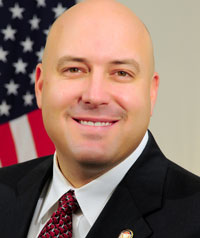
photo by: Contributed
Acting KBI Director Robert Jacobs
The third law enforcement witness to testify was acting KBI Director Robert Jacobs, who said that he was responsible for the many databases at the KBI that contain information about people, including databases that deal with offender registration, criminal history and other matters.
He said accuracy in these databases was important because it helped to prevent misidentification and failure to identify. The “golden record,” he said, was a data point, like biological sex, that was consistent across all systems. He said, to that end, documenting biological sex on a driver’s license assisted law enforcement professionals.
On cross-examination, he acknowledged that in his decades in law enforcement he couldn’t identify a problem that had resulted from a transgender person changing a sex marker on a driver’s license.
Two medical professionals also testified for the state Thursday.
One was a sexual behavioral scientist, Dr. James Cantor, from Toronto, who said he believed there was no biological basis for gender identity, which he said was commonly confused with sexual orientation. The word “transgender,” he said, has no objective meaning because it is based on a person’s say-so and cannot be detected through something like a blood test. He contrasted that with biological sex, which he said was objectively verifiable.
On cross-examination, he acknowledged that conditions like depression also cannot be detected through a blood test.
He criticized research in the field, such as that presented by some experts on the plaintiffs’ side Wednesday, that heavily relied on methods like self-reporting surveys.
On cross-examination, he said he was not offering an opinion on whether SB 244 was good policy, but he said that it was a “foreseeable consequence” that allowing transgender people to use their preferred bathroom could increase the incidence of voyeurism or exhibitionism in women’s restrooms.
The other medical professional to testify was Dr. Alyson McGregor, an emergency medicine doctor from the University of South Carolina. McGregor has written extensively about how “male-centric medicine” has negatively impacted women.
She told the court that “sex is an incredibly important diagnostic tool for doctors,” noting that drug dosing and metabolism were different in men and women, for example. She said that knowing a person’s biological sex in the emergency room “can be life and death.”
She said information about one’s sex on a driver’s license couldn’t tell her “everything” — for example, whether the patient had a uterus or was taking hormones — but it allowed her “to make assumptions” that she could build upon, especially if the person was unconscious and unable to convey information.
On cross-examination, she said she had no opinion about what a driver’s license should say as a policy matter.
The state is expected to wrap up its case on Friday with one more witness, and closing arguments are expected in coming days.
In order to obtain a temporary injunction, the plaintiffs have to show McCabria that they have a likelihood of ultimately winning; show that enforcement of SB 244 would cause immediate and irreparable harm; and show that a temporary injunction serves the public interest and that no other remedy is available.
State Government

Opinion: The Lawrence man seeking to break the power of Republican, Democratic parties this election
State tax receipts top estimate by $147M for quarter
TOPEKA — The state of Kansas collected $147 million more in taxes than anticipated during the first quarter of ...
Rep. Tracey Mann to skip candidate forum in Lawrence; spokesman scarce on details

Kobach, Mann debate criminal justice priorities at Tuesday event as they campaign in attorney general race
Kansas must count mail ballots that arrive three days after November election, appeals court rules