Ballard Center caps child care tuition at 7% of household income, boosts benefits for its educators
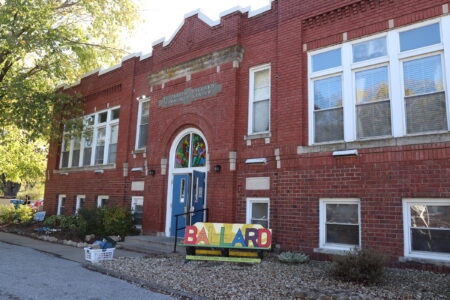
photo by: Josie Heimsoth/Journal-World
The Ballard Center, 708 Elm St., is pictured on Friday, Oct. 31, 2025.
To help make child care more affordable for local families, Lawrence’s Ballard Center is trying a new approach — capping tuition at 7% of a household’s income.
In a news release, the Ballard Center said that 1 in 4 families in the community live paycheck to paycheck, and the average Kansas family spends 20% of their income on child care. But with its new model, the Ballard Center will review each family’s gross household income and ensure that no family pays more than 7% of that amount. The center will also assess families’ eligibility for child care assistance through the state Department for Children and Families.
“They have a certain amount that they will assist with, and if your income is higher than that amount, you’re not eligible. If your income is lower, you are eligible,” Will Averill, chief operating officer of the Ballard Center, said. “And we’ll look at 7% of what their gross income is, and then we will charge them 7%, but then the rest of it will be covered by DCF if they are eligible.”
Before the new model was implemented in January, the Ballard Center charged a flat $600 per month fee for child care services, Averill said, but for many families this is a significant cost.
Averill said all of the existing families being served at the Ballard Center have been transitioned to the new model, and nine families in care right now are paying less than they were previously. He added that a family recently told the Ballard Center they were no longer able to afford care, but now the new model has helped them stay and qualify for DCF funding.
Why 7% specifically? That percentage of household income is what the U.S. Department of Health and Human Services considers affordable child care. Using this standard, 43% of U.S. families with young children currently pay unaffordable rates for child care, and 134,000 families are pushed into poverty by child care expenses every year, according to a Center for American Progress report published in 2024.
Averill said Ballard will be monitoring the new model’s performance, including the impact it has on the center’s budget and the impact on the community.
“I think it’s going to be exciting to watch it move forward, and I think the opportunities to help some folks in our community who previously would have found it financially unattainable and maybe done something like have to drop out of the workforce in order to provide care for their kiddos,” Averill said. “I’m hoping we can alleviate some of that pressure in the community.”
In addition to a new way to help families afford child care, the Ballard Center has also been developing new ways to help out its staff. Ballard CEO Kyle Roggenkamp said the center has been working on ways to provide living wages and expand health benefits and retirement contributions for staff, all of which has been made possible through donations, fundraisers and the organization’s reserve funds.
“We’ve put away every extra penny and nickel the last five years into a reserve fund so that we can sustain these initiatives, both for our staff and for families,” Roggenkamp said. “And we’re finally at a point where the annual projected cost for both can be maintained long-term by the reserve fund, so we are just so proud and excited to be moving in this direction.”
Last year, the Ballard Center partnered with The Dwayne Peaslee Technical Training Center to create a program with the center’s donations and funds so educators could earn their child development associate credentials online while they worked at Ballard. After completing the program, the educators will be earning a minimum of $20 an hour, Roggenkamp said.
“We enrolled our first three educators last year, and what it does is it gives them six to nine months of really intensive, wonderful coursework,” Roggenkamp said. He said Peaslee covered the majority of the cost of the apprenticeships with scholarships, “and we pay for the small remainder so that our educators don’t have any cost going in.”
Roggenkamp added that they will go through all of the benchmarks of becoming an early childhood educator. He said they will exercise those practices in the classroom and be evaluated by Ballard’s education director and the child development associate program.
“When they graduate, they have the accreditation to become an education director someday without having to get a college degree,” Roggenkamp said. “So the living wage initiative isn’t just about making sure we are accountable to our educators; it’s about also wrapping around them opportunities to learn and grow.”
“And we want them to take that talent and be able to spread their wings and do with it whatever fills their bucket moving forward, whether it’s at Ballard or not,” Roggenkamp said.
Roggenkamp said the new tuition model, the living wage initiative and rolling out health benefits this year for the first time have been dreams at Ballard for the last five years.
“I think because of this community, we might be one of the first statewide to have affordable tuition and a living wage for our educators without being subsidized by state or federal dollars,” Roggenkamp said. “It’s one of the most beautiful things I’ve ever been a part of, but the most important aspect of all of this is that educators deserve respect and a living wage and families deserve access to quality early childhood education.”
…
As the Journal-World reported, Ballard opened its new food and clothing pantry in November along with a dedicated volunteer space for organizing donations. The space doubles the pantry’s former service capacity and two families can use the pantry at a time instead of one.
The former pantry was in the basement of the Ballard Center’s historic building. And now, Roggenkamp said it’s going to go through renovations to be turned into a brand new therapy space for the therapists who work with the students at Ballard, which is one of the renovations that will be happening to the building.
He said currently, therapists meet with kids in conference rooms, his office and other rooms throughout the building, and “the therapists deserve that space.”
“With the building renovations, we have this beautiful, over 100-year-old historical building,” Roggenkamp said. “… Our main priority with renovating this building is honoring that history while also bringing it up to 2025 standards and codes.”
A part of those efforts is installing a new fire-suppression sprinkler system, and it will be the first renovation effort Ballard will work toward. A local plumber has already replaced the organization’s aging plumbing over winter break without interrupting child care services.
“The big step comes next winter break,” Roggenkamp said. “We need to raise an additional $200,000 to install a sprinkler system.”
There are also plans to eventually focus on how to improve the classrooms at the Ballard Center.
“We have the most wonderful educators, the most deserving kids, and we need to make sure that those children and their families have the spaces they deserve in those classrooms,” Roggenkamp said.
Families interested in enrolling their children at the Ballard Center can contact 785-842-0729 or visit www.ballardcenter.org for details.
Other News

U.S. Army says cleanup at Sunflower Army Ammunition Plant is ‘slowing down’; PFAS investigation at site still needs funding

‘One of a kind’: Sale at the Lawrence Arts Center will find new homes for late musician’s unique custom guitars

Go, See, Do: KU homecoming, Halloween happenings and other events
Student-run coffee shop opens at Community Connections at Pinckney, teacher receives surprise $1,000 award

‘This is for all of us’: Midco Prairie, an oasis of native plants in downtown Lawrence, opens to the public