

Arsenic in the water: Evergy working to deal with pollutants left from coal ash dump sites
Utility says public's health not in direct danger; clean-up plans are taking years
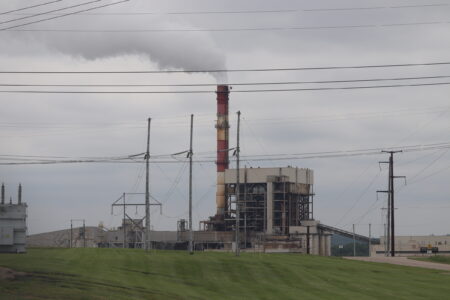
photo by: Josie Heimsoth/Journal-World
The Lawrence Energy Center is pictured on Thursday, May 21, 2026.
Updated on Thursday, May 28, 2026
Nearly every day people who look just northwest of the city limits can see the environmental impact of the Lawrence Energy Center – a stream of white smoke rising from the power plant’s stack.
That smoke comes from the burning of coal at the power plant, and environmentalists have long been warning about the impacts that coal has on everything from air quality to global warming.
But less thought about is what’s literally left behind by the burning of that coal. It is ash, and it looks similar to what’s left behind after burning in a wood stove.
While that ash doesn’t send out a daily reminder of its existence, like the smoke from the smokestack, there certainly are signs that it has existed at and near the Lawrence Energy Center, 1250 North 1800 Road. In total, the power plant has produced over 2 million cubic yards of coal ash.
That’s enough to fill more than 600 Olympic-sized swimming pools. Very dirty swimming pools.
A Journal-World investigation has found that the “legacy” coal ash dump sites at the Lawrence coal plant – called ponds – have high levels of toxic chemicals that have begun showing up in the groundwater beneath the site, and it may have potentially leached into a surrounding property on at least one occasion.
The ash is made up of a mix of chemicals, and exposure can increase the risk of cancer, heart and thyroid disease, reproductive failure and neurological harm, according to Earthjustice.
At the Lawrence sites, the chemicals include some that a general resident may not be too familiar with, such as molybdenum and boron. But there is one that even a casual science observer may recognize – arsenic, a compound that has made its way into many murder mysteries due to its well understood poisonous effects on humans.
March data reviewed by the Journal-World shows arsenic concentrations are roughly nine times higher than what scientists say are safe levels for groundwater and drinking water at a monitoring well in one of the Lawrence legacy ponds.
A spokesperson for Evergy, the owner and operator of the plant, said the company is well aware of the issues surrounding the legacy dump sites, and is working on a pilot program to determine how to proceed.
In the meantime, the company contends the toxic chemicals aren’t presenting a direct threat to human health because the site is closed to the public, and there aren’t users of groundwater near the site.
However, the Journal-World’s investigation did find evidence that the toxic chemicals have moved onto a neighboring property. The Journal-World found a 2022 letter on file with Evergy, in which Evergy notified an adjacent property owner that groundwater contamination levels above federal standards were present under their property.
Meanwhile, Evergy officials stressed that the site today is in compliance with regulations from the Environmental Protection Agency and the Kansas Department of Health and Environment.
“Our site is in compliance with environmental regulations established by the KDHE and EPA,” Evergy spokesperson Gina Penzig said via email. “Evergy works to be a good steward of the environment in a manner that balances affordability for our customers.”
This comes at a time when the EPA has proposed changes to the federal regulations for coal ash, and environmentalists argue that it’s a significant step backwards.
Cleanup and remedy efforts
While regulators and utility officials say they have already taken steps to address the contamination, Evergy has known about the pollution at least since 2020.
Penzig said it has taken years to decide on a remedy because it would need to include source control and groundwater treatment.
“Source control means removing the ash, and that was completed in 2021,” Penzig said. “The removal of the ash prevents any further groundwater contamination and allows natural conditions to begin remediation while further actions are researched and designed.”
Penzig said that groundwater moves slowly, and many of the contaminants are “filtered out naturally.”
Jill Bronaugh, a spokesperson for the KDHE, said coal combustion residual dump sites in Kansas are largely regulated by the EPA under federal regulations. Since the contamination was found, she said Evergy reports its progress on a corrective measurements assessment to the EPA annually.
Evergy has gotten into legal trouble in the past for not complying with closure and clean up requirements. In 2022, the EPA and Evergy reached a $120,000 settlement at the company’s retired Tecumseh Energy Center coal-fired power plant in Tecumseh, Kansas. The company was required to take certain actions addressing potential groundwater contamination from an impoundment at the site, according to a release from the EPA.
But officials say that is not the case with the Lawrence Energy Center.
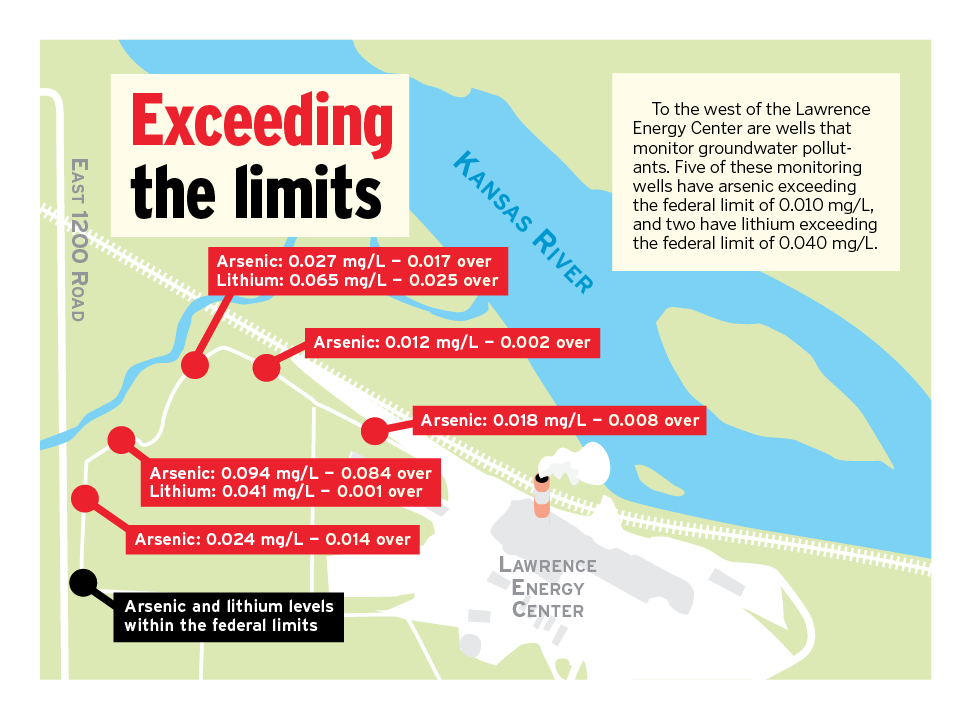
photo by: Sylas May/Journal-World
The map shows the groundwater monitoring wells at the Lawrence Energy Center’s “legacy” coal ash dump sites exceeding groundwater protection standards established by the Environmental Protection Agency.
“While elements at the (inactive ponds) have been identified at levels above EPA standards, the impacted groundwater area is limited and not currently accessible to the public,” Penzig said via email.
According to Evergy’s latest remedy selection progress report from March, the company has engaged with Lawrence Energy Center personnel for operational support of a pilot system, which will be used to test the selected remedy.
“The pilot study design is currently at 90 percent completion,” the report said. “The design took into consideration existing site infrastructure, site hydrogeologic aquifer properties, and appropriate water management processes.”
Penzig said once the pilot is active, Evergy will sample the groundwater and use the data to design and implement a full scale system.
The cleanup measures being considered include letting “natural filtering” remove the potentially toxic elements, pumping and reusing the water at the plant, and treating the water without removing it.
“The effectiveness and difficulty of these approaches will impact which one we select,” Penzig said. “We report our progress to the KDHE and EPA.”
Pollution from coal ash
The Lawrence Energy Center has high concentrations of specific pollutants and other elements – what regulators refer to as constituents – in groundwater monitoring wells at inactive “legacy” ponds on site.
Under the Coal Combustion Residuals Rule, coal-fired power plants are required to install and operate groundwater monitoring systems around coal ash disposal sites. These include a network of wells placed “upstream” of the groundwater flow – before it reaches the coal ash site – and “downstream” wells along the perimeter of the dump site.
Arsenic has exceeded 0.010 milligrams per liter in all of the groundwater monitoring wells immediately surrounding the inactive ponds except one, according to June 2025 data. This has been a trend happening for years.
In one of those monitoring wells, arsenic concentrations were as high as 0.094 mg/L – roughly nine times higher than the protection standard.
In addition, two monitoring wells had high levels of lithium, which has a protection standard of 0.040 mg/L. One of those wells was 0.025 over the federal limit. There is no drinking water standard for lithium, and little research has been conducted to see how lithium might impact human health.
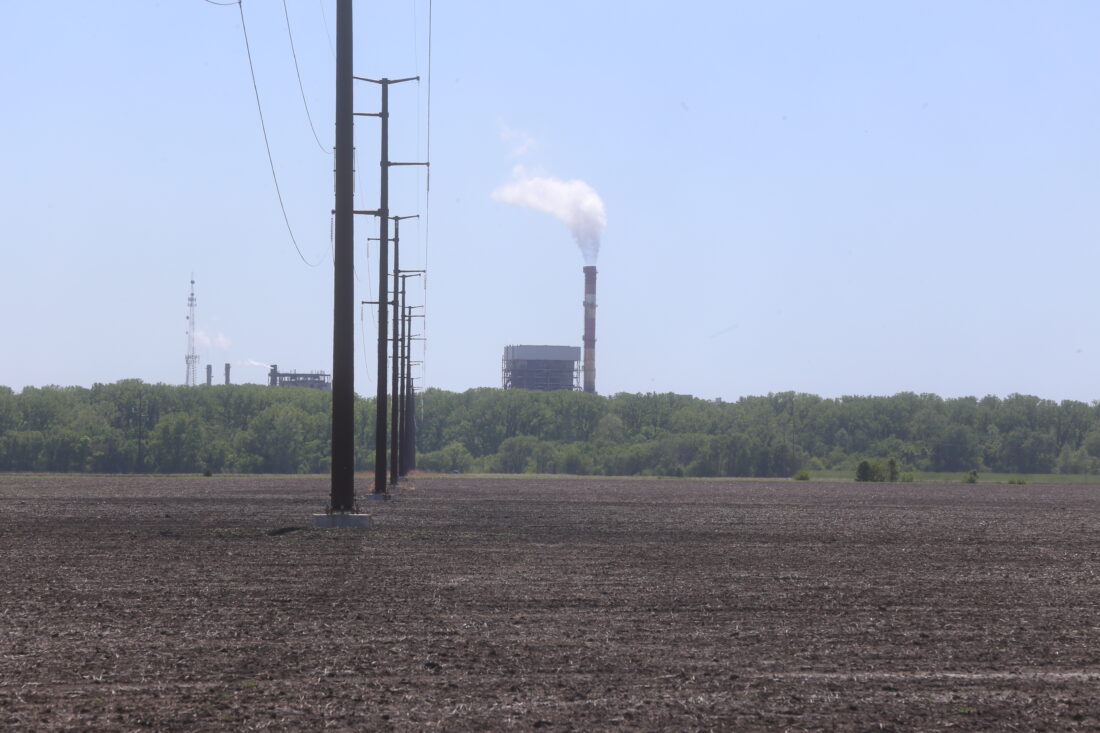
photo by: Chad Lawhorn/Journal-World
A row of high voltage power lines leading into Lawrence is pictured on April 24, 2026. The Lawrence Energy Center, a coal fired power plant operated by Evergy, is pictured in the background.
“While in a small number of instances, constituent levels in some groundwater tests have been above EPA screening values, our publicly available risk assessment shows no adverse impacts to human health,” Penzig said via email.
However, because the wells have exceeded these pollutants, the coal ash units are considered to be causing groundwater contamination that requires corrective action. This means it is required to initiate a formal cleanup process.
Ashtracker – an interactive, public-facing database created by the Environmental Integrity Project – tracks groundwater contamination near ash dumps, specifically how coal ash pollution at coal plants are exceeding public health thresholds.
For example, from a drinking water standpoint, Ashtracker said the Lawrence Energy Center is easily exceeding public health thresholds set by the EPA for molybdenum and boron in almost all of its groundwater monitoring wells. Currently, neither of these elements have drinking water standards that are federally regulated.
Abel Russ, director of law and policy at the Environmental Integrity Project, said the current coal ash rules don’t require offsite monitoring, so unless some areas don’t independently collect data from offsite wells or groundwater, there’s no way of truly knowing the impacts.
Even if people did test the groundwater offsite, Russ said oftentimes, they might not know the extent of the pollution until years later. Which is why it’s important for utilities to clean up these dump sites as soon as possible.
“The peak offsite concentrations would be sometimes many years … after the coal ash pond was first put into operation,” Russ said. ” … It might be too early to see the worst possible impacts, which is why we’re trying to get everybody to deal with it now before the situation gets worse.”
Recent hits to the coal ash rule
This year, the EPA has been making moves to scale back coal ash regulations. The EPA implemented its first federal safety standards for coal ash in 2015. Those rules were expanded two years ago to cover inactive “legacy” ponds and abandoned landfills. The 2024 rule ensures formerly unregulated, often leaking, sites must comply with groundwater monitoring, closure and cleanup requirements similar to active plants.
In February, the EPA extended compliance deadlines for legacy coal ash sites. The final rule pushed out the deadline for owners of “legacy” inactive coal ash ponds and landfills to begin cleaning them up to February 2032.
Additionally, the rule may take other hits if proposed changes by the EPA are implemented. The changes – brought forward in April – could reduce the scope of regulated sites and allow local agencies to bypass national standards on a case-by-case basis.
Lisa Evans, senior counsel at Earthjustice, said the proposed changes are a huge disappointment and would weaken the 2015 and the 2024 rules. If the 2026 proposals are finalized, she said, it will do irreparable harm to communities living near coal plants and coal ash dumps.
Evans said the proposed regulations would exempt a large category of leaking ash dumps, also known as coal combustion residuals management units, which are found at nearly every coal plant and were regulated under the 2024 rule.
Additionally, state agencies and the EPA would be able to weaken monitoring and cleanup requirements at dumps upon the request of the utilities, she said. For example, companies could move the location of wells intended to detect coal ash contamination 150 meters from the coal ash dump rather than at the edge of the dump, effectively permitting a zone of contamination.
The rule is also expected to delay the monitoring, closure and cleanup of hundreds of legacy coal ash ponds by removing deadlines set by the 2024 Legacy Coal Ash Rule. The proposed rule would allow permitting authorities to wait years to establish standards or to decide no closure and cleanup are even needed.
“It’s unequivocally dangerous and reckless,” Evans said. “There are other proposals that have come and gone that we acknowledge will do damage, but this is the most damaging proposal I have seen in my career at Earthjustice, which is over 20 years at this point.”
Among other removed safeguards, states and the EPA can increase the amount of cobalt, lithium, molybdenum and lead permitted in coal ash-contaminated water above federal safe standards if the proposed rules are passed.
“I think what the EPA should be doing right now is enforcing the current protections,” Evans said. ” … What’s happening now is totally one sided actions.”
Penzig said Evergy supports coal ash regulation that “allows for site specific considerations working with local state regulators.”
Penzig added that the company is currently working with industry peers at the Edison Electric Institute to provide the EPA with information concerning coal ash disposal and groundwater remediation to inform regulations.
The EPA will be accepting comments on the proposal until June 12. People can submit their comments online on the EPA’s website.
This story was updated to clarify that the Lawrence Energy Center has produced at least 2 million cubic yards of coal ash over time.
Other News

‘One of a kind’: Sale at the Lawrence Arts Center will find new homes for late musician’s unique custom guitars

Go, See, Do: KU homecoming, Halloween happenings and other events

Student-run coffee shop opens at Community Connections at Pinckney, teacher receives surprise $1,000 award

‘This is for all of us’: Midco Prairie, an oasis of native plants in downtown Lawrence, opens to the public
Douglas County commissioners express interest in fireworks sales dates that include a weekend
